Between the builders and the buyers: EdTech Ecosystem Hubs catalyze innovation, evidence, and adoption

What Edtech Ecosystem Hubs are, and why they're starting to matter even more.

Education Intelligence Unit

calendar image
May 13, 2026

Education systems around the world are navigating a real dilemma about technology. Some are under pressure to adopt the latest solutions fast (AI, especially), while others are pushing back, questioning whether EdTech delivers on its promises at all. And most are somewhere in between, trying to figure out what actually works, for which learners, in which contexts.

The problem isn't a shortage of EdTech products. There are thousands—according to the latest estimate, between 40-50,000 are active in the global market. The challenge is that getting teachers, faculty and administrators the most rigorous, up-to-date, reliable and quality resources seems to be genuinely difficult. Procurement is slow. Evidence is thin. School systems and startups rarely speak the same language. Capital doesn't always flow where the need is greatest.

EdTech Ecosystem Hubs exist to work on that gap.They are organisations and initiatives, sometimes university-based, sometimes independent, sometimes government-backed, that sit between the people building education technology and the institutions trying to use it. They run pilots. They connect startups with schools. They broker relationships between researchers, funders, and policymakers. They are the connective tissue of an ecosystem that helps build resilient and useful solutions for teaching and learning.

What does this look like in practice? Tec de Monterrey's IFE EdTech Hub was created to strengthen connection, collaboration, and innovation across Latin America's education technology ecosystem, sitting inside one of the region's most influential universities, running pilots and convening the market. USC's Rossier School of Education runs an EdTech Accelerator aimed at tech-enabled solutions with high potential to improve the quality and equity of education, working with startups from K-12 through workforce learning. In Africa, Injini, founded in 2017, is an EdTech-specialised accelerator, combining startup support with original research on what works in African contexts. At University College London, the Knowledge Lab led a Jacobs Foundation–funded research project that produced the first framework for systemic EdTech testbed models, which led to the formation of a Global EdTech Testbed

Network convening practitioners across regions. In Ukraine, even under the pressures of war, EdTech Ukraine Association was formed to give the country's fragmented EdTech sector a unified voice, and within a year it had grown to more than 40 member organisations, signed a memorandum with the Ministry of Education and Science, joined the European EdTech Alliance, and begun organising delegations to peers in Estonia and Poland. And the recently formed Alliance of Alliances brings together EdTech membership associations from around the world to support each other's work.

There are many hubs operating globally, across every region. Some are well-resourced and institutionally embedded. Others are operating on thin margins in challenging environments. What they share is a conviction that innovation doesn't support education systems on its own, it needs infrastructure, relationships, and coordination to do so responsibly.

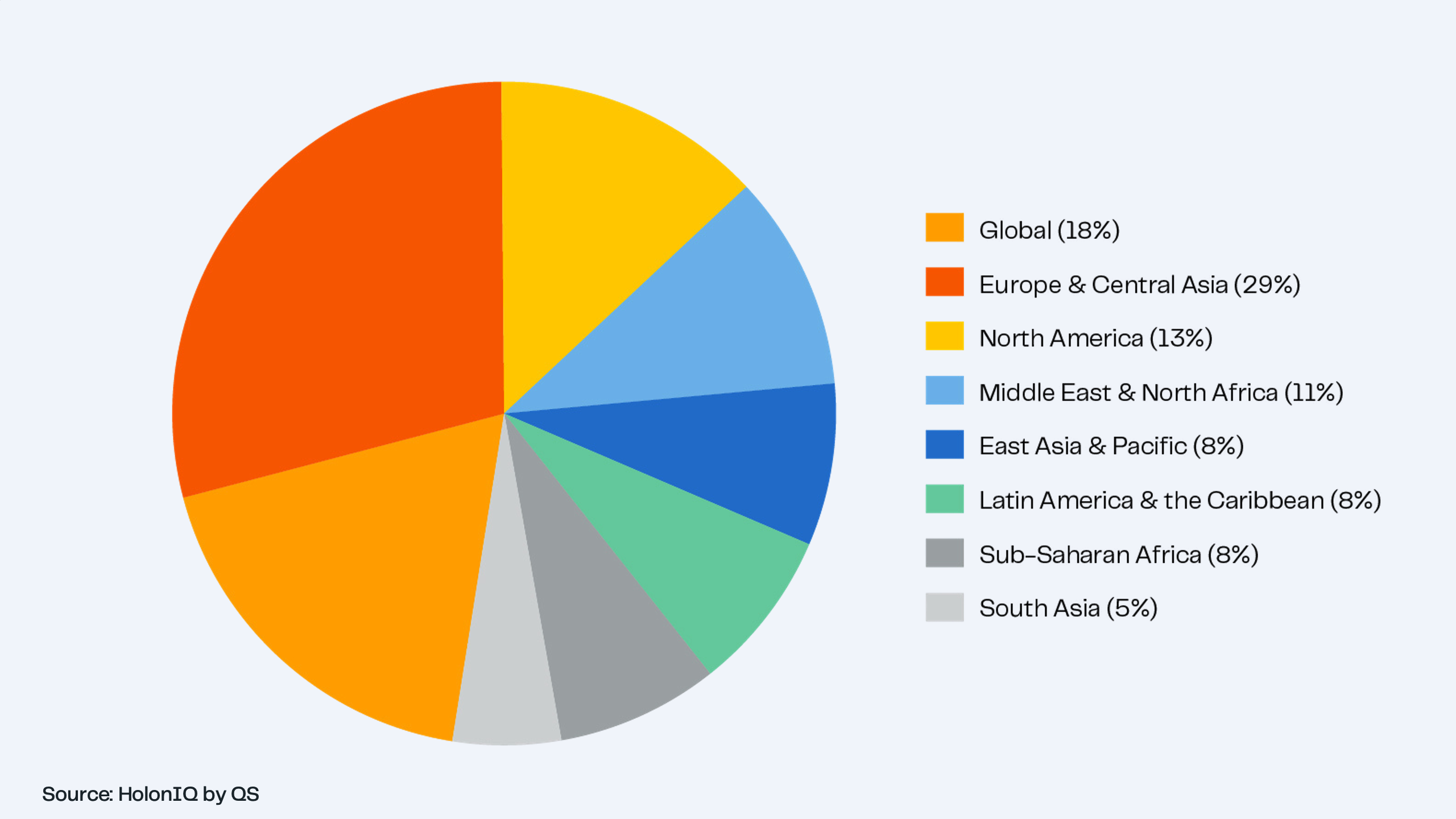
Figure 1. EdTech Ecosystem Hubs represent 7 distinct regions, with Europe & Central Asia representing almost one third.
No items found.

The Global EdTech Ecosystem Hub Project

HolonIQ by QS’s research examined how EdTech Ecosystem Hubs operate across different contexts, drawing on surveys and interviews with hubs across 7 regions. A central theme in the report is that hubs are not all doing the same thing, and that's not a problem. Four distinct operating models emerge, each shaped by local conditions: Pilot Programs, Research-Aligned hubs, Network Connectors, and Ecosystem Anchors.

Two of these are becoming especially important right now: Research-Aligned hubs that build and support the evidence base that gives innovation credibility with institutions and schools, and Network Connector hubs that broker relationships across fragmented ecosystems, connecting people and resources. As adoption pressure grows, both functions are shifting from nice-to-have to foundational.

Figure 2. Four EdTech Ecosystem Archetypes across funding stability and operating structure.

Success Enablers for EdTech Ecosystem Hubs

Five conditions associated with sustained hub effectiveness: policy alignment, market access, capital connectivity, ecosystem coordination, and research credibility. These are not discrete activities hubs built in isolation, they describe the environments hubs operate within, and they point to what funders, universities, and governments need to strengthen if they want hubs to continue to deliver.

Figure 3. Success enablers for EdTech Ecosystem Hubs

The full report explores these dynamics in depth and the challenges each archetype faces. Download it today if you are interested in understanding where EdTech innovation gets built, tested, and championed.

EdTech Ecosystem Hubs

Catalysing Innovation Across Education Systems

No items found.

Latest Insights

Global Insights from HolonIQ’s Intelligence Unit. Powered by our Global Impact Intelligence Platform.

Back to School VIP
Back to School VIP
2025 Back to School
2025 Back to School
Global Skills Week
Global Skills Week
Newsletter
Newsletter
2024 Back to School
2024 Back to School
North America EdTech 200
2024 Paris HE Summit
2024 San Juan Speaker
Indices
Indices
Cities
Cities
2023 Back to School Featured Speaker
New York
New York
2023
2023
Webinar
Webinar
Economics
Economics
Draft
Draft
Platform
Platform
2022
2022
Digital Transformation
MedTech
MedTech
Global Impact Summits
Impact 3000
Impact 3000
Nuclear
Nuclear
Mobility
Mobility
Electric Vehicles
Electric Vehicles
2021
2021
2020
2020
Sub Saharan Africa
Sub Saharan Africa
Nordic Baltic
Nordic Baltic
North America
North America
South Asia
South Asia
East Asia
East Asia
ANZ
ANZ
Market Sizing
Market Sizing
Augmented Reality
Augmented Reality
Blockchain
Blockchain
Virtual Reality
Virtual Reality
Regions
Regions
Markets
Markets
Mobile
Mobile
Client Report
Client Report
Publishers
Publishers
Labor Markets
Labor Markets
Global Landscape
Global Landscape
10 Charts Series
10 Charts Series
R&D
R&D
LMS
LMS
United Kingdom
United Kingdom
Executive Panel
Executive Panel
Language Learning
Language Learning
Russia
Russia
Israel
Israel
Germany
Germany
France
France
Media and Press
Media and Press
Climate Tech
Climate Tech
MENA
MENA
South Korea
South Korea
Japan
Japan
Southeast Asia
Southeast Asia
Health Tech
Health Tech
Global EdTech 1000
Global EdTech 1000
Unicorns
Unicorns
MOOCs
MOOCs
Global Giants
Global Giants
Client Note
Client Note
Capital Markets
Capital Markets
Advanced Technology
Advanced Technology
OPM
OPM
International Education
India
India
China
China
Canada
Canada
Venture Capital
Venture Capital
Bootcamps
Bootcamps
Online learning
Online learning
Notes
Notes
Europe
Europe
Asia
Asia
Africa
Africa
LATAM
LATAM
Brazil
Brazil
Robotics
Robotics
Education in 2030
Education in 2030
Artificial Intelligence
SDG 17
SDG 17
SDG 16
SDG 16
SDG 15
SDG 15
SDG 14
SDG 14
SDG 13
SDG 13
SDG 12
SDG 12
SDG 11
SDG 11
SDG 10
SDG 10
SDG 9
SDG 9
SDG 8
SDG 8
SDG 7
SDG 7
SDG 6
SDG 6
SDG 5
SDG 5
SDG 4
SDG 4
SDG 3
SDG 3

Sign Up for our Newsletters

We provide you with relevant and up-to-date insights on the global impact economy. Choose out of our newsletters and you will find trending topics in your inbox.

Weekly Newsletter

Climate Technology

Weekly Newsletter

Education Technology

Weekly Newsletter

Health Technology

Weekly Newsletter

Higher Education

Daily Newsletter

Chart of the Day

Daily Newsletter

Impact Capital Markets