$512M in Q1 signals a slow start to 2026, with capital continuing to favor AI-enabled, career-aligned platforms.

Fewer Deals. Sharper Focus. $512M in Venture Capital with 70% in workforce solutions. Upskilling and employability in focus.

Education Intelligence Unit

calendar image
April 22, 2026

Against a backdrop of geopolitical tension, uneven economic signals, and fluctuating global markets, EdTech investment continued, but with noticeably tighter discipline around where capital flowed and how much risk investors were willing to carry.

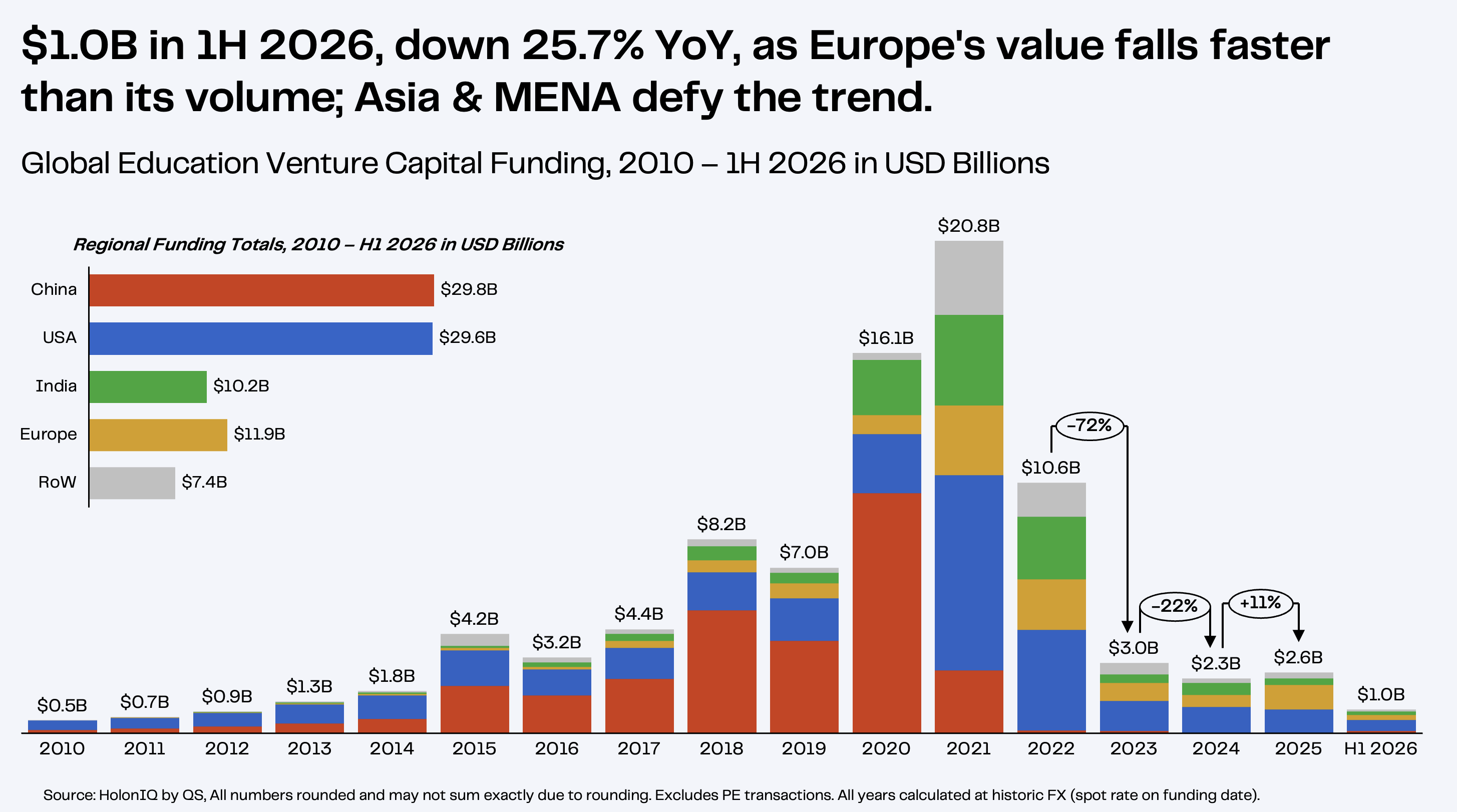
Venture funding in Q1 reached $512M across 63 deals, reflecting a 24% decline in value and a 10% decline in volume compared with Q1 2025. The decline wasn’t driven by waning interest so much as by fewer large rounds clearing the market, as investors remained selective in a year where uncertainty continues to shape decision‑making well beyond the education industry.

For education stakeholders, this matters less as a headline and more for what it implies operationally: a more uneven vendor landscape, with some platforms well-capitalised and others likely operating with tighter margins and shorter runways.

Figure 1. Global Education Venture Capital Funding, 2010-Q1 2026

Workforce solutions draw continued attention, powered by AI. 

The clearest signal in venture capital came from workforce language learning solution Preply’s $150M raise, the largest round of the quarter, suggesting investors were willing to write checks where demand is global, outcomes are job‑aligned, and usage is repeatable. By contrast, other activities skewed earlier stage. Guidde’s $50M stood out as another meaningful exception, reflecting continued appetite for AI‑enabled tools that support 360 talent solutions that serve multi-purposes such as onboarding, enablement, upskilling and productivity inside organizations rather than introducing new learning models that require buyers to change behaviour. Capital seems to be gravitating toward platforms already embedded in day‑to‑day work and training environment, particularly those that are getting enhanced and upgraded with AI. Expect sharper differentiation between vendors with scale and those still proving durability.

Across sectors, investment concentrates in learner support, upskilling, system-wide solutions, with content increasingly in focus in K-12 and Early Learning.

Figure 2. Global Education Venture Capital Funding by Sector & Sub-Sector, Q1 2026
No items found.

Workforce attracts 70% of funding in Q1

Sector patterns were equally telling. Workforce training captured over 70% of venture capital in Q1, anchored by a small number of large rounds. Post‑secondary funding fell sharply, and K‑12 activity remained present but largely at smaller ticket sizes. When budgets feel constrained, markets with clear buyers and measurable outcomes continue to attract capital, and workforce training & development has been a historically solid sector in which to invest. Innovation tied to employability, certification, and regulated training is advancing faster than solutions aimed at discretionary or longer‑cycle adoption. In K‑12, investment activity in Q1 2026 remained steady, capturing 13% of funding. Notable solutions that attracted funding were for digital content delivery: Subject, an AI-personalized learning solution, Vimi, a tutoring companion, and Sora Schools, an incumbent in online and virtual school models. Post‑secondary, by contrast, saw a deeper pullback in venture funding since last year, but did grab 12% of Q1 funding with program delivery solution, Emversity, and AI assistant, Nectir leading the way. Expect funding patterns to remain consistent, with capital continuing to concentrate in workforce training and AI-enhanced and delivery product investments persisting in K-12 and post-secondary. Absent a shift in market conditions, deal sizes and sector focus are likely to mirror current dynamics rather than expand meaningfully.

North America leads funding, with regional totals shaped by a few large rounds. 

Regionally, deal volume declined across most markets, with MENA and East Asia & Pacific as exceptions. North America accounted for 62% of funding, largely due to the Preply round. Europe’s funding value declined year-over-year, despite only a modest reduction in deal count, reflecting the absence of larger transactions rather than a withdrawal of investor participation. 

Figure 3. Global Education Venture Capital Funding by Region & Sector,  Q1 2026

Ready to get started?

Get a personalized walkthrough of HolonIQ's Global Intelligence Platform.

M&A reaches 116 deals in Q1 as consolidation drives market activity

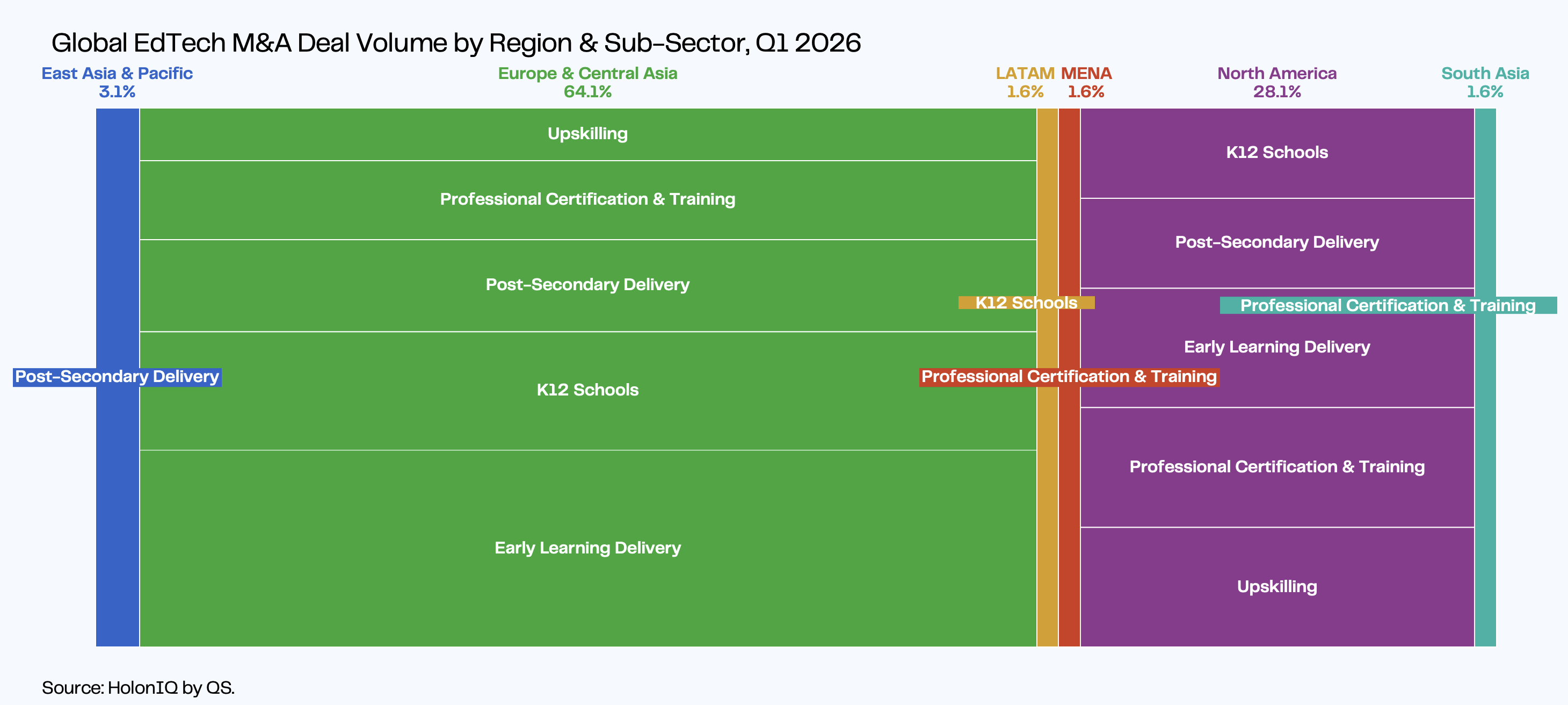
While venture capital slowed, M&A activity accelerated, with 116 transactions recorded in Q1. The standout deal—the Coursera–Udemy merger, valued at over $2.5B—reinforced a broader theme: in uncertain times, scale, distribution, and delivery capacity matter. As AI advances continue and macro forces impact the industry, consolidation is likely to continue, vendor ecosystems may simplify but also become more bundled. Decisions about platforms increasingly carry longer‑term implications for pricing, integration, and flexibility.

Figure 3. Global Education M&A Volume by Region & Sub-Sector, 2025

Q1 2026 reflects an EdTech market navigating a year with caution rather than retreat.
Capital is still moving, but selectively, prioritising durability, clear demand, and platforms that can operate through uncertainty rather than in spite of it.

👉 The full Q1 briefing and detailed deal lists are available on the QS Analytics platform.

If you’re tracking these shifts across AI-enabled learning, post secondary, K–12, and workforce development, explore the HolonIQ by QS Analytics Platform or connect with our team for a demo. Our platform includes detailed transaction histories, curated deal lists, analyst briefings, charts, and sector benchmarks to support strategy, investment, and market analysis.

No items found.

Latest Insights

Global Insights from HolonIQ’s Intelligence Unit. Powered by our Global Impact Intelligence Platform.

Back to School VIP
Back to School VIP
2025 Back to School
2025 Back to School
Global Skills Week
Global Skills Week
Newsletter
Newsletter
2024 Back to School
2024 Back to School
North America EdTech 200
2024 Paris HE Summit
2024 San Juan Speaker
Indices
Indices
Cities
Cities
2023 Back to School Featured Speaker
New York
New York
2023
2023
Webinar
Webinar
Economics
Economics
Draft
Draft
Platform
Platform
2022
2022
Digital Transformation
MedTech
MedTech
Global Impact Summits
Impact 3000
Impact 3000
Nuclear
Nuclear
Mobility
Mobility
Electric Vehicles
Electric Vehicles
2021
2021
2020
2020
Sub Saharan Africa
Sub Saharan Africa
Nordic Baltic
Nordic Baltic
North America
North America
South Asia
South Asia
East Asia
East Asia
ANZ
ANZ
Market Sizing
Market Sizing
Augmented Reality
Augmented Reality
Blockchain
Blockchain
Virtual Reality
Virtual Reality
Regions
Regions
Markets
Markets
Mobile
Mobile
Client Report
Client Report
Publishers
Publishers
Labor Markets
Labor Markets
Global Landscape
Global Landscape
10 Charts Series
10 Charts Series
R&D
R&D
LMS
LMS
United Kingdom
United Kingdom
Executive Panel
Executive Panel
Language Learning
Language Learning
Russia
Russia
Israel
Israel
Germany
Germany
France
France
Media and Press
Media and Press
Climate Tech
Climate Tech
MENA
MENA
South Korea
South Korea
Japan
Japan
Southeast Asia
Southeast Asia
Health Tech
Health Tech
Global EdTech 1000
Global EdTech 1000
Unicorns
Unicorns
MOOCs
MOOCs
Global Giants
Global Giants
Client Note
Client Note
Capital Markets
Capital Markets
Advanced Technology
Advanced Technology
OPM
OPM
International Education
India
India
China
China
Canada
Canada
Venture Capital
Venture Capital
Bootcamps
Bootcamps
Online learning
Online learning
Notes
Notes
Europe
Europe
Asia
Asia
Africa
Africa
LATAM
LATAM
Brazil
Brazil
Robotics
Robotics
Education in 2030
Education in 2030
Artificial Intelligence
SDG 17
SDG 17
SDG 16
SDG 16
SDG 15
SDG 15
SDG 14
SDG 14
SDG 13
SDG 13
SDG 12
SDG 12
SDG 11
SDG 11
SDG 10
SDG 10
SDG 9
SDG 9
SDG 8
SDG 8
SDG 7
SDG 7
SDG 6
SDG 6
SDG 5
SDG 5
SDG 4
SDG 4
SDG 3
SDG 3

Sign Up for our Newsletters

We provide you with relevant and up-to-date insights on the global impact economy. Choose out of our newsletters and you will find trending topics in your inbox.

Weekly Newsletter

Climate Technology

Weekly Newsletter

Education Technology

Weekly Newsletter

Health Technology

Weekly Newsletter

Higher Education

Daily Newsletter

Chart of the Day

Daily Newsletter

Impact Capital Markets