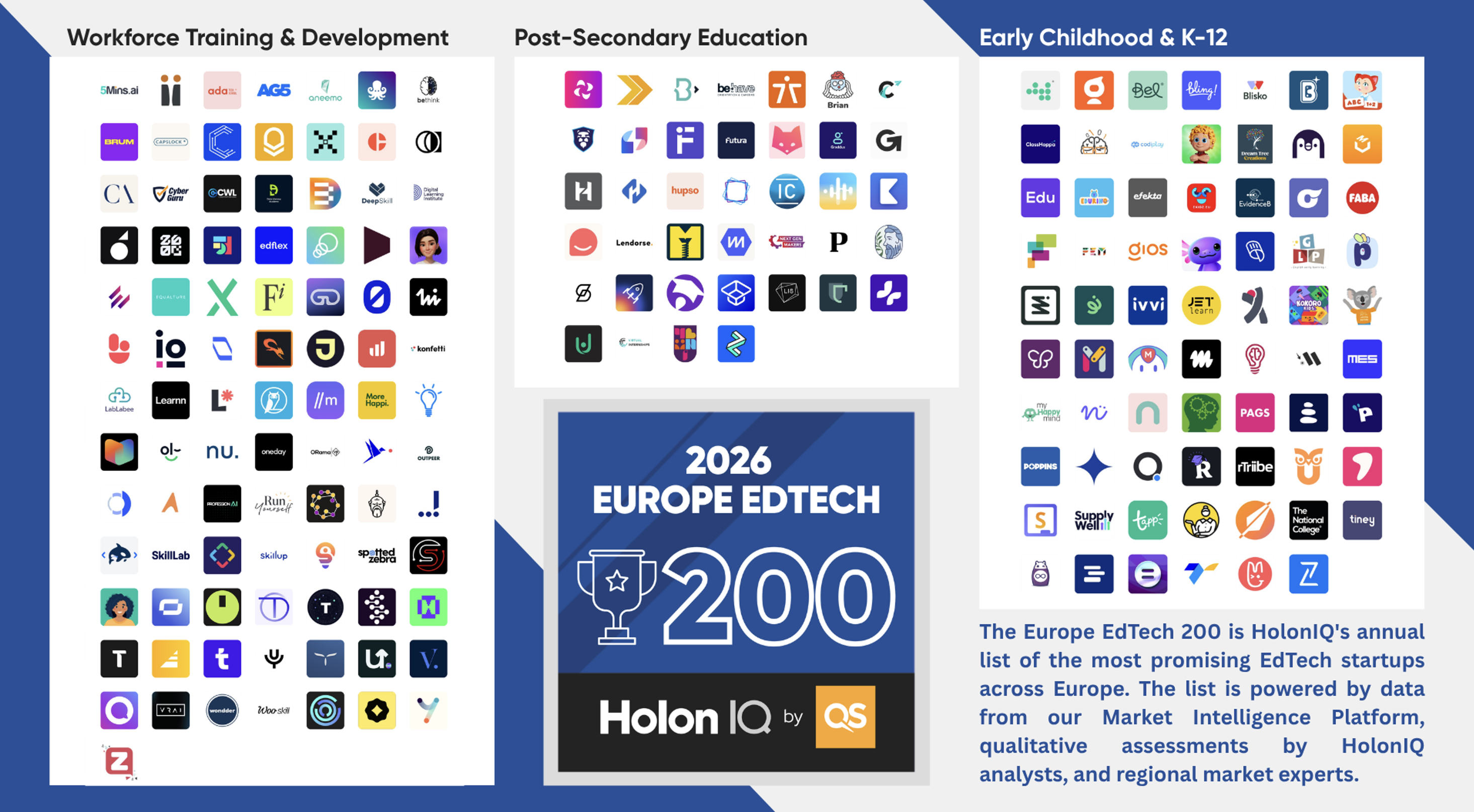
Every year, HolonIQ’s Education Intelligence Unit identifies the most promising 1000 EdTech startups around the world. The global 1000 is built region by region from over 10,000 nominations, applications and screening to ensure the global cohort is diverse and to shine a light on the inspiring innovation happening all around the world.
Each regional list is focused on identifying young, fast growing, and innovative learning and upskilling start-ups. To be eligible, startups are generally less than 10 years old (though there are some exceptions), are either headquartered in the region, or predominately focused on the market (e.g. > 80% revenue/customers), are pre exit (not acquired or listed) and not a subsidiary of a larger company or controlled by an investor group (e.g. via private equity buyout or controlling investment).
The HolonIQ Education Intelligence Unit and select market experts assess each organization based on HolonIQ’s startup scoring rubric, which covers the following dimensions:
Market. The quality and relative attractiveness of the specific market category in which the company competes.
Product. The quality, uniqueness and impact of the product itself.
Team. The expertise and diversity of the leadership team.
Capital. The financial health of the company and its ability to generate or secure sufficient funding.
Momentum. Positive changes in the size, velocity and impact of the company over time.
A market anchored in K–12, rising in workforce readiness, and maturing in post-secondary support.
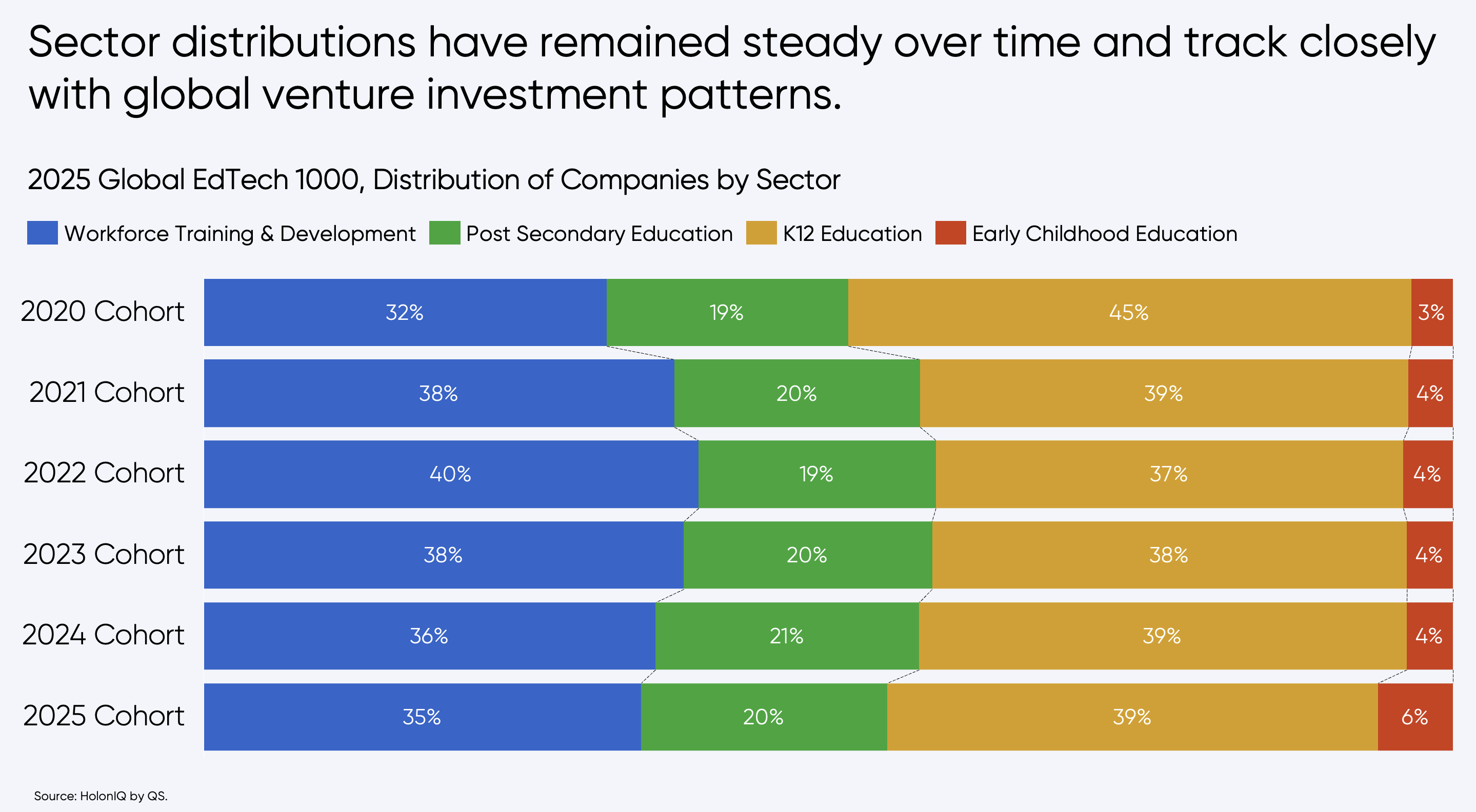
The 2025 Global EdTech 1000 highlights a market still young, with K–12 continuing to play a large role and workforce learning accelerating. K–12 represents nearly 40% of this year’s cohort, driven by demand for tutoring, content, school support, and classroom infrastructure. Workforce training and development accounts for more than one-third, consistent with the global shift toward job-relevant, short-cycle learning. Post-secondary represents about 20%, and Early Childhood Education remains a small but steady segment. Sector distributions have remained steady over the past five years, with K–12, Workforce, Post-secondary, and Early Childhood maintaining consistent proportions across the Global EdTech 1000.
Figure 1. 2025 EdTech 1000 - Distribution by Sector. 2020-2025
Deep Dive the List
Customers can deep dive the open-source list on the platform. Request a demo to learn more.
Subsector activity illustrates where innovation is concentrating. Early Childhood innovation remains centered on learning content, foundational skills, and parent-focused learning solutions, often delivered through child development and learning apps. Latin America offers standout examples such as Yuna and Escribo, both advancing early literacy and foundational learning.
Figure 3. 2025 Global EdTech 1000, Distribution by Sub-Sector, Early Childhood Education
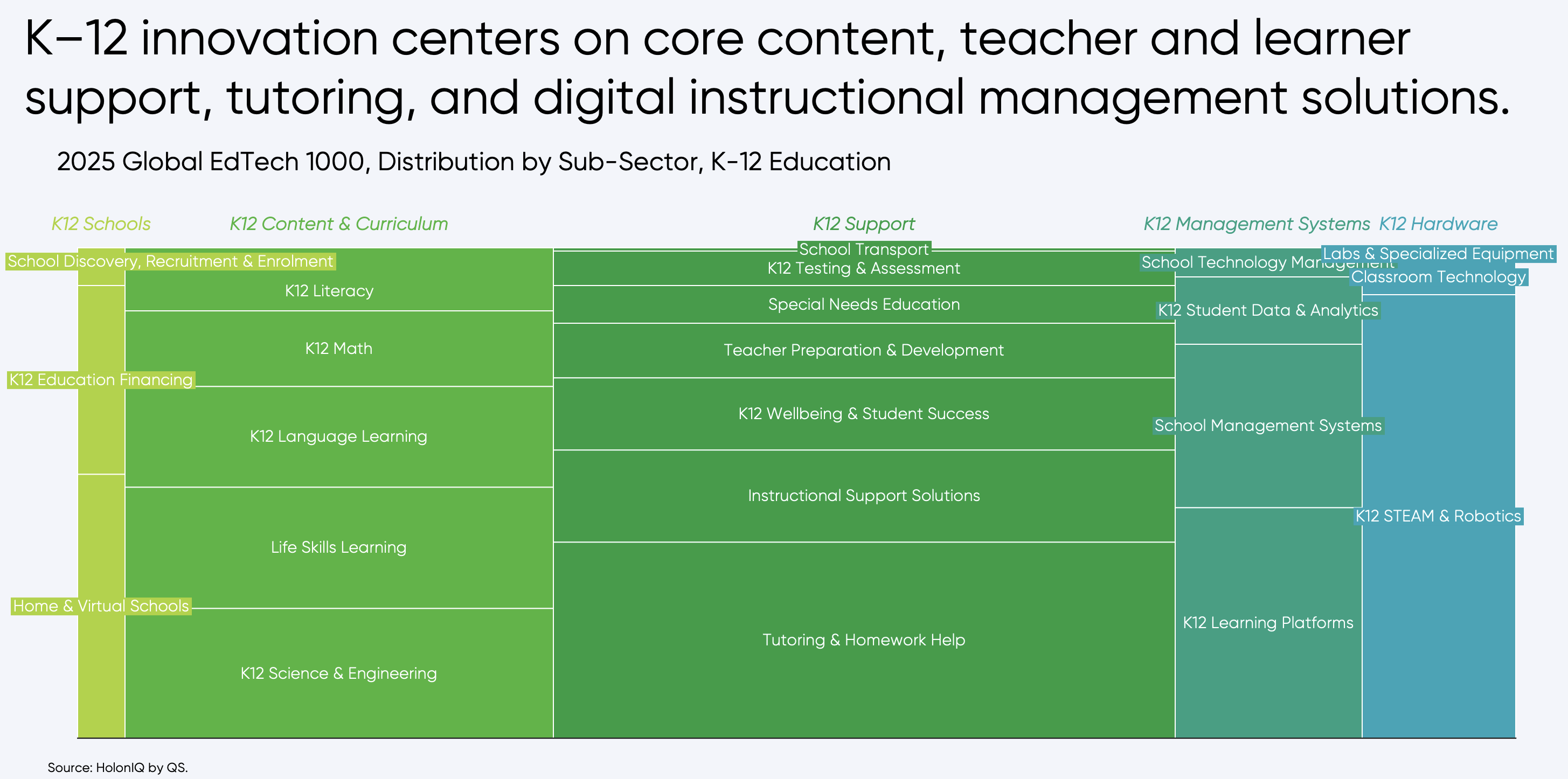
In K–12, support, curriculum, and management systems lead, with energy around STEM and learning companions like Miko, which brings early-stage AI to young learners. Across tutoring and support, solutions such as African startups, FoondaMate and Gradely continue to gain traction, while East Asia maintains deep strength through Mathpresso and Monoxer, both advancing mastery-based and long-term learning pathways.
Figure 4. 2025 Global EdTech 1000, Distribution by Sub-Sector, K-12 Education
In post-secondary, startups remain diverse but converge on learner support, including access, engagement, mentoring, financing, recruitment, and research. Keenious (Norway) improves research support through natural language processing, while Asia’s SuperKalam adds real-time, personalized test prep; together showing how global post-secondary innovation splits between academic support and career-prep learning.
Figure 5. 2025 Global EdTech 1000, Distribution by Sub-Sector, Post Secondary Education
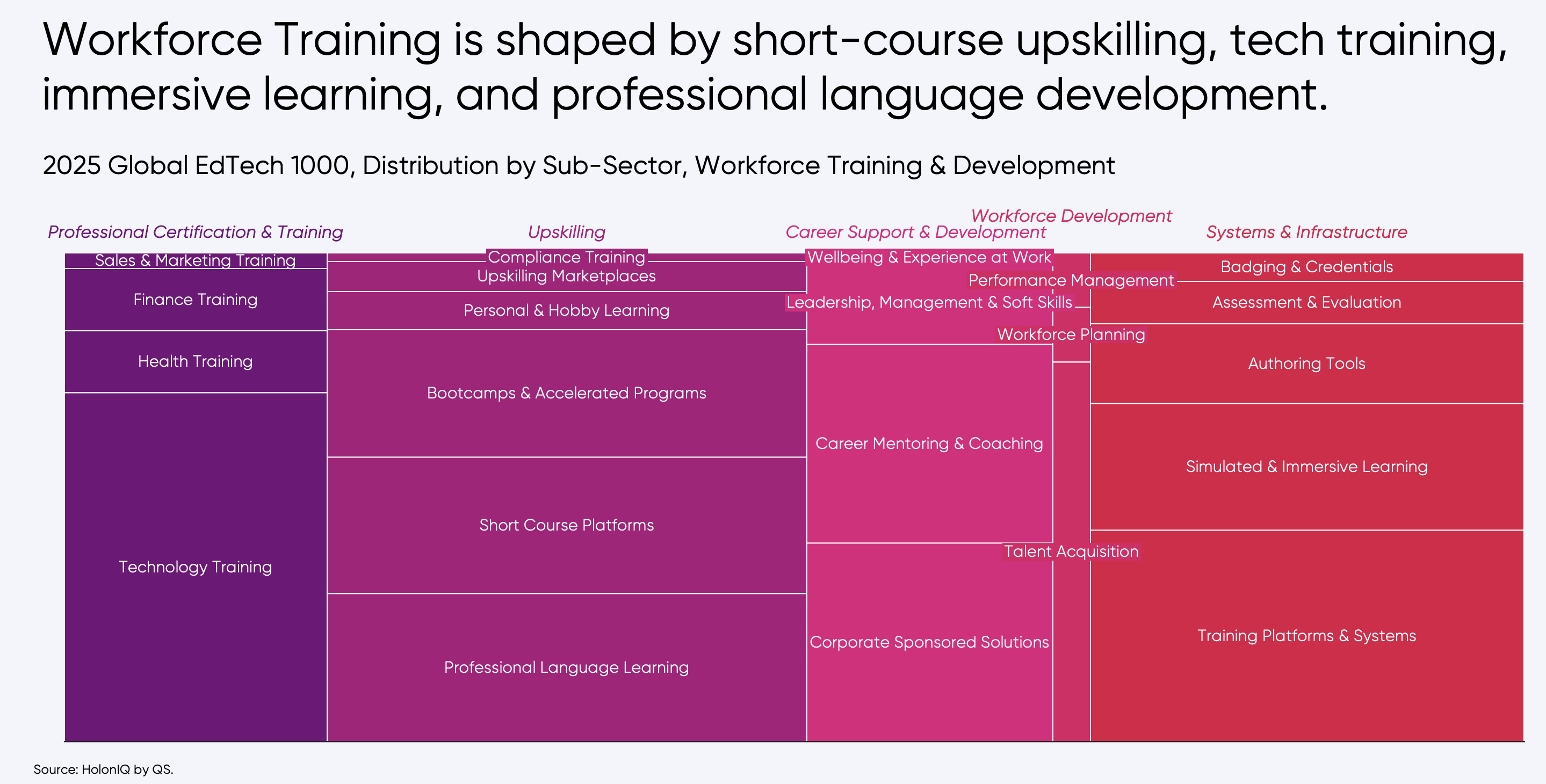
Workforce Training remains one of the most active clusters. Europe’s Sana, recently acquired by Workday for $1.1B, underscores rising demand for AI-enabled flexible learning systems in the Workforce, while South Asian and African markets continue to expand job-oriented upskilling through platforms like Seekho, GrowthSchool, SkillUp, and communication-focused tools such as Stimuler.
Figure 6. 2025 Global EdTech 1000. Distribution by Sub-Sector, Workforce Training and Development
Innovation patterns reflect regional markets, institutional priorities, and emerging ecosystems.
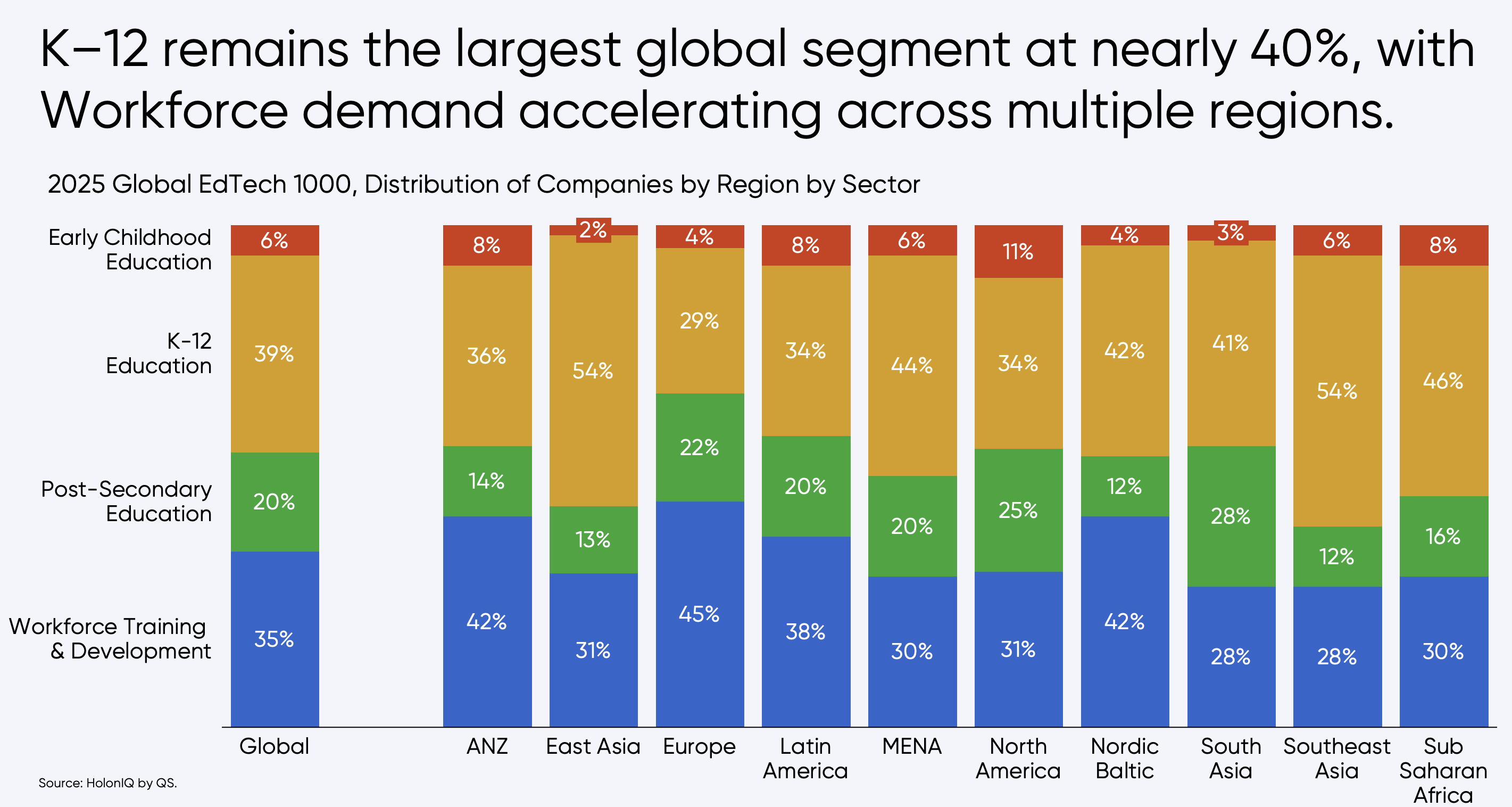
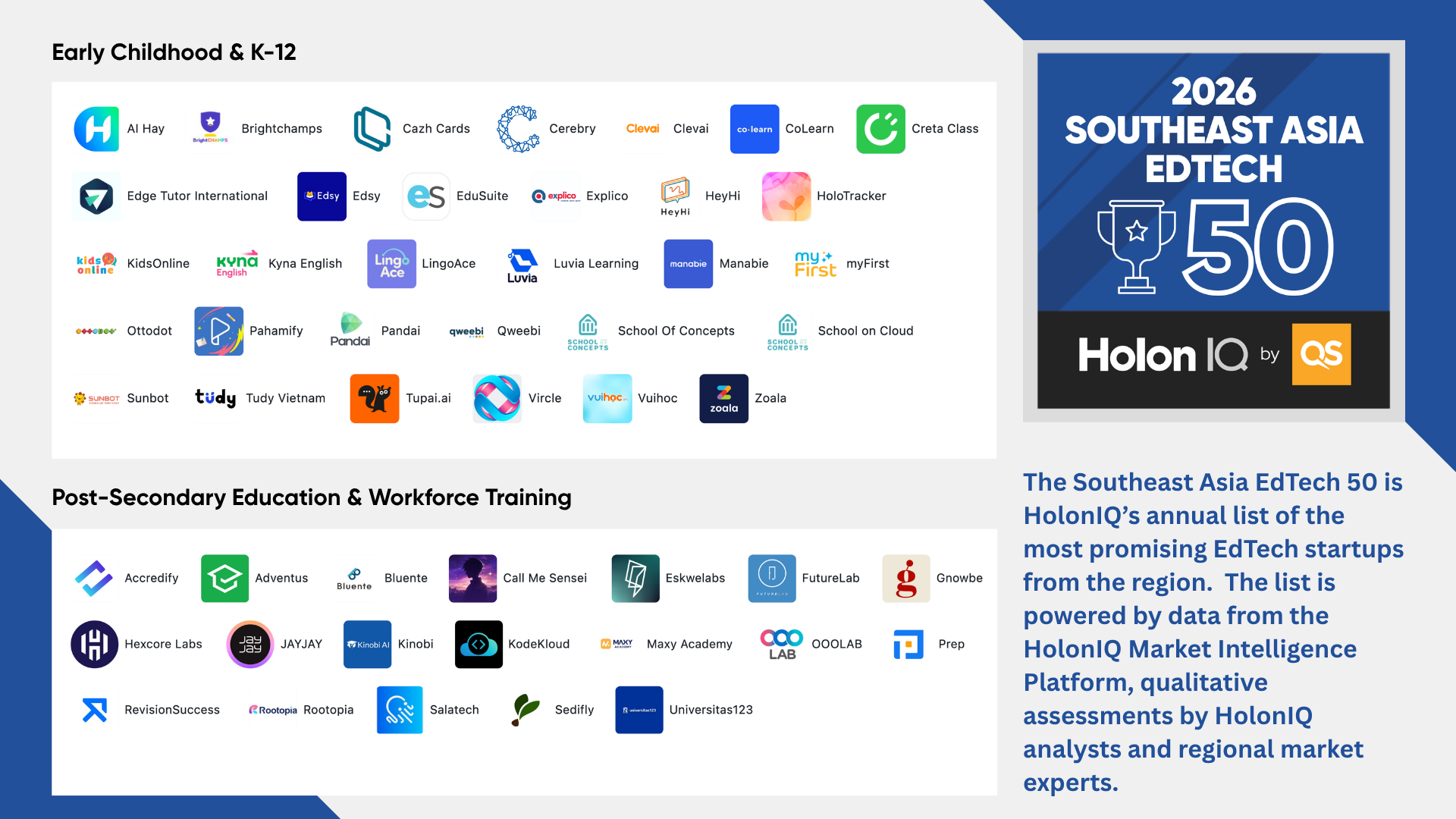
Asia contributes a significant share of K–12 and upskilling startups, driven by learner demands and AI experimentation. Europe remains a global center for workforce, enterprise learning and systems platforms in assessment and training. Nordic and Baltic ecosystems produce research-driven and authoring-focused tools such We Are Learning, and a strong workforce segment exemplified by cyber security training solution, Pistachio. MENA deepens its footprint through career-connected learning and hybrid school-to-work solutions. Platforms like Jotit and Career180 serve youth populations, while the UAE continues to operate as a regional scaling hub, shown by companies like Qureos. Southeast Asia’s mix of support and curriculum tools, including CoLearn and Explico, demonstrates how systems with strong student markets prioritize personalized learning and assessment.
Figure 7. 2025 Global EdTech 1000. Distribution by Sector and Region
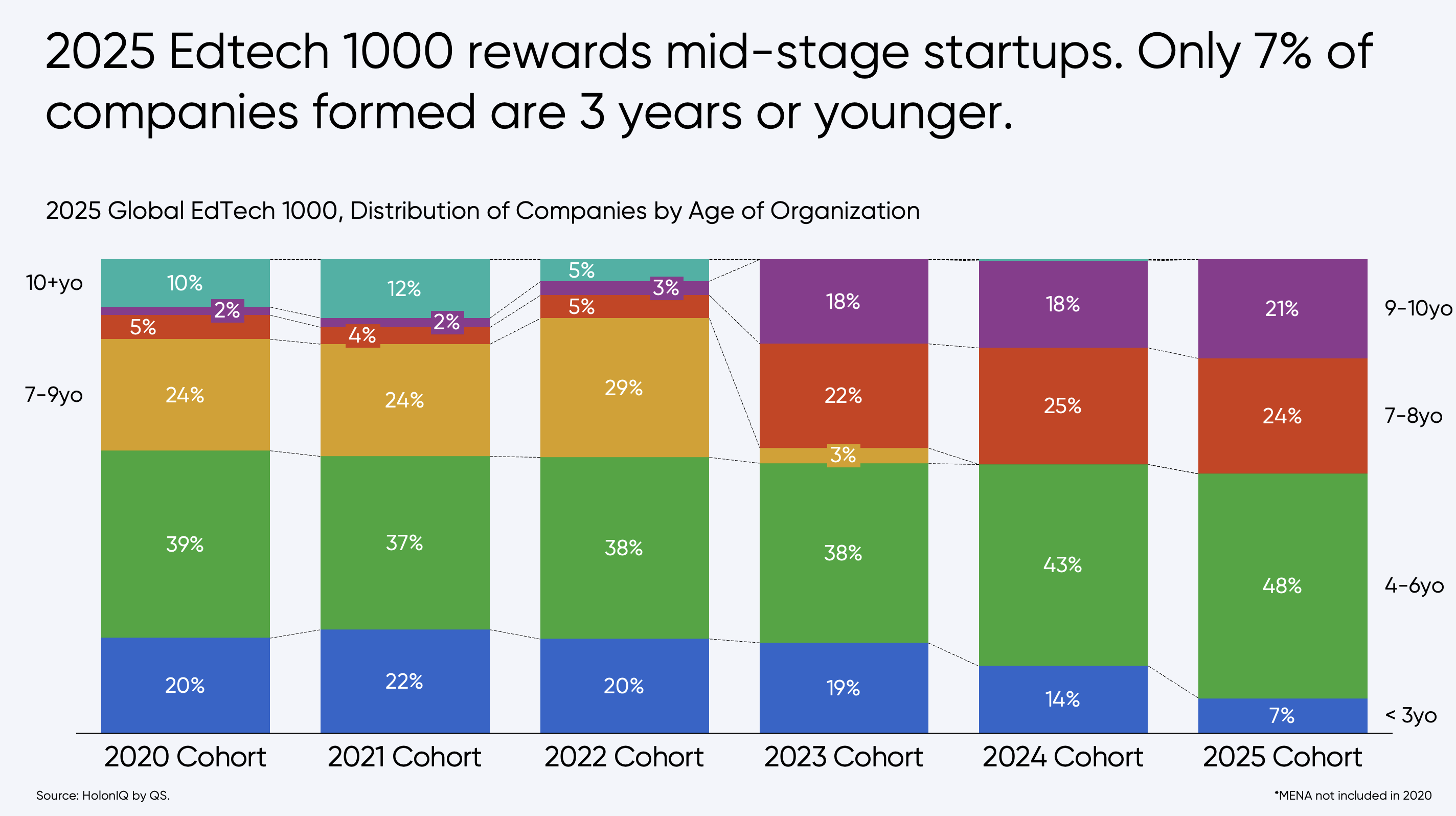
The 2025 cohort shows a noticeable shift compared to 2024 with only 7% of startups under 3 years old.
The share of younger startups has declined, with only 7% of companies three years old or younger, down from last year’s 14% very early-stage representation. Nearly half of the cohort is between four and six years old, reinforcing the strength of the mid-stage pipeline and highlighting how quickly the sector reinvents itself. A smaller cluster of older companies, typically 7–10 years old, clusters in workplace learning, school management systems, and professional certification, reflecting clearer product–market fit and more stable revenue. Workforce learning continues to show the highest concentration of maturing firms aligned with employer demand.
Figure 8. 2025 Global EdTech 1000. Distribution of Companies by Age of Organization, 2020-2025
Lean, modular, and consumer-oriented models dominate as institutions and consumers prioritize value and outcomes.
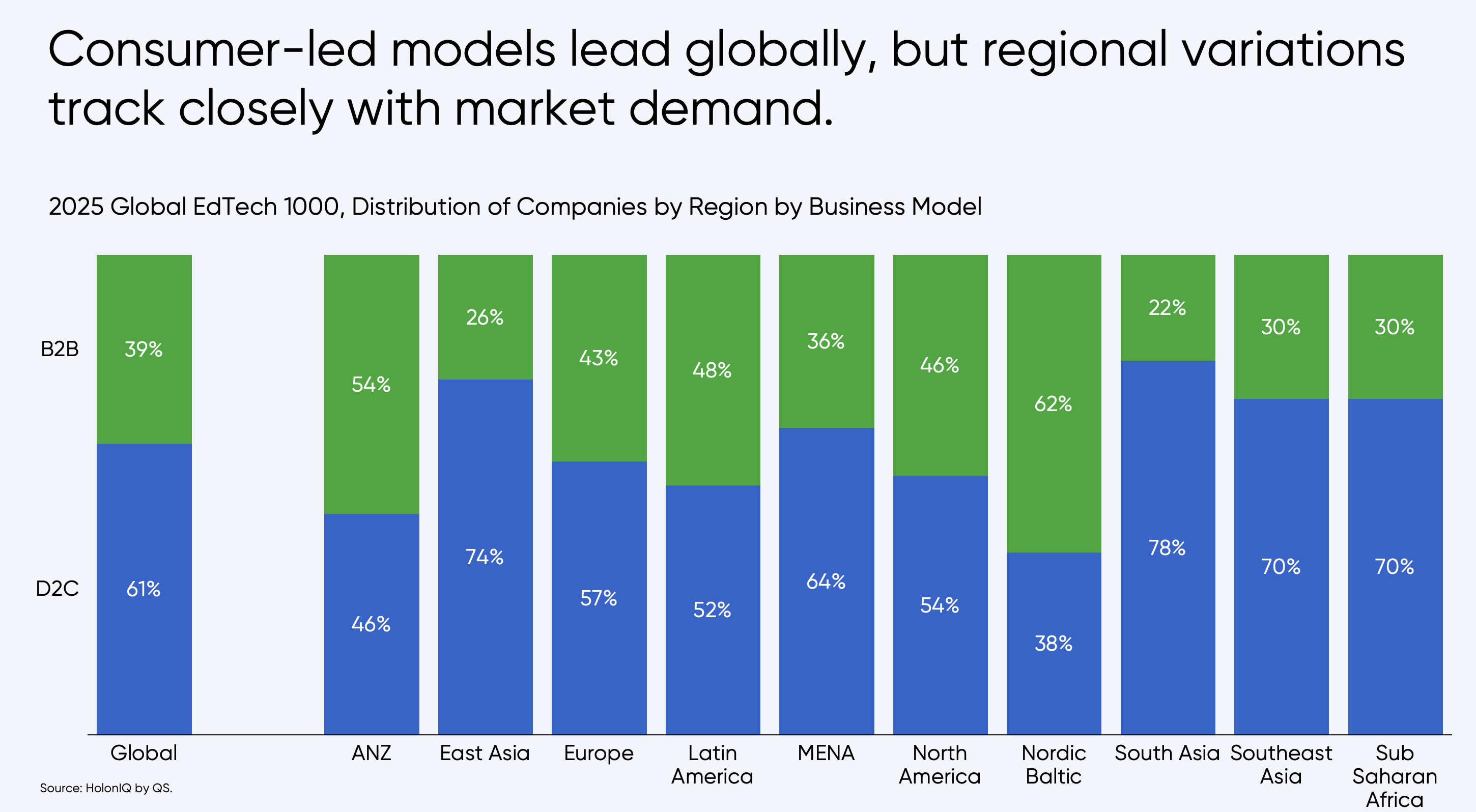
Consumer-led models remain the dominant global business model, especially in K–12, where direct-to-consumer purchasing and school partnerships reduce distribution friction. Regional variations largely reflect local market demands, particularly in workforce learning, where ANZ and Nordic Baltic continue to favor B2B and enterprise channels. Business model distributions have remained stable over time, following long-term patterns in institutional adoption cycles and consumer purchasing. Founders continue to favor models that support quick iteration and clear value demonstration; this is one reason that short-course learning, modular content, and infrastructure solutions remain strong segments.
Figure 9. 2025 Global EdTech 1000. Distribution of Companies by Region by Business Model
No items found.
Track the most promising EdTech startups globally.
HolonIQ customers can track the data for the most promising EdTech startups globally on the HolonIQ Intelligence Platform. Look for the 2025 Global EdTech 1000 list and double click into the data behind the charts. Request a Demo if you are not a customer and would like to learn more.
No items found.
Latest Insights
Global Insights from HolonIQ’s Intelligence Unit. Powered by our Global Impact Intelligence Platform.
We provide you with relevant and up-to-date insights on the global impact economy. Choose out of our newsletters and you will find trending topics in your inbox.





.png)


.png)