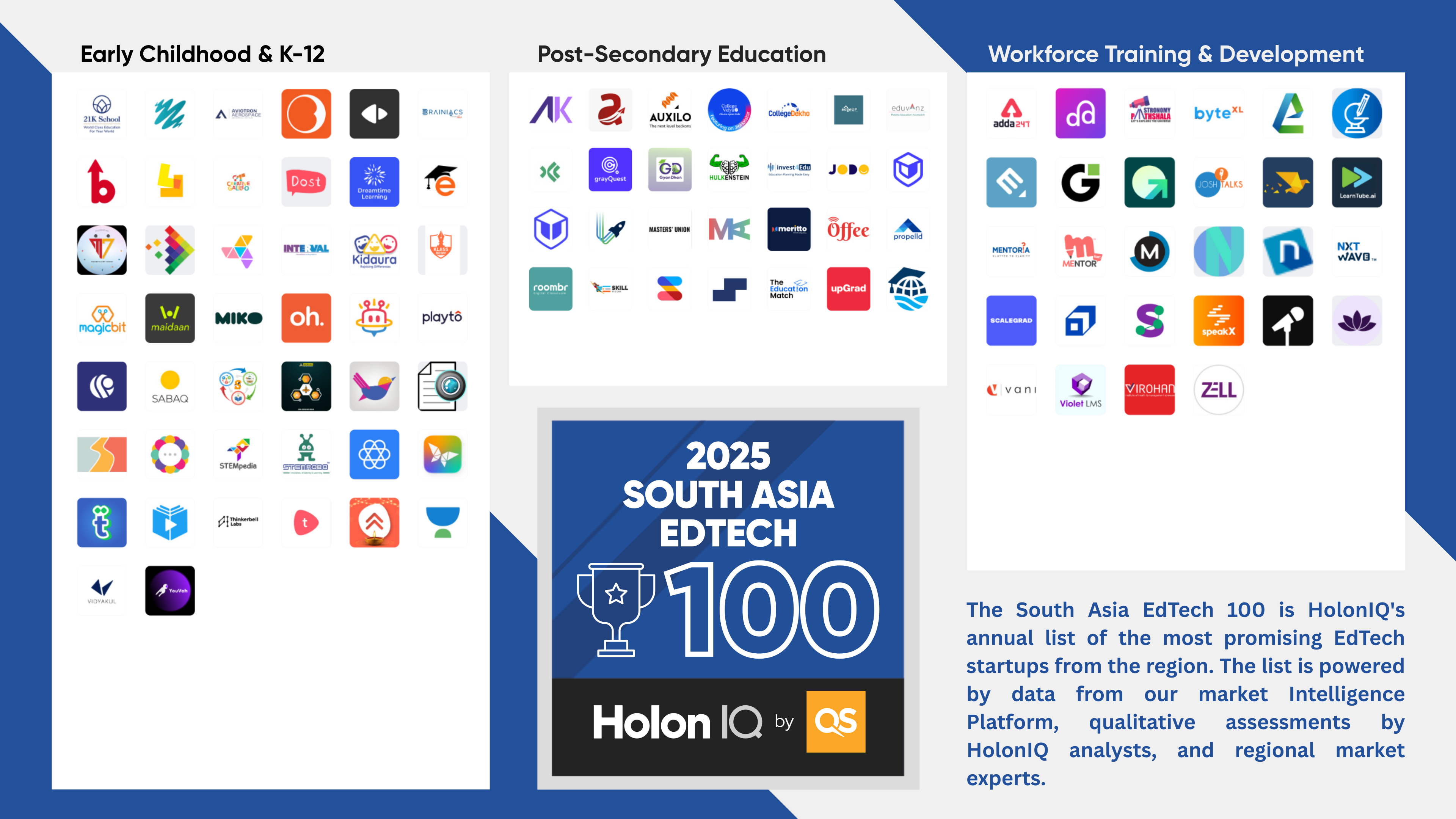
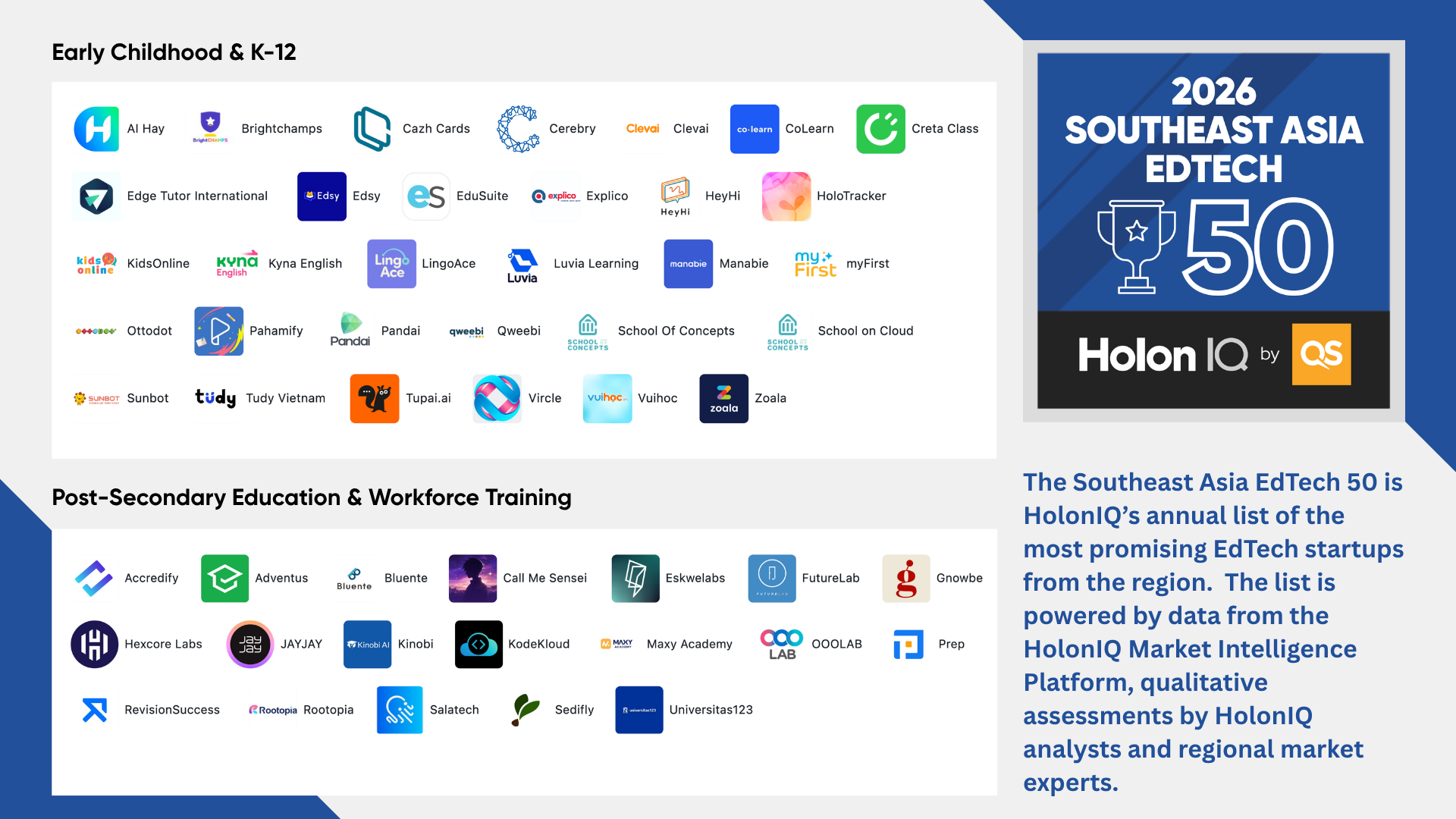
The South Asia EdTech 100 is HolonIQ's annual list of the most promising EdTech startups from the region.
The South Asia EdTech 100 is focused on identifying young, fast growing and innovative learning, teaching and up-skilling startups from the region. Powered by data and insights from our Impact Intelligence Platform together with qualitative assessments by HolonIQ’s Intelligence Unit, and local market experts, organizations are evaluated and scored based on our eligibility and assessment criteria, which excludes EdTech's founded over 10 years ago, or those which have exited (listed, acquired or controlled by another organisation).
The South Asia EdTech 100 is aligned to the Global Learning Landscape, an Open-Source Taxonomy that maps the education and talent market
Exhibit 2
K–12 reasserts its position as talent intelligence gains momentum
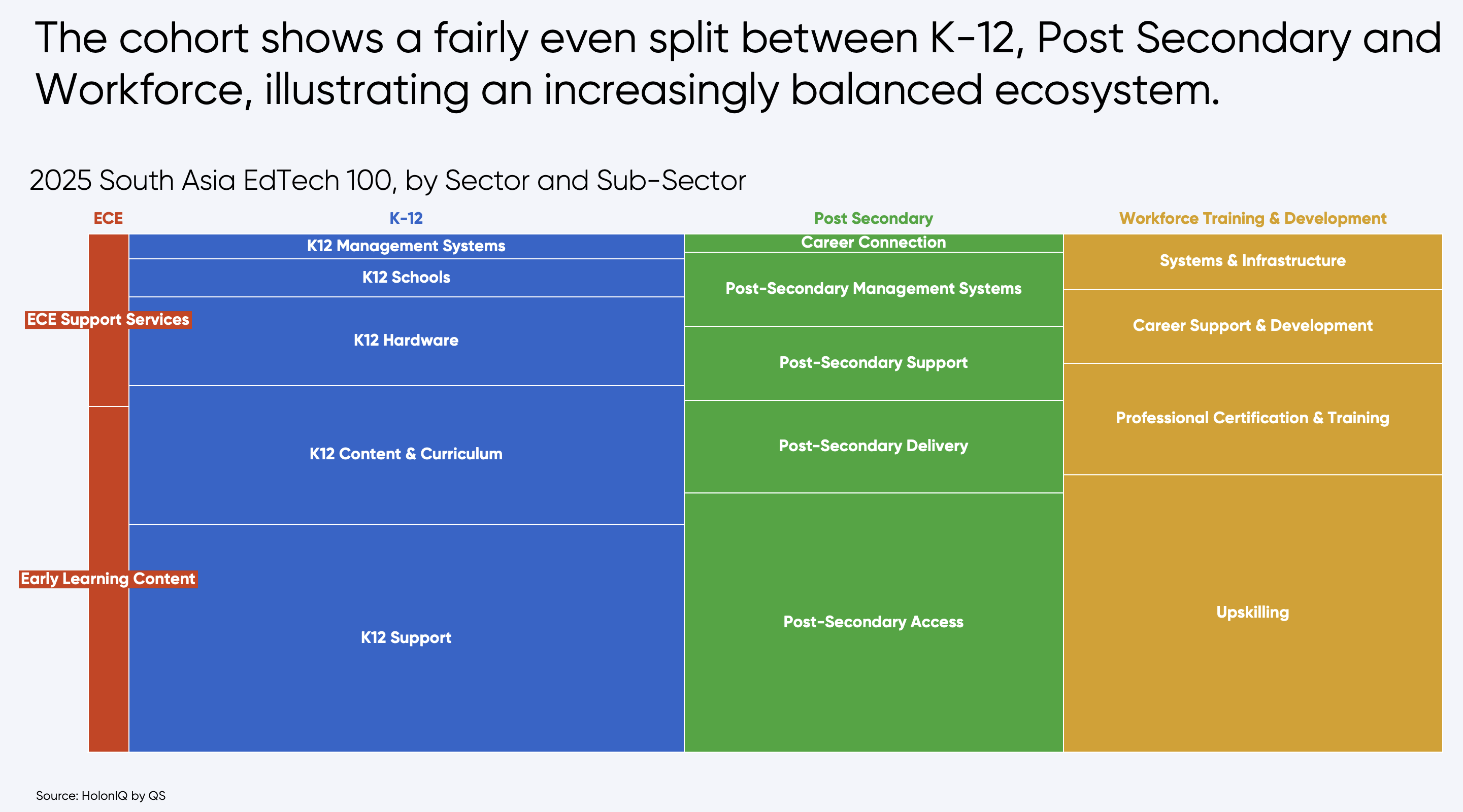
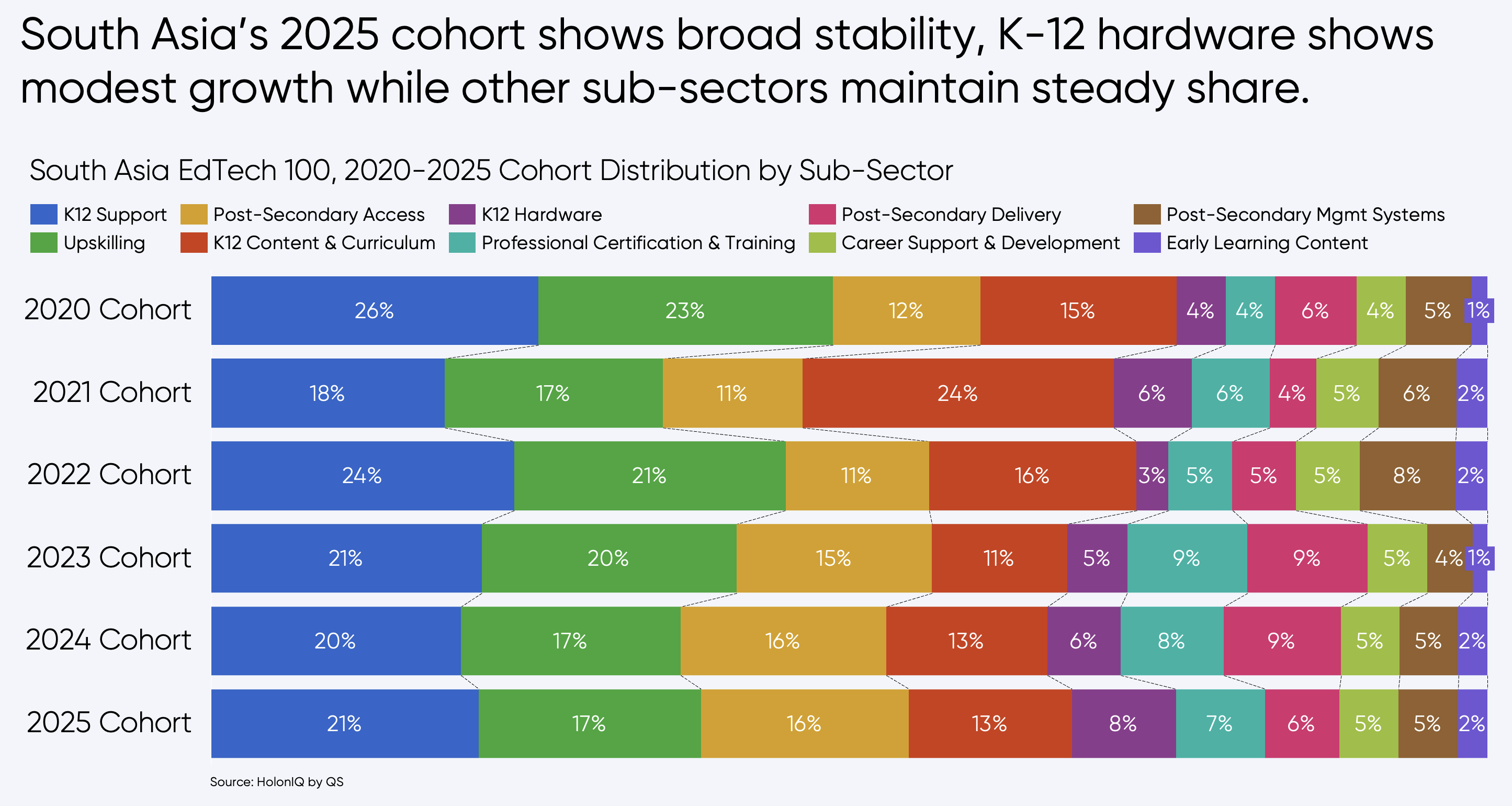
HolonIQ’s 2025 South Asia EdTech 100 reflects a region recalibrating its innovation priorities. After several years of intense orientation toward post-secondary expansion and general upskilling marketplaces, this year’s cohort signals a renewed emphasis on foundational learning and student success in schools, while a parallel wave of workforce-focused platforms advances new approaches to job readiness and talent intelligence.
K–12 learning providers comprise the largest share of this year’s cohort, reaffirming the long-term centrality of the school segment to South Asia’s EdTech ecosystem. The category’s renewed strength is visible across instructional support, assessment, and STEM-led curriculum solutions. Platforms such as Toddle integrate into school teaching and learning workflows, while Creative Galileo extends game-based early learning into science and literacy-rich environments. Hands-on, experiential learning is also evolving beyond the classroom, with Maidaan introducing live assessment experiences and Miko pushing the frontier of educational hardware through AI-powered robotic companions aimed at engaging younger students. Further, Smart Paper illustrates how assessment is moving from digitization to analytics, analyzing learning data captured from handwritten responses rather than requiring a fully digital environment. These examples underscore a shift in K–12 priorities: digital tools are moving beyond optional enrichment toward infrastructure-level expectations in content, pedagogy, assessment, and student engagement.
Exhibit 3
Ready to get started?
Get a personalized walkthrough of HolonIQ's Global Intelligence Platform.
Workforce learning extends beyond skills toward employability and talent intelligence
Workforce and professional learning solutions remain a significant segment of the cohort, but their purpose has evolved. Rather than simply offering courses, these startups are redefining how skills are signaled, validated, and translated into employment outcomes. Companies such as GenuineIN apply skill profiling and credentialing capabilities to help employers verify talent in real hiring contexts, while platforms including Seekho and GrowthSchool orient learners toward specific, job-ready outcomes through short-cycle, industry-aligned programs. The region is also seeing category specialization deepen: NxtWave builds technology-led pathways for digital careers, Skillinabox focuses vocational skilling for women, and Virohan offers professional certification for the healthcare sector, where employers face acute workforce shortages. This approach marks a gradual but meaningful pivot from “skills taught” to “skills trusted,” and reflects confidence that employability requires more than content; it requires recognized pathways, embedded connections to hiring, and evidence that learners are job-ready.
Post-Secondary providers maintain ground, but their role is shifting
Post-secondary solutions remain steady in representation but have shifted from broad content providers toward platforms that influence decision-making, financing, and institutional workflows. Meritto, for example, now positions enrollment and recruitment as a competitive capability for institutions, while Invest4Edu, GrayQuest, and Auxilo address the financing bottleneck that often determines whether a learner can enroll and persist. Meanwhile, emerging offerings such as Ambitio simplify complex choices around studying abroad through AI-enabled guidance, and YouVah introduces early opportunities for teenagers to gain professional exposure through internships. These models operate less as alternatives to traditional institutions and more as infrastructure that supports high-stakes transitions across the educational lifecycle.
Exhibit 4
India captures the region's majority.
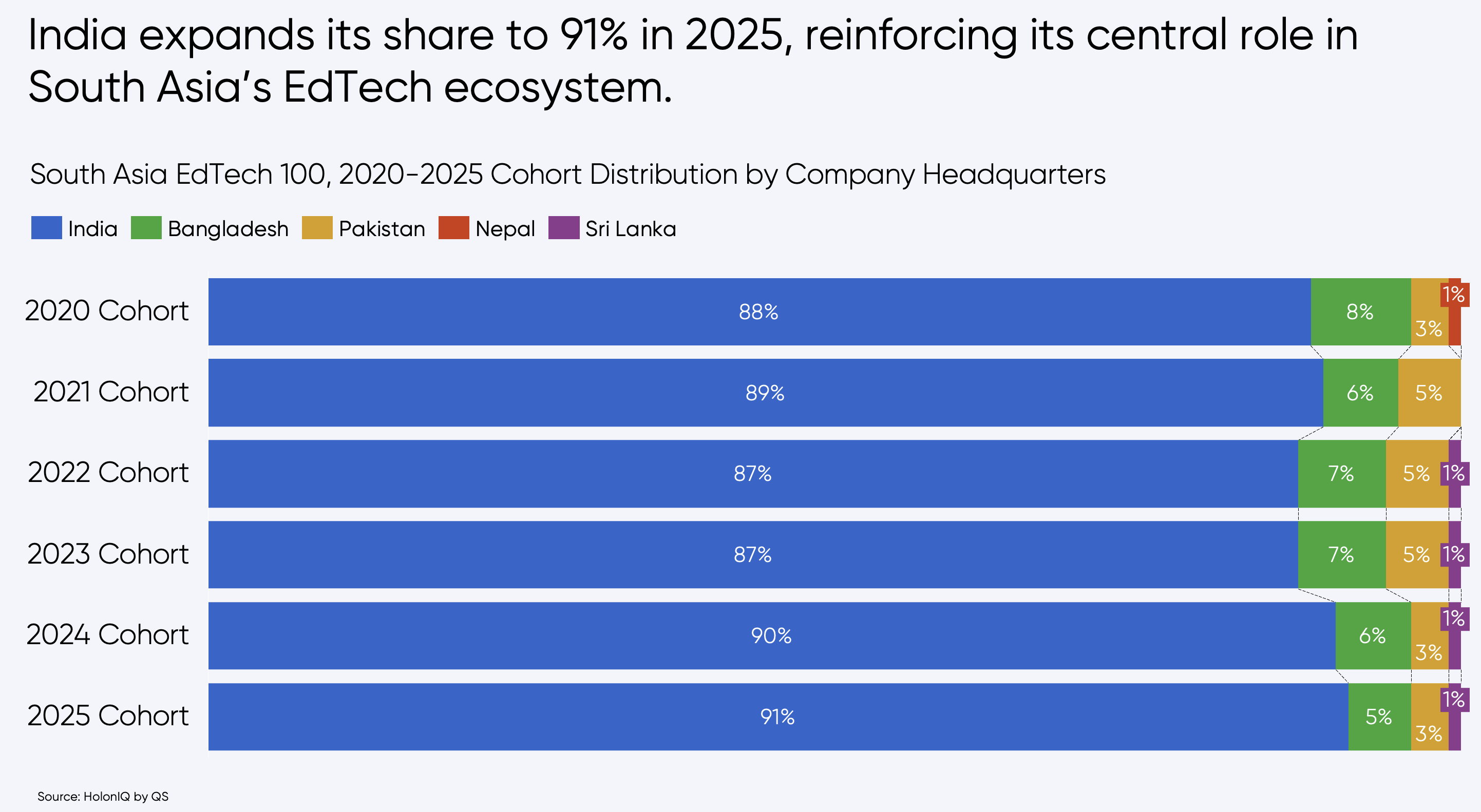
India’s share climbs to 91% of the 2025 cohort, confirming its position as the region’s most prolific incubator for education innovation. Scale, distribution efficiency, and capital availability continue to draw founders and investors into the market. Other countries in the region remain active—Bangladesh features companies such as Astronomy Pathshala and BigyanPriyo, while Pakistan contributes providers like SABAQ—but the density of experimentation, product evolution, and commercial traction remains overwhelmingly centered in India.
Exhibit 5
D2C strengthens as the region’s primary business model
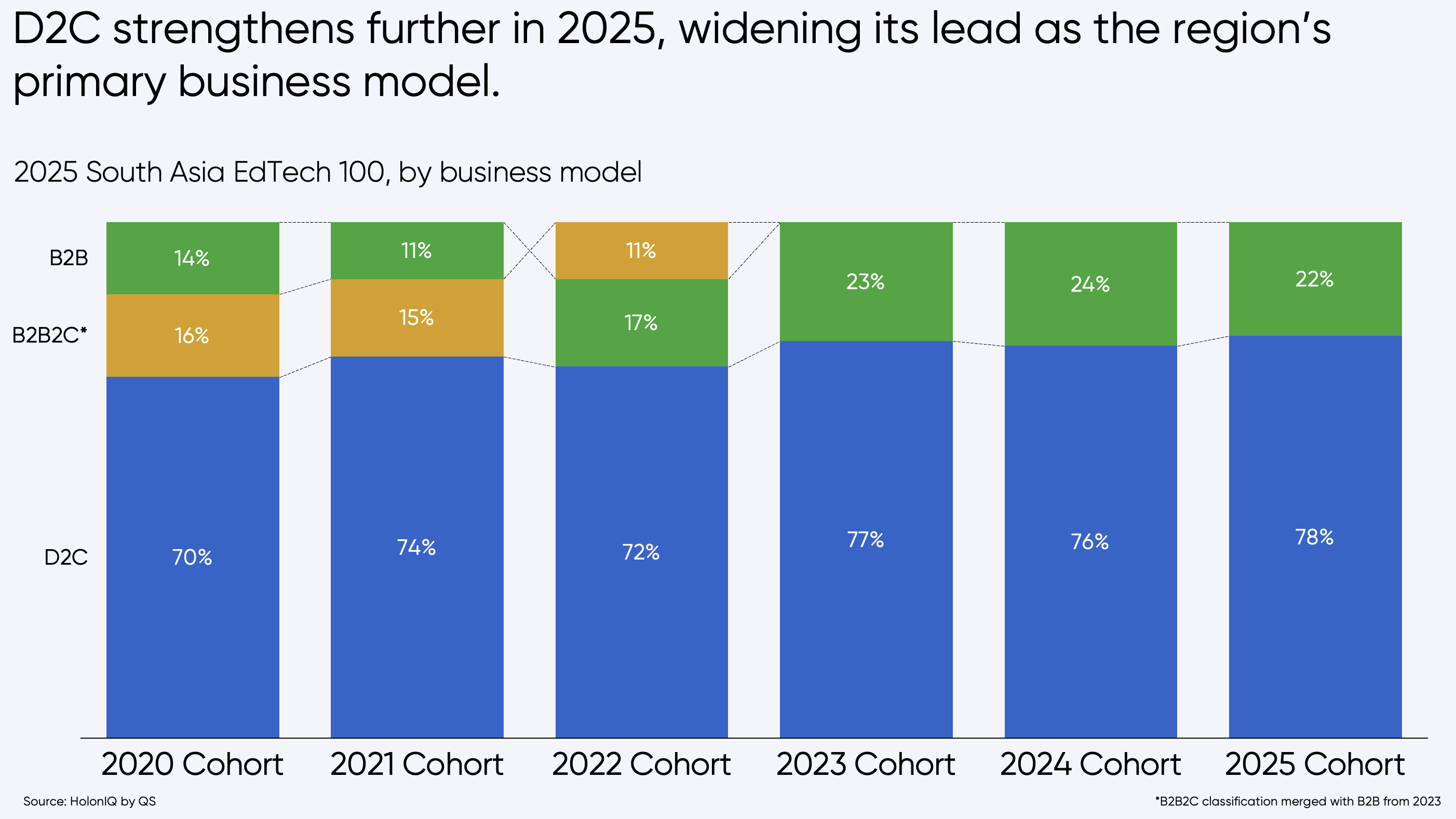
Direct-to-consumer solutions remain the most common business model in 2025, reflecting users’ willingness to invest directly in personal economic and academic pursuits. While institutional sales persist, the clear majority of this year’s cohort continues to rely on brand-led discovery, engagement, and conversion to reach learners and families directly.
Exhibit 6
Fewer new entrants, more market depth
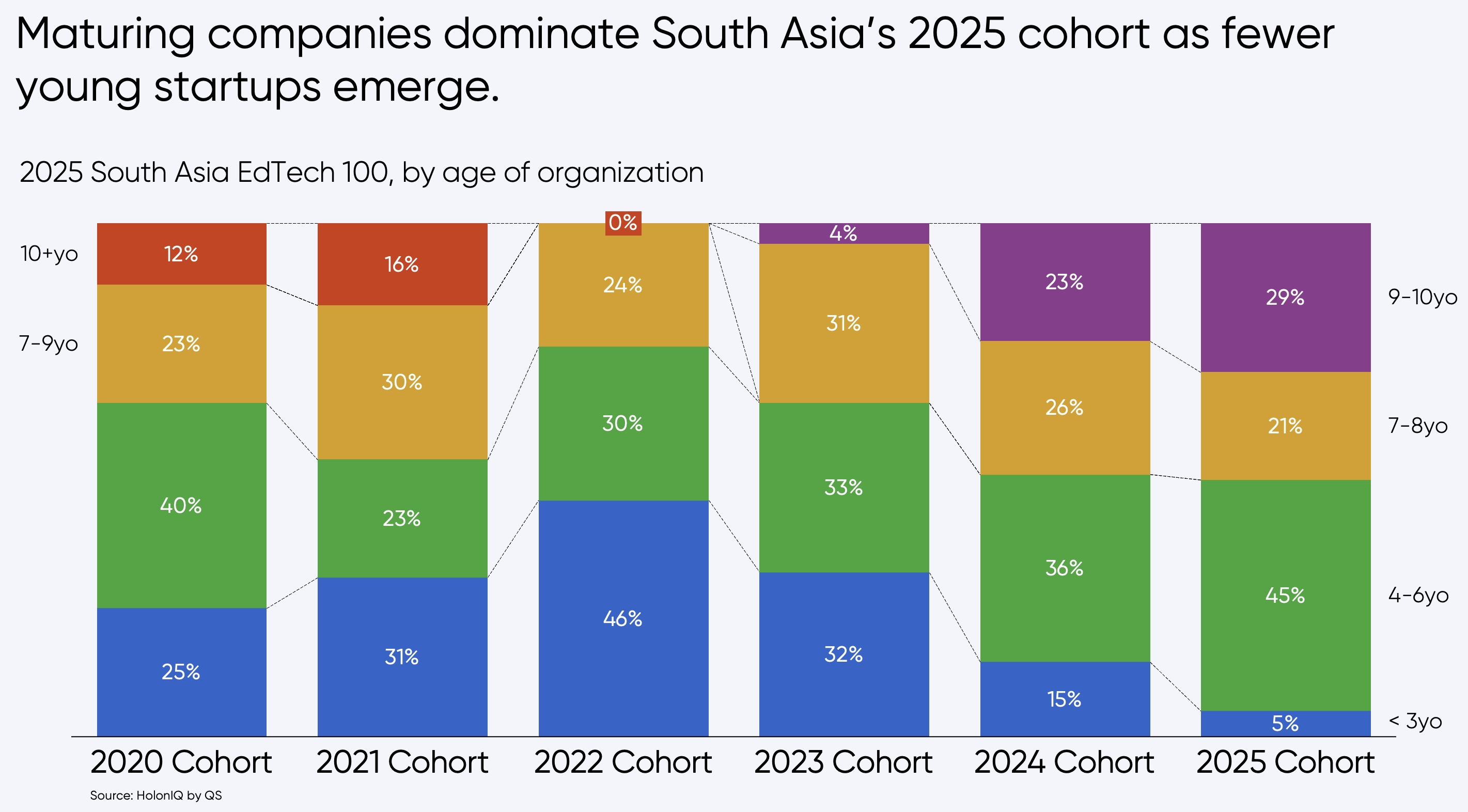
Younger startups represent a smaller proportion of this year’s list, and those that do appear stand out for AI-enabled models. Stimuler, for instance, takes an AI-first approach to speaking proficiency, and Kalam offers real-time academic evaluation through personalized feedback. These examples represent targeted, purpose-built innovation rather than broad-market experimentation, a sign that founders are entering the sector with narrower, more technically differentiated theses.
Exhibit 7
Track the 2025 Cohort
HolonIQ customers can track the data for the most promising EdTech startups in the region on the HolonIQ Analytics Platform. Look for the 2025 South Asia EdTech 100 list and double click into the data behind the charts. Request a Demo if you are not a customer and would like to learn more.
We provide you with relevant and up-to-date insights on the global impact economy. Choose out of our newsletters and you will find trending topics in your inbox.




.png)


.png)