2026 North America EdTech 200

HolonIQ’s annual list of the 200 most promising EdTech startups from North America.

Education Intelligence Unit

calendar image
April 15, 2025

The North America EdTech 200 is HolonIQ's annual list of the most promising EdTech startups from North America.

The 2026 cohort reflects a market where, despite uncertain AI job augmentation, child screen time debates, and unclear career pathways, edtech continues to support daily practice across teaching, learning, student support, and workforce development. AI-enabled products are becoming increasingly deployed across classrooms, institutions, and workplaces. From early learning through workforce development, activity for the region clusters around solutions equipping educators with new ways of work, emboldening students to engage and persist, and lighting the path from learning to livelihood by connecting skills and careers.

The North America EdTech 200 is focused on identifying young, fast growing and innovative learning, teaching and up-skilling startups in Canada and the United States. Powered by data and insights from our Impact Intelligence Platform together with qualitative assessments by the Education Intelligence Unit, and local market experts in each region, organizations are evaluated and scored based on our eligibility and assessment criteria.

Exhibit 1

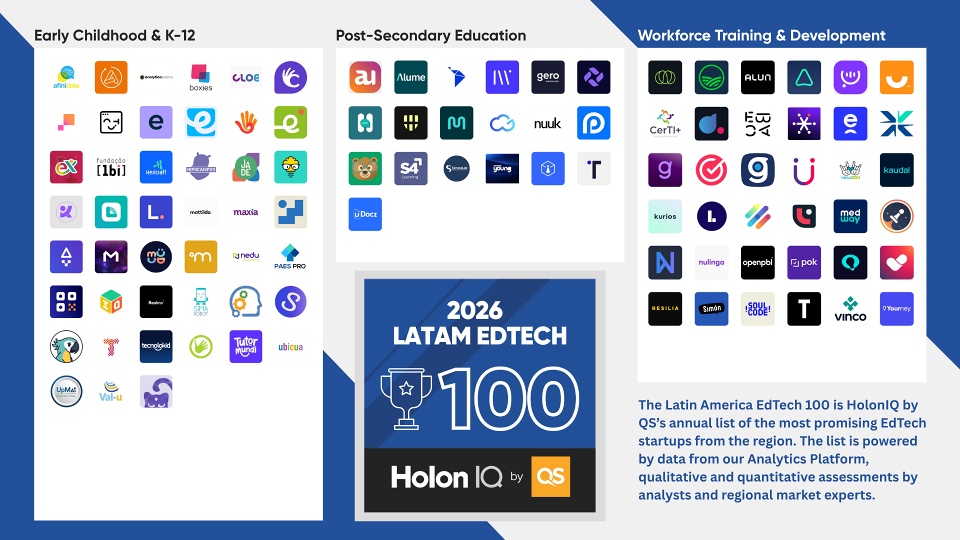
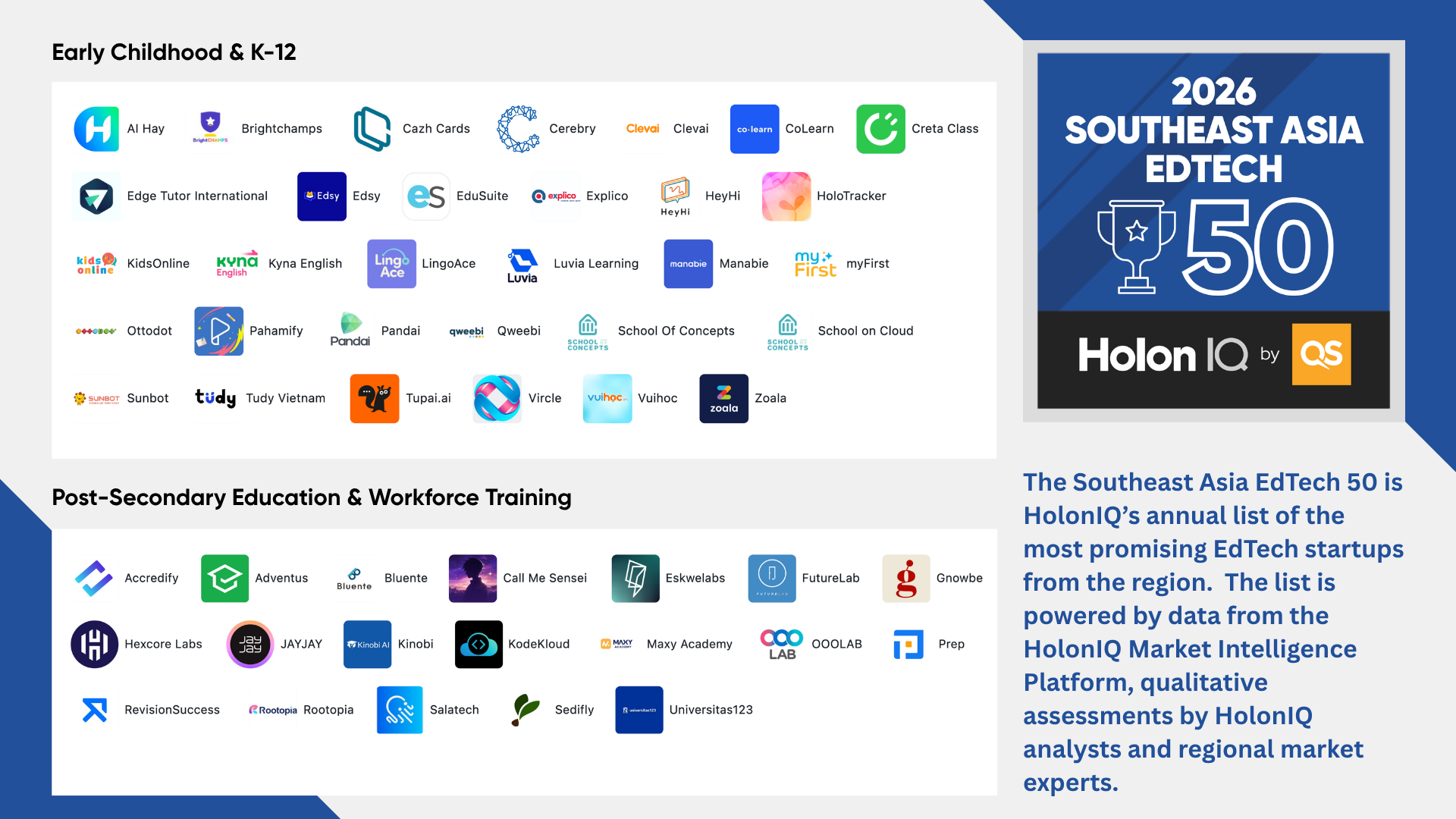
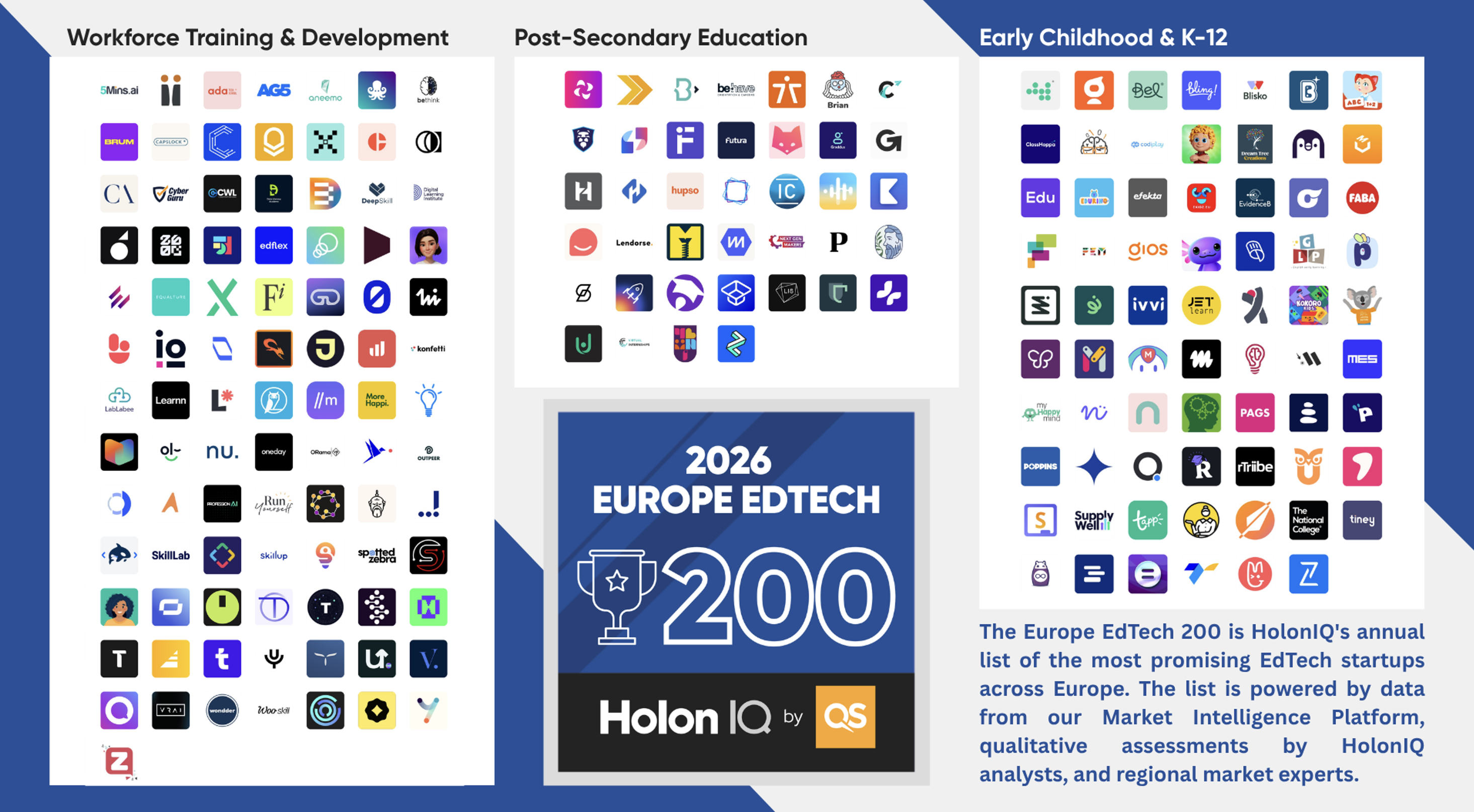
Download the Market Map. Companies are categorized by their main area of focus following the globallearninglandscape.org. Categories in the market map are not mutually exclusive.

Deep Dive the List

Customers can deep dive the open-source list on the platform. Request a demo to learn more.

HolonIQ’s 2026 North America EdTech 200 is aligned to the Global Learning Landscape, an Open-Source Taxonomy that maps the education and talent market.

The North America 2026 cohort concentrates around platforms with clear adoption pathways and crystal clear use cases. Companies gaining traction tend to focus on instructional and administrative workflows, student wellbeing, assessment, and career alignment. Funding conditions continue to stabilize this year, but investors are still relatively conservative, and so the cohort rewards products that fit inside how schools, universities, and employers already work.

Exhibit 2

The North America 200 by Sector: Early learning values content, K–12 prioritizes support, post‑secondary seeks learner engagement, workforce demands outcomes.


Early childhood makes up under 10% of the cohort, with content in focus. Companies concentrate around engagement, access, and provider operations, with narrowly defined use cases in focus. KiBeam, Giant, and Kid Company apply AI to early literacy, communication, and guided interaction, while Bumo and Illumine address childcare access and center operations. Direct-to-Consumer products such as Pok Pok and Buddy.ai continue to see demand where play‑based learning and early language development fit clearly defined settings and culture.

K–12 represents over a third of the cohort, and clusters around instructional support workflows, assessment, and student wellbeing, driven by tools that fit into everyday classroom practice. Platforms such as MagicSchool AI and SchoolAI support teacher workflows, Parallel Learning and Snorkl anchor assessment and feedback, and Cartwheel, Wayfinder, and TadHealth reflect wellbeing becoming closer to core. Instructional tools such as Diffit, Subject, Yourway, and Playlab gain traction where they reduce prep time and support differentiation.

Post‑secondary companies account for just over a quarter of the cohort, centering on communication, retention, and academic support, favoring system‑level solutions like Nectir and academic support solutions such as OpenNote, alongside delivery products including Campus. Solutions that strengthen existing structures are gaining more traction than those that require organizational redesign.

Workforce development represents just under 30% of the cohort and remains one of the most active segments. Companies such as Workera, Transfr, Certiverse, and Skillmaker.ai illustrate solutions gaining traction that are linked to perceived employment results, with solutions spanning skills assessment, immersive training, and credential pathways when they connect learning clearly to jobs.

Ready to get started?

Get a personalized walkthrough of HolonIQ's Global Intelligence Platform.

The 2026 cohort shows a significant uptick in direct-to-consumer models.


Business models split clearly across the cohort. Consumer‑facing models account for approximately two‑thirds of companies, with B2B just under 40%. The pattern holds by sector. Workforce skews more B2B. Early childhood stays heavily consumer. K‑12 and post‑secondary sit between, with mixed routes to adoption. Compared with 2025, the model mix looks steady.

Exhibit 3

The 2026 North America’s EdTech 200 reflects a cohort concentrated in the middle years of growth.

The cohort remains young, but the distribution is telling. Companies under three years old account for less than 10% of the list. This cohort has leaned away from very early‑stage companies, reflecting persistent barriers to entry in education markets.

The four‑to‑six‑year range is where activity concentrates, now representing nearly 60% of the cohort. This mirrors last year’s pattern, when the majority of companies sat just past the early‑stage threshold. These firms are far enough along to show real adoption and institutional fit, but still early in their market trajectory. This age band continues to carry most of the market’s momentum.

At the upper end, companies aged nine to ten years make up just under 10% of the cohort, a small drop from 2025. Their shrinking presence suggests that adaptation to changing markets is paramount. Longevity alone is not translating into a growing share of attention, reinforcing that continued relevance matters as much as survival.


The 2026 North America EdTech 200 reflects a market that is active, selective, and built around practicality. Innovation concentrates where products fit inside how education systems already run, while extending capacity for educators, institutions, and learners. The cohort stays young, yet a clearer middle tier has taken shape. Across early learning, K‑12, post‑secondary, and workforce, the direction is consistent and solutions that integrate cleanly, hold up under real usage, and connect learning to livelihood keep winning attention in North America.

 Exhibit 4

Track the 2026 Cohort

Customers can track the data for the most promising EdTech startups in North America on the QS Analytics Platform. Look for the 2026 North America EdTech 200 list and double click into the data behind the charts. Request a Demo if you are not a customer and would like to learn more.

Deep Dive the List

Customers can deep dive the open-source list on the platform. Request a demo to learn more.

Latest Insights

Global Insights from HolonIQ’s Intelligence Unit. Powered by our Global Impact Intelligence Platform.

Back to School VIP
Back to School VIP
2025 Back to School
2025 Back to School
Global Skills Week
Global Skills Week
Newsletter
Newsletter
2024 Back to School
2024 Back to School
North America EdTech 200
2024 Paris HE Summit
2024 San Juan Speaker
Indices
Indices
Cities
Cities
2023 Back to School Featured Speaker
New York
New York
2023
2023
Webinar
Webinar
Economics
Economics
Draft
Draft
Platform
Platform
2022
2022
Digital Transformation
MedTech
MedTech
Global Impact Summits
Impact 3000
Impact 3000
Nuclear
Nuclear
Mobility
Mobility
Electric Vehicles
Electric Vehicles
2021
2021
2020
2020
Sub Saharan Africa
Sub Saharan Africa
Nordic Baltic
Nordic Baltic
North America
North America
South Asia
South Asia
East Asia
East Asia
ANZ
ANZ
Market Sizing
Market Sizing
Augmented Reality
Augmented Reality
Blockchain
Blockchain
Virtual Reality
Virtual Reality
Regions
Regions
Markets
Markets
Mobile
Mobile
Client Report
Client Report
Publishers
Publishers
Labor Markets
Labor Markets
Global Landscape
Global Landscape
10 Charts Series
10 Charts Series
R&D
R&D
LMS
LMS
United Kingdom
United Kingdom
Executive Panel
Executive Panel
Language Learning
Language Learning
Russia
Russia
Israel
Israel
Germany
Germany
France
France
Media and Press
Media and Press
Climate Tech
Climate Tech
MENA
MENA
South Korea
South Korea
Japan
Japan
Southeast Asia
Southeast Asia
Health Tech
Health Tech
Global EdTech 1000
Global EdTech 1000
Unicorns
Unicorns
MOOCs
MOOCs
Global Giants
Global Giants
Client Note
Client Note
Capital Markets
Capital Markets
Advanced Technology
Advanced Technology
OPM
OPM
International Education
India
India
China
China
Canada
Canada
Venture Capital
Venture Capital
Bootcamps
Bootcamps
Online learning
Online learning
Notes
Notes
Europe
Europe
Asia
Asia
Africa
Africa
LATAM
LATAM
Brazil
Brazil
Robotics
Robotics
Education in 2030
Education in 2030
Artificial Intelligence
SDG 17
SDG 17
SDG 16
SDG 16
SDG 15
SDG 15
SDG 14
SDG 14
SDG 13
SDG 13
SDG 12
SDG 12
SDG 11
SDG 11
SDG 10
SDG 10
SDG 9
SDG 9
SDG 8
SDG 8
SDG 7
SDG 7
SDG 6
SDG 6
SDG 5
SDG 5
SDG 4
SDG 4
SDG 3
SDG 3

Sign Up for our Newsletters

We provide you with relevant and up-to-date insights on the global impact economy. Choose out of our newsletters and you will find trending topics in your inbox.

Weekly Newsletter

Climate Technology

Weekly Newsletter

Education Technology

Weekly Newsletter

Health Technology

Weekly Newsletter

Higher Education

Daily Newsletter

Chart of the Day

Daily Newsletter

Impact Capital Markets