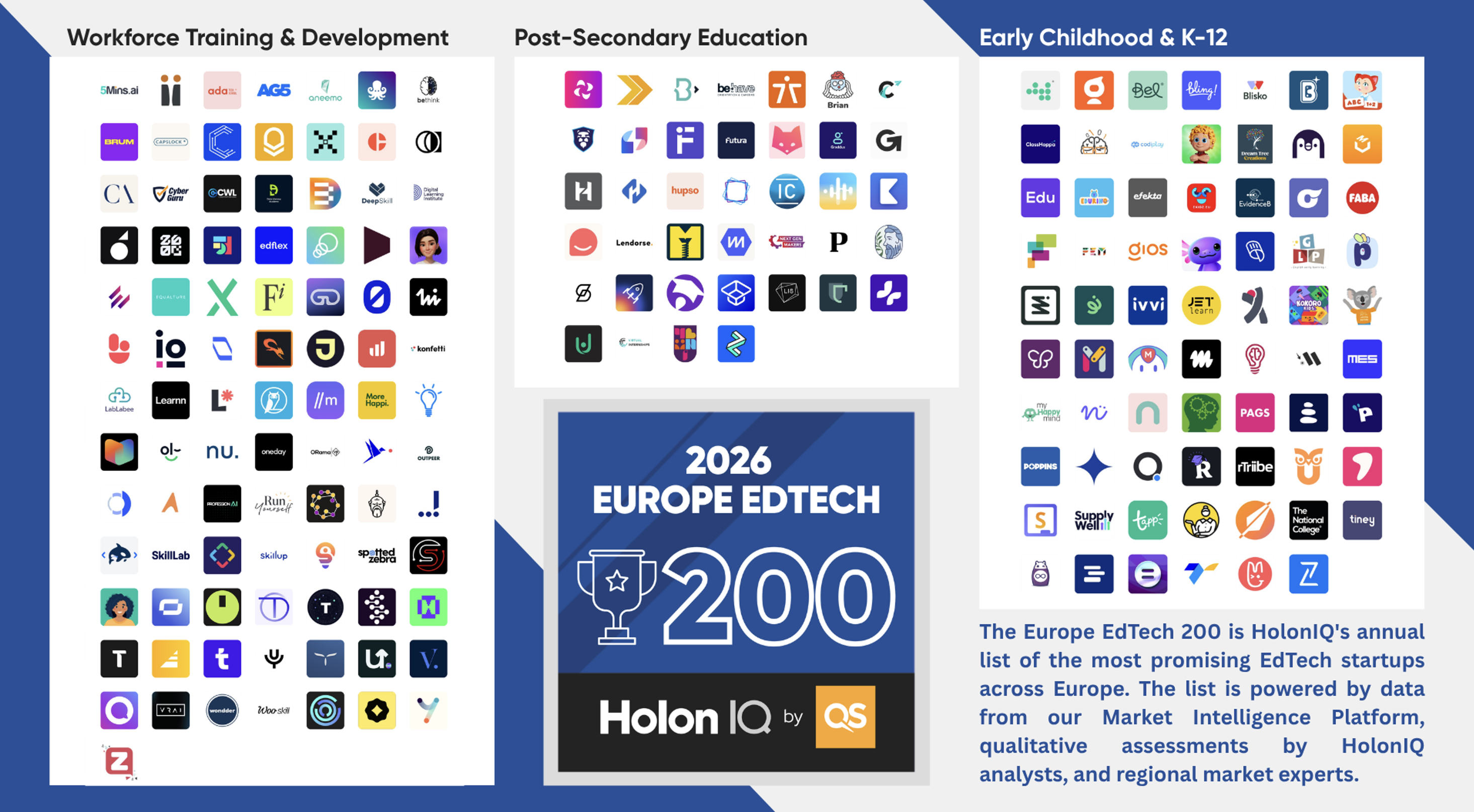
The Europe EdTech 200 is HolonIQ's annual list of the most promising EdTech startups from the region.
The 2026 cohort reflects a market that is maturing without slowing. Across the continent, edtech activity concentrates around workforce development solutions, infrastructure for institutions, and increasingly robust support solutions for K–12 learners. AI-enabled products are seen across sectors and education departments, and from early childhood through professional upskilling, this year’s cohort reflects organizations that integrate into existing educational structures and that connect learning directly to work.
The Europe EdTech 200 is focused on identifying young, fast-growing, and innovative learning, teaching, and upskilling startups headquartered across Europe*. Powered by data and insights from our Impact Intelligence Platform together with qualitative assessments by the Education Intelligence Unit and local market experts across the region, organisations are evaluated and scored based on our eligibility and assessment criteria. *This list excludes the Nordic-Baltic region which is covered in the annual Nordic-Baltic EdTech 50, the 2026 edition will be published in late 2026.
The 2026 Europe EdTech 200 aligned to the Global Learning Landscape, an Open-Source Taxonomy that maps the education and talent market
The 2026 European cohort clusters around products with clear integration pathways and well-defined use cases with Workforce Training and Development leading in 2026; however, the list is notable for the breadth of infrastructure and support solutions running underneath it. Funding remains cautious, but strong compared to other regions, and the cohort reflects its selectivity. Organizations that are aligned to European schools, universities, and employers current use cases and operations are winning attention from investors and awards.
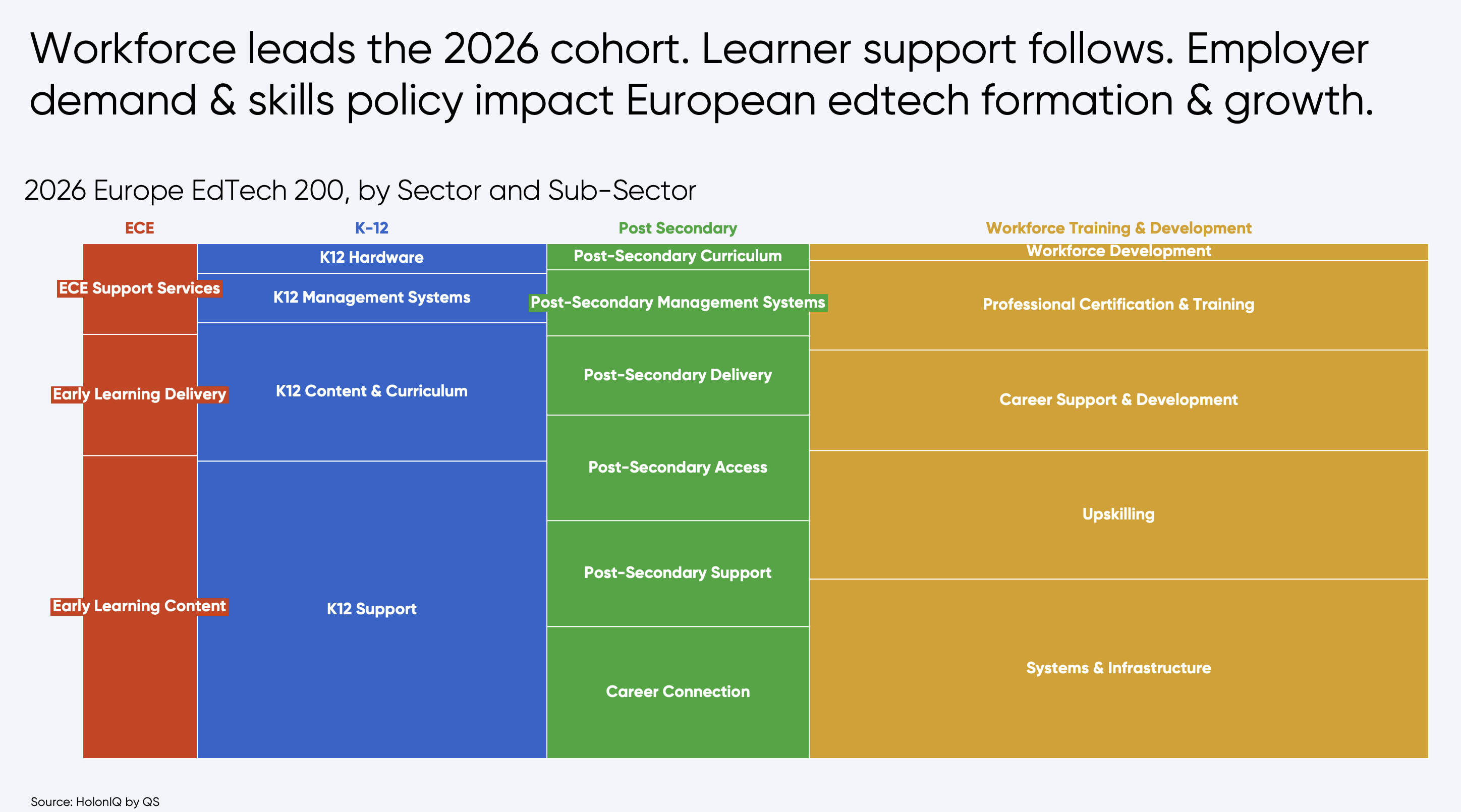
Workforce anchors the 2026 Cohort while K–12 focuses on support, post-secondary centers on delivery, and early childhood stays narrow and stable.
Workforce training and development accounts for nearly half the cohort, a reflection of macro conditions. Across the UK and Europe, policy attention to skills gaps, career-aligned learning, and workforce productivity has made workforce training edtech a priority for employers, governments, and investors alike. The cohort mirrors that pressure: platforms like Synthesia (who announced a 200M deal late 2025) and NOLEJ AI, address how organisations create and deploy learning content, while More Happi and Spotted Zebra focus on the coaching and assessment solutions that reflect employment outcomes.
K–12 represents just over a quarter of the cohort and concentrates around support and content rather than infrastructure. Tutoring and student learning platforms including MyEdSpace and Evulpo gain traction by supporting schools and students directly, while curriculum providers such as 8billionideas address specific life skills learning gaps without asking institutions to restructure academics.
Post-secondary accounts for 20% and concentrates around alternative delivery, career connection, and management systems with solutions such as Tomorrow University and ThePowerMBA , representing newer models of credentialed degrees. CareerOS and Virtual Internships address the gap between qualification and employment that institutions across Europe are under increasing pressure to close.
Early childhood makes up around 8% of the list and remains tightly focused. CatnClever applies gamified approaches to preschool development. The segment is small but consistent, and solutions here are narrowly defined and directly consumer-facing.
Exhibit 2. 2026 Europe EdTech 200, by sector and sub-sector
No items found.
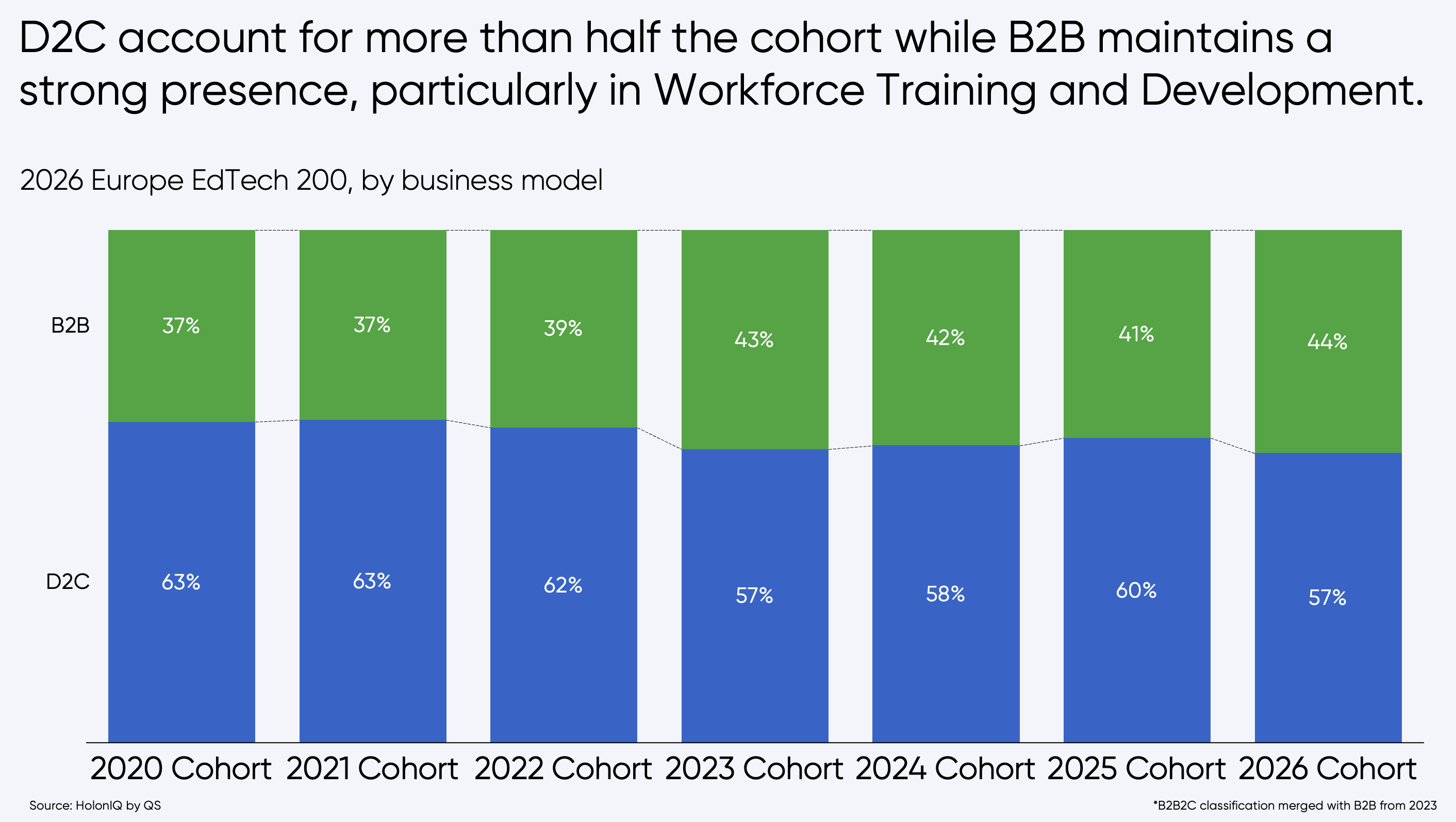
Direct-to-consumer models account for half the cohort, but B2B remains structurally strong, especially for Workforce Training and Development.
Business model distribution in the 2026 cohort splits roughly evenly, with D2C models accounting for over half and B2B with 44%. The pattern holds by sector: workforce skews more B2B, early childhood stays heavily consumer, and K–12 and post-secondary sit between.
The trajectory tells a clearer story. D2C share peaked at over 60% in the early 2020s before a sustained correction through 2023–2025. The 2026 cohort continues that stability. Europe's workforce sector is the steadiest it has been since the indexing began, and workforce-heavy cohorts correlate historically with stronger B2B representation. Expect companies that sell to institutions and employers to remain steady for this region.
Exhibit 3. 2026 Europe EdTech 200, by business model
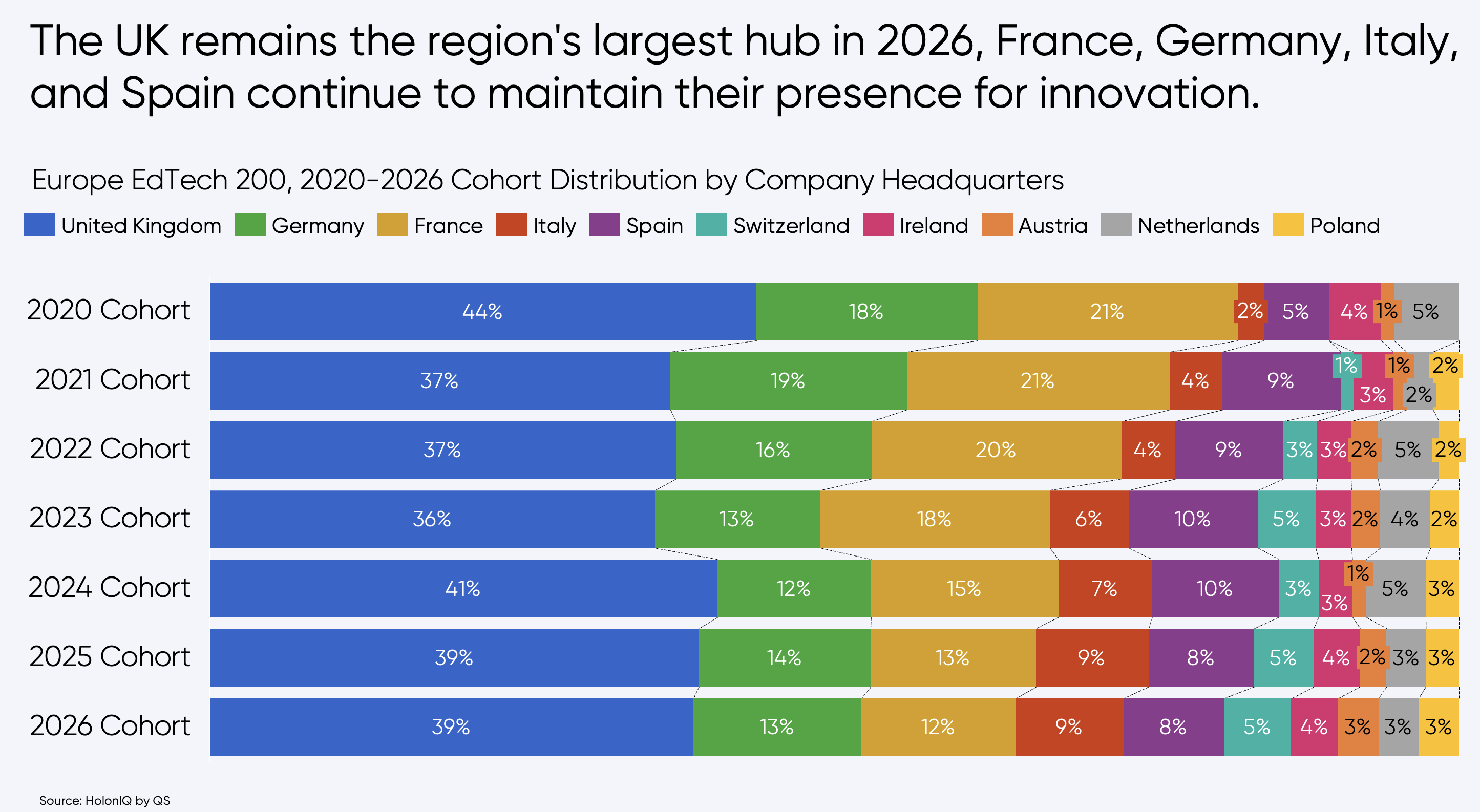
The UK holds its position as the single largest hub, but France, Germany, Italy and Spain continue to strengthen as innovation centres.
The United Kingdom accounts for 39% of the 2026 cohort, still the largest national concentration, but no longer dominant in the way it was in the early years of these lists. UK companies appear across every major sector.
Germany at 13% and France at 12% hold second and third place for regional hubs. Together with the UK, the three leading markets account for 64% of the cohort. Notable French companies include EMMA, an AI language tutor, Klara, an employee coaching and mentoring platform , Edflex, an employment training platform. Germany has strong representation from Seven Education, a school communications platform, Edurino, a solution for early learners, and Tomorrow University, among others.
Italy and Spain together account for 17% of the cohort, and Switzerland warrants particular note: with 5% of the cohort relative to its market size, companies including Evulpo, Scholé, and Univerbal signal a concentrated, high-quality startup cluster. With more countries contributing to the cohort over the years, it’s genuinely becoming a pan-European ecosystem that was less visible five years ago.
Exhibit 4. Europe EdTech 200, 2020-2026. Cohort distribution by company headquarters
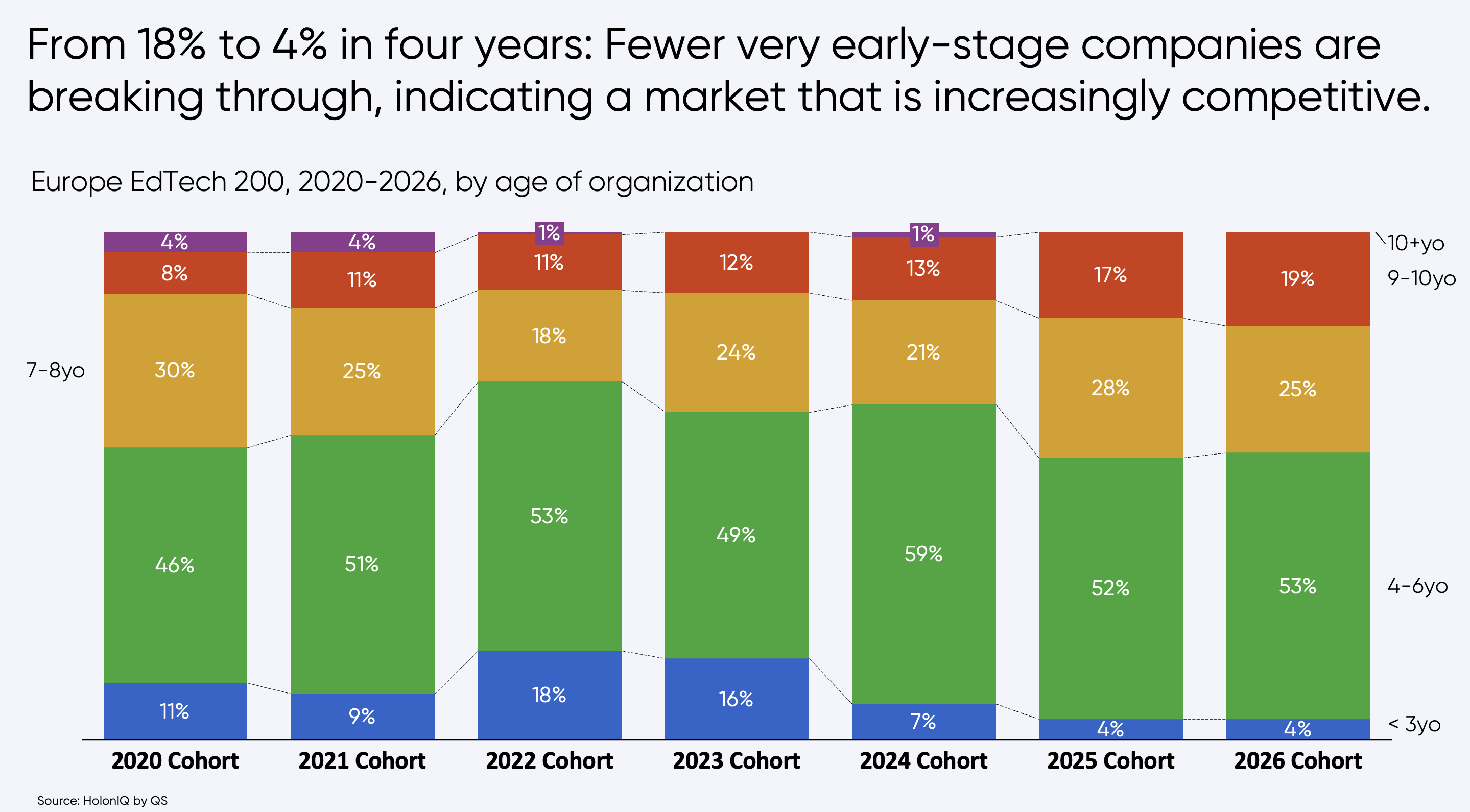
The 2026 cohort concentrates in the 4-to-6-year range, with the earliest-stage companies now a small minority.
Companies aged four to six years account for 53% of the cohort, the largest single band and consistent with prior years. These companies are far enough along to show real traction and institutional fit, but still early in their market trajectory. The European EdTech 200 has tracked this band as the centre of mass since 2020; the 2026 cohort maintains that pattern.
The very youngest companies—under three years old—account for just 4% of the list, continuing a decline from a peak in 2023. Scholé ($3M, January 2026) and Graddus ($685K, March 2026) illustrate the type: narrowly focused, technically sharp, and already demonstrating early traction. Their presence reflects a new wave of AI-native products entering the market, but the overall cohort rewards demonstrated adoption over early ambition.
At the upper end, companies aged nine to ten years account for 19% of the cohort, a slight increase on prior years. Continued presence on the list signals sustained relevance, not just longevity.
Exhibit 5. Europe EdTech 200, 2020-2026. Cohort distribution company age.
The 2026 Europe Edtech 200 reflects a market that is active, geographically distributed, and built value innovation for practical use cases. Workforce development anchors the cohort, shaped by macro pressures that are unlikely to ease. Across K–12, post-secondary, and early learning, products gaining traction that align with demand and clear learner behaviour. The regional map is broadening for EdTech innovation: Europe's EdTech market is earning its global weight.
Track the 2026 Cohort
HolonIQ customers can track the data for the most promising EdTech startups in the region on the HolonIQ Intelligence Platform. Look for the 2026 Europe EdTech 200 list and double click into the data behind the charts. Request a Demo if you are not a customer and would like to learn more.
Deep Dive the List
Customers can deep dive data behind the 2026 EdTech 200. Request a demo to learn more.
We provide you with relevant and up-to-date insights on the global impact economy. Choose out of our newsletters and you will find trending topics in your inbox.



.png)



.png)