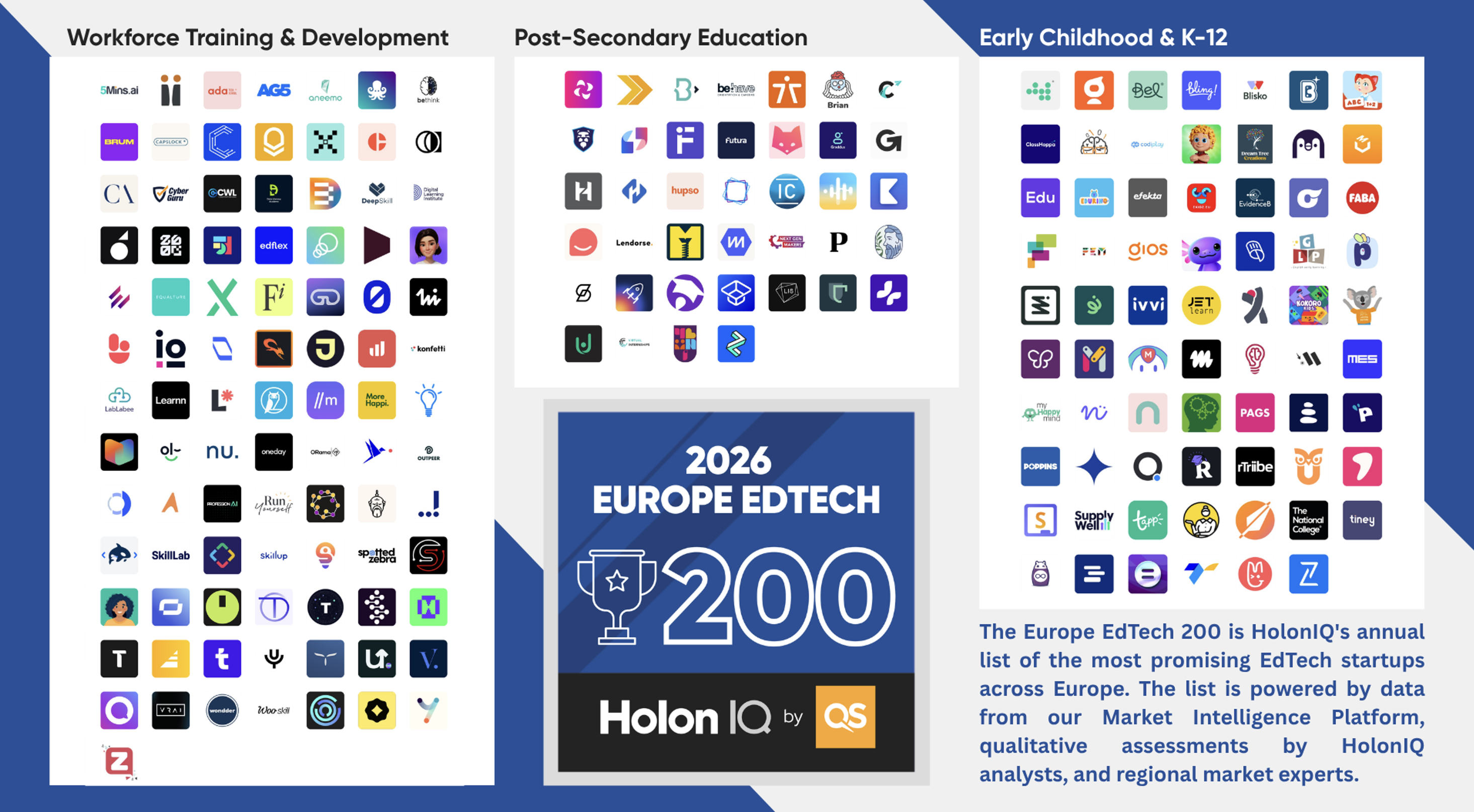
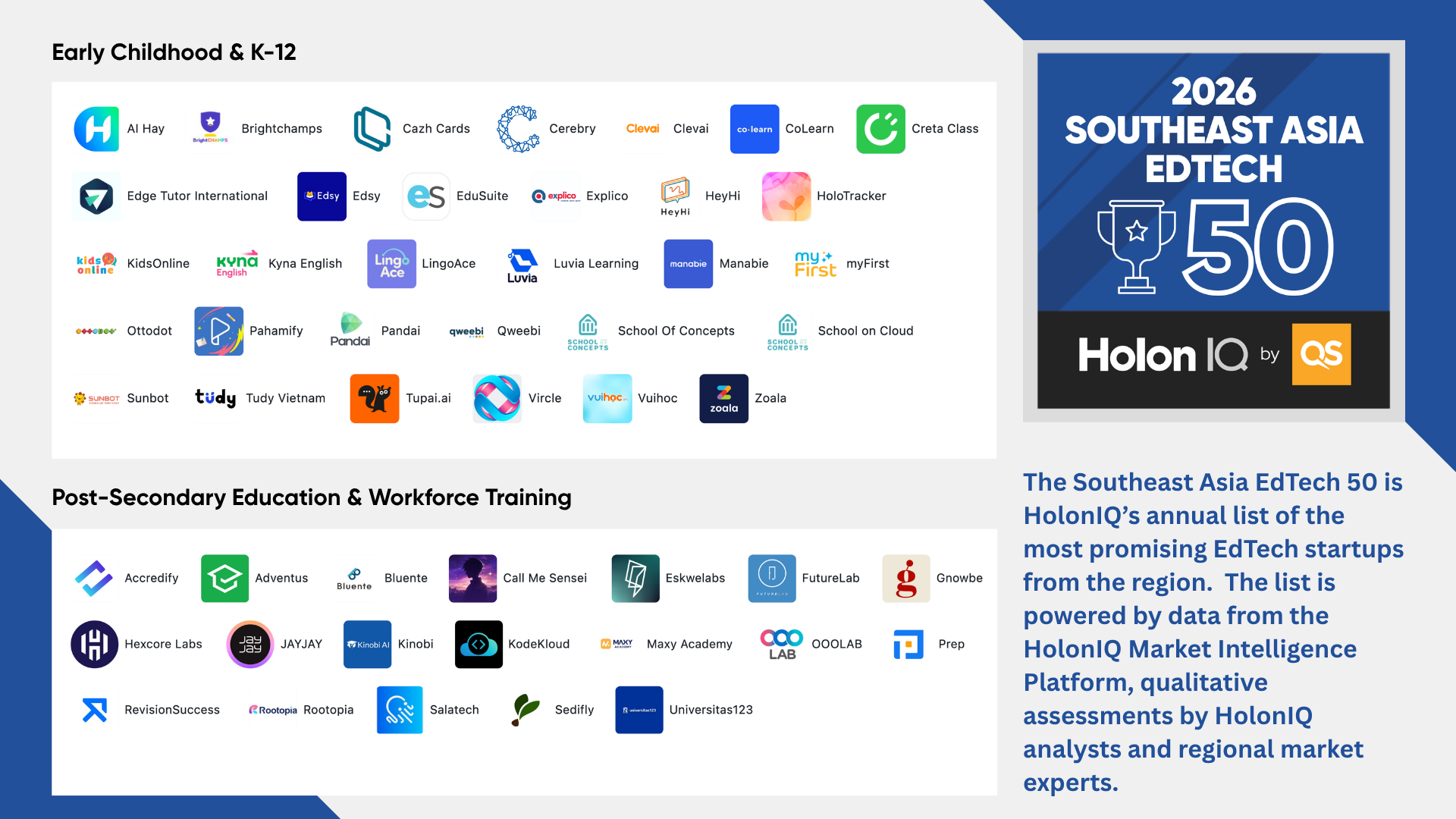
The Southeast Asia EdTech 50 is HolonIQ's annual list of the most promising EdTech startups from the region.
The Southeast Asia EdTech 50 is focused on identifying fast growing and innovative learning, teaching and up-skilling startups from across Southeast Asia. Powered by data and insights from the HolonIQ Impact Intelligence Platform together with qualitative assessments by HolonIQ’s Intelligence Unit, and local market experts in each region, organizations are evaluated and scored based on our eligibility and assessment criteria.
The Southeast Asia EdTech 50 is aligned to the Global Learning Landscape, an Open-Source Taxonomy that maps the education and talent market
Exhibit 2
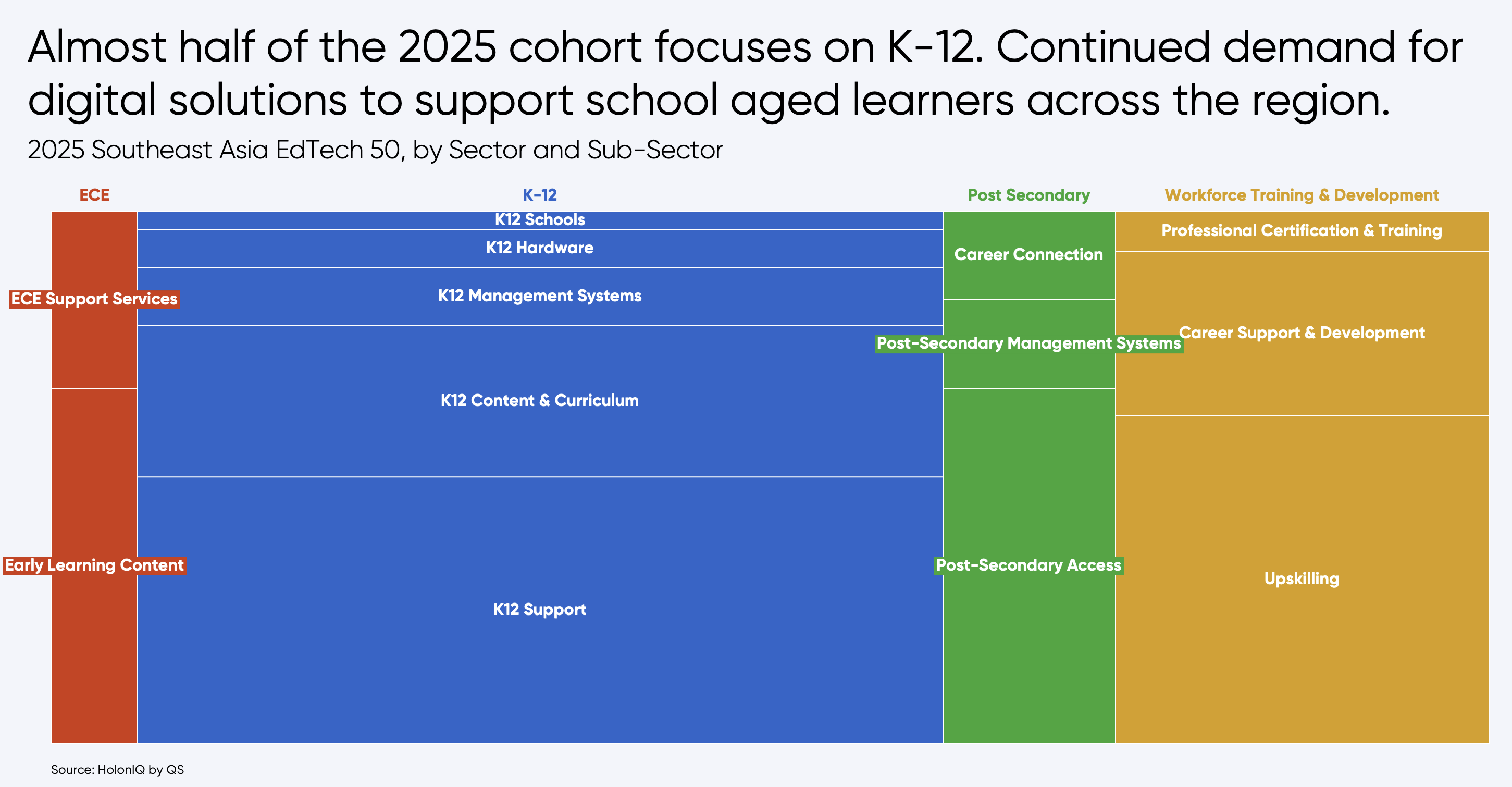
K–12 leads Southeast Asia’s 2025 cohort, driven by digital learning and school support.
K–12 accounts for almost half of the 2025 Southeast Asia cohort, reflecting sustained demand for learner-facing platforms and classroom digitalization across the region. Workforce and skills solutions maintain a steady share of around one-third, while post-secondary representation has eased slightly to about 16%. Within K–12, support platforms such as CoLearn and Explico have gained traction, signaling a shift toward richer learner experiences and more personalized learning. In post-secondary, platforms like Emeritus illustrate the region’s growing focus on bridging education and employment. Overall, the 2025 cohort reflects an ecosystem centered on foundational learning, economic mobility, and scalable learner support.
Exhibit 3
Ready to get started?
Get a personalized walkthrough of HolonIQ's Global Intelligence Platform.
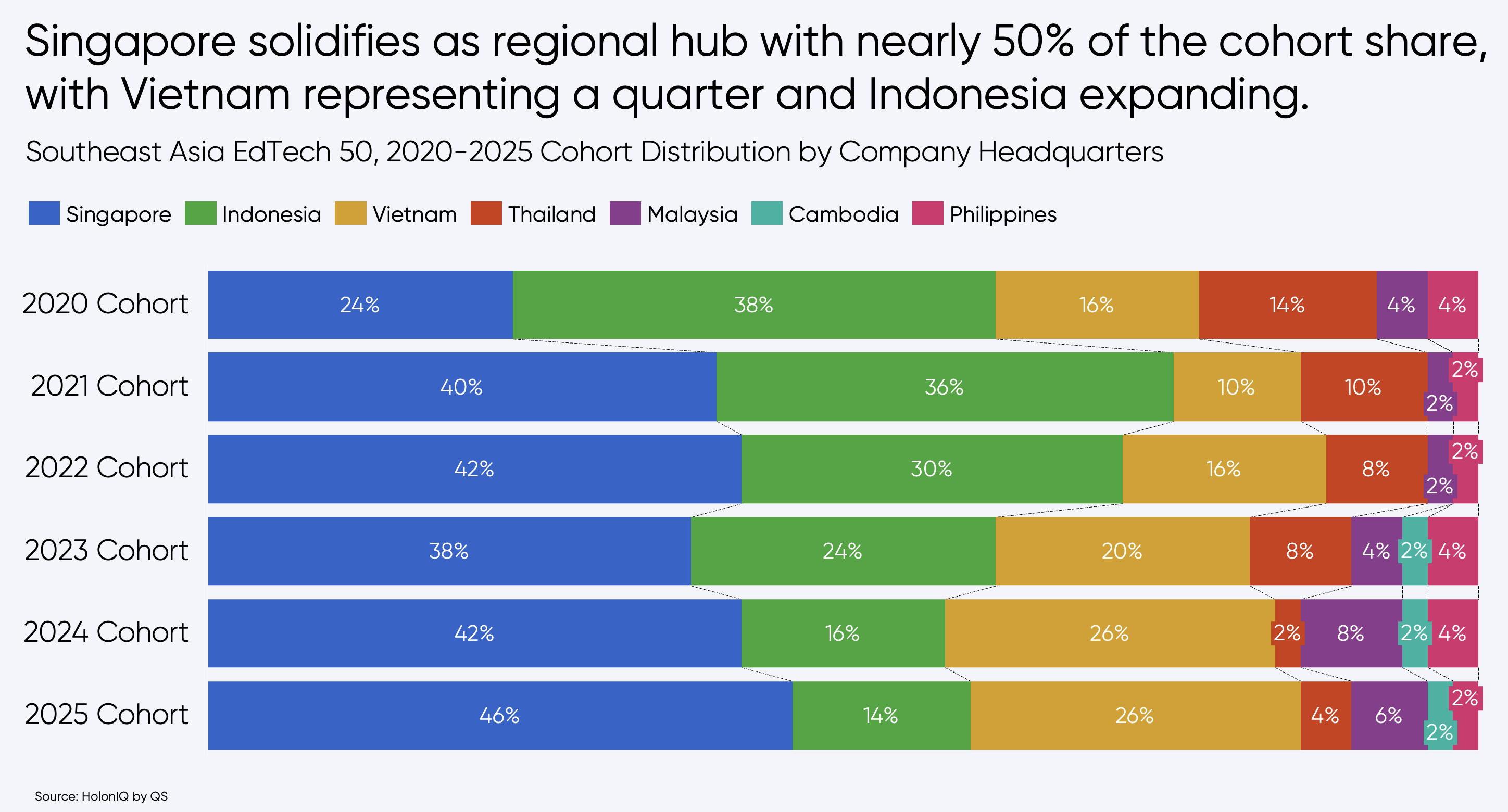
Singapore retains leadership as Southeast Asia’s EdTech hub.
Singapore continues to anchor the region’s startup ecosystem, accounting for nearly half of the 2025 Southeast Asia EdTech 50. The city-state remains a strategic headquarters location for startups expanding regionally. Vietnam and Indonesia follow as key markets for innovation together grabbing around 40%, each maintaining strong representation through K-12 platforms and emerging workforce models. Thailand, while smaller in share, continues to demonstrate increasing startup activity, particularly in language learning and corporate training, underscoring its rising role in the regional EdTech landscape. Companies such as Cialfo illustrate Singapore’s pathway innovation , while Jay Jay in Indonesia reflects the appetite for innovative workforce solutions. The geographic mix highlights Southeast Asia’s distributed growth model, Singapore as a hub, with Vietnam, Indonesia, and Thailand as vibrant local markets driving regional momentum.
Exhibit 4
Direct-to-Consumer models dominate as institutional adoption steadies.
Direct-to-consumer (D2C) models represent about 70% of the 2025 cohort, a modest increase from last year, underscoring sustained regional appetite for consumer-facing products. Institutional (B2B) solutions remain stable at roughly a quarter, reflecting steady adoption among schools and universities rather than rapid expansion. The persistence of consumer-led models indicates Southeast Asia’s large addressable learner base, while the consistent B2B presence points to gradual digital integration in formal education systems.
Exhibit 5
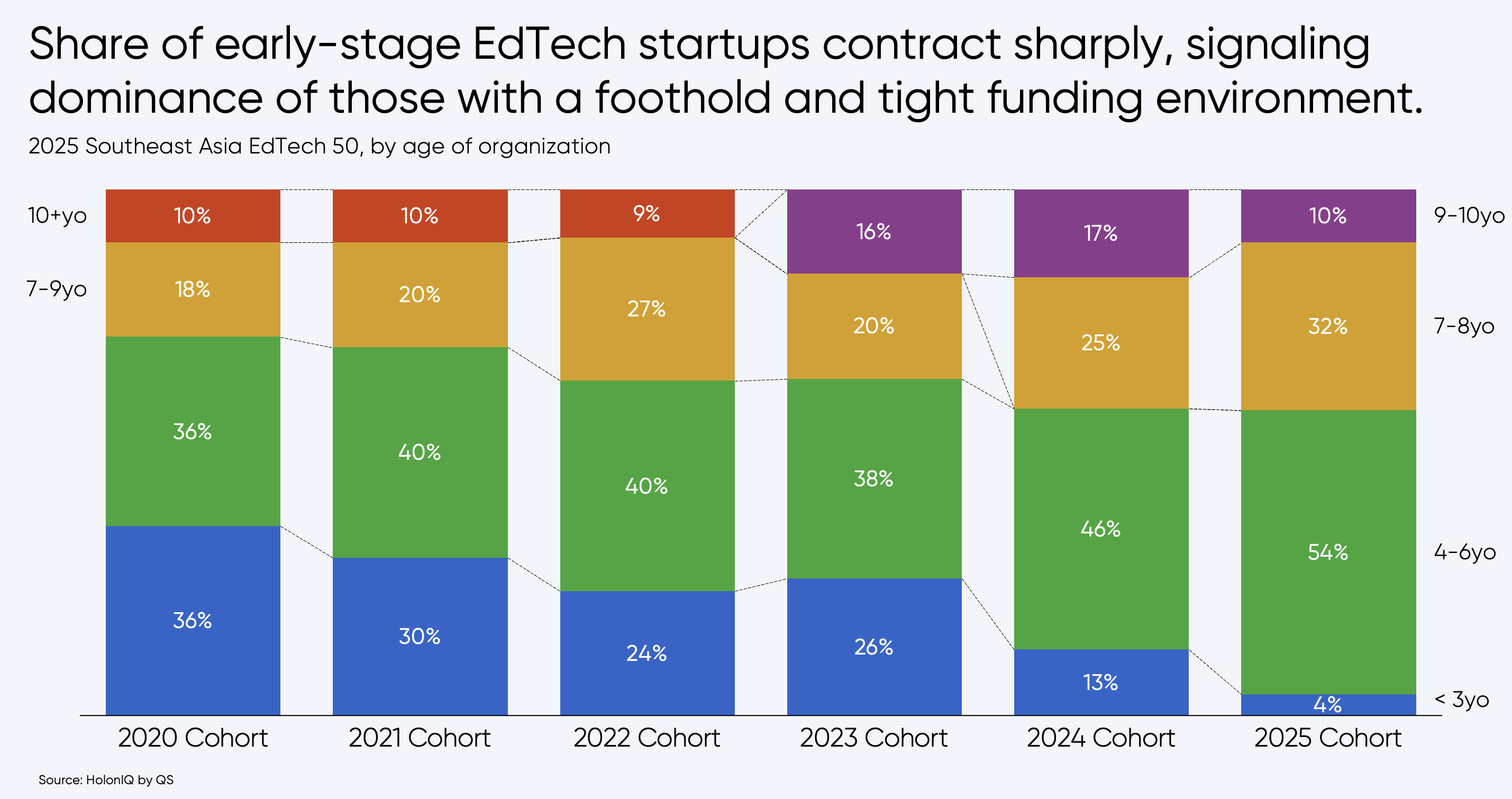
Mid-stage companies drive maturity and market depth while early-stage EdTech struggle for a foothold.
The 2025 cohort shows a maturing age profile, with over half of companies in the 4–6 year range and only 4% classified as early-stage (0–3 years old). This structure underscores an operational maturity within the region’s EdTech landscape. Mid-stage companies, including Al Hay and Manabie, both raised capital this year, illustrating the trend toward scale and traction. The scarcity of very young startups suggests a stable market focused on expansion and proven models rather than early experimentation.
Exhibit 6
Track the 2025 Cohort
HolonIQ customers can track the data for the most promising EdTech startups in the region on the HolonIQ Intelligence Platform. Look for the 2025 Southeast Asia EdTech 50 list and double click into the data behind the charts. Request a Demo if you are not a customer and would like to learn more.
Deep Dive the List
Customers can deep dive the open-source list on the platform. Request a demo to learn more.
We provide you with relevant and up-to-date insights on the global impact economy. Choose out of our newsletters and you will find trending topics in your inbox.


.png)



.png)


.png)