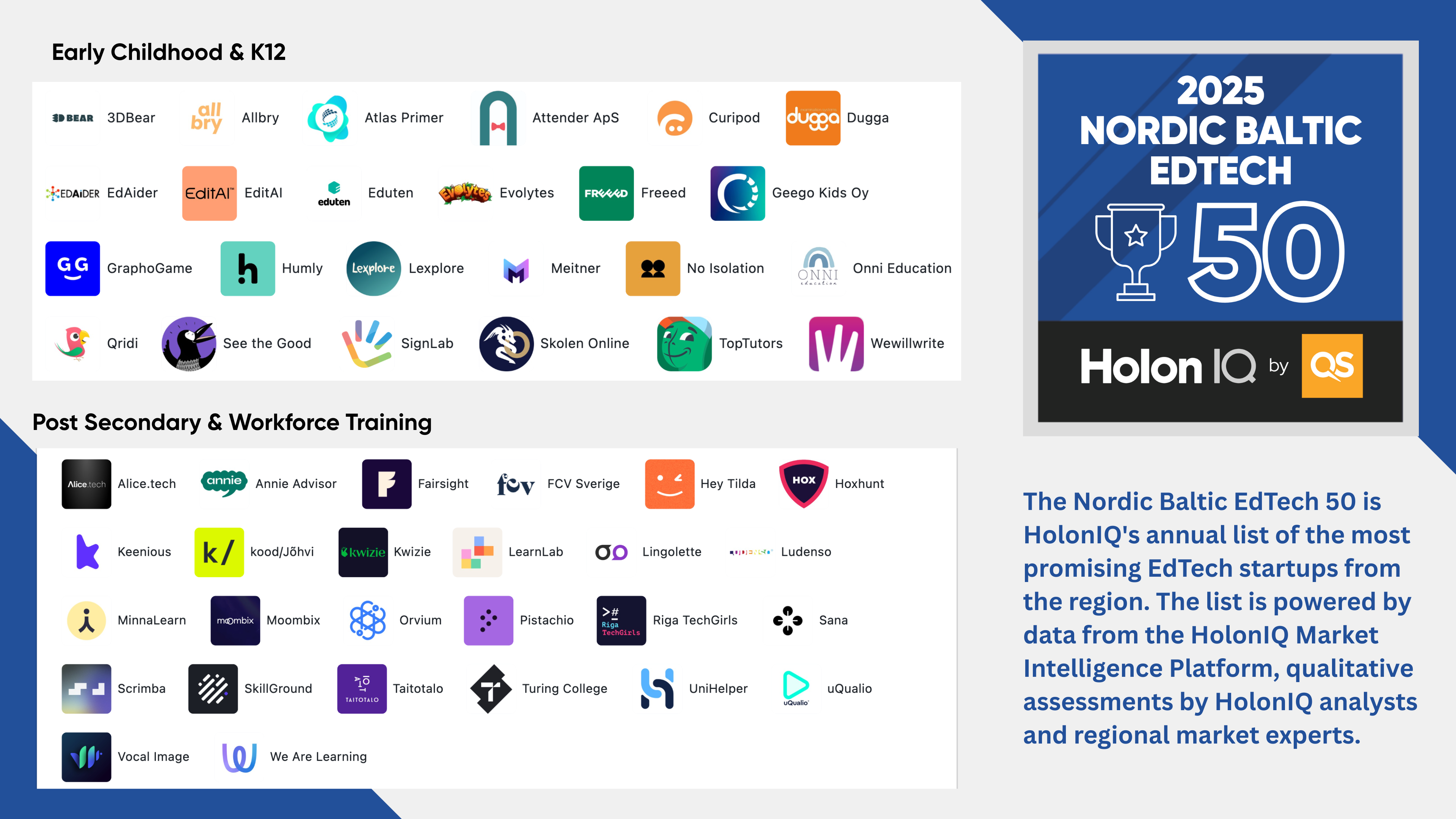
The Nordic Baltic EdTech 50 is HolonIQ's annual list of the most promising EdTech startups from the region.
The Nordic Baltic EdTech 50 is focused on identifying young, fast growing and innovative learning, teaching and up-skilling startups from the region. Powered by data and insights from our Impact Intelligence Platform together with qualitative assessments by HolonIQ’s Intelligence Unit and local market experts, organizations are evaluated and scored based on our eligibility and assessment criteria, which excludes EdTech's founded over 10 years ago, or those which have exited (listed, acquired or controlled by another organisation). See the 2025 Europe EdTech 200 for full Europe coverage.
The Nordic Baltic EdTech 50 is aligned to the Global Learning Landscape, an Open-Source Taxonomy that maps the education and talent market
Exhibit 2
K12 holds share but continues to decline as workforce learning solutions grow.
K-12 remains the largest sector, making up 44% of the 2025 cohort, but this represents its lowest share on record, down steadily from 64% in 2020. Workforce and Post-Secondary are capturing more attention, with Workforce nearly doubling its share since 2020 and Post-Secondary doubling year-on-year to reach 12% in 2025. Sweden’s Sana, an AI-powered enterprise learning platform, raised $55M this year, underscoring Workforce’s momentum, alongside Norway’s Pistachio, a cybersecurity training solution, and We Are Learning, an immersive AI authoring provider. In Post-Secondary, Norway’s Keenious, an NLP-powered research search tool, and Ludenso, an AR authoring platform for publishers, illustrate the sector’s growing role.
Subsectors diversify as Post-Secondary and Research emerge
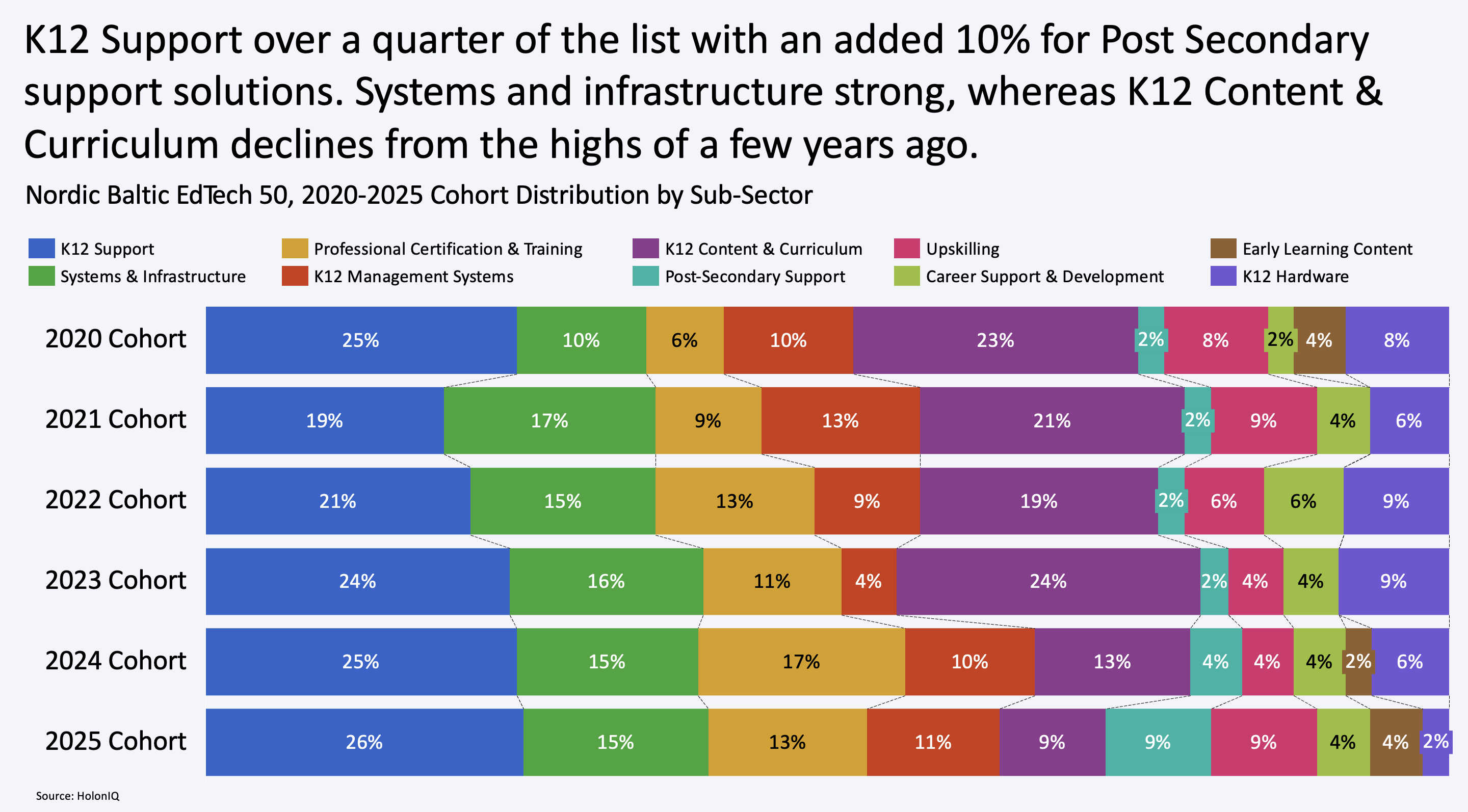
K-12 Content & Curriculum has dropped to a new low of 9%, continuing a steep decline from 24% in 2023. At the same time, Post-Secondary Support has doubled its share over the past two years, and Research has appeared for the first time with 2%. Estonia’s Orvium represents this new Research segment as a scientific publishing platform for researchers and institutions. In Post-Secondary, Annie Advisor offers student guidance chatbots from Finland. The diversification of subsectors signals a market that is maturing beyond its traditional K-12 core.
Ready to get started?
Get a personalized walkthrough of HolonIQ's Global Intelligence Platform.
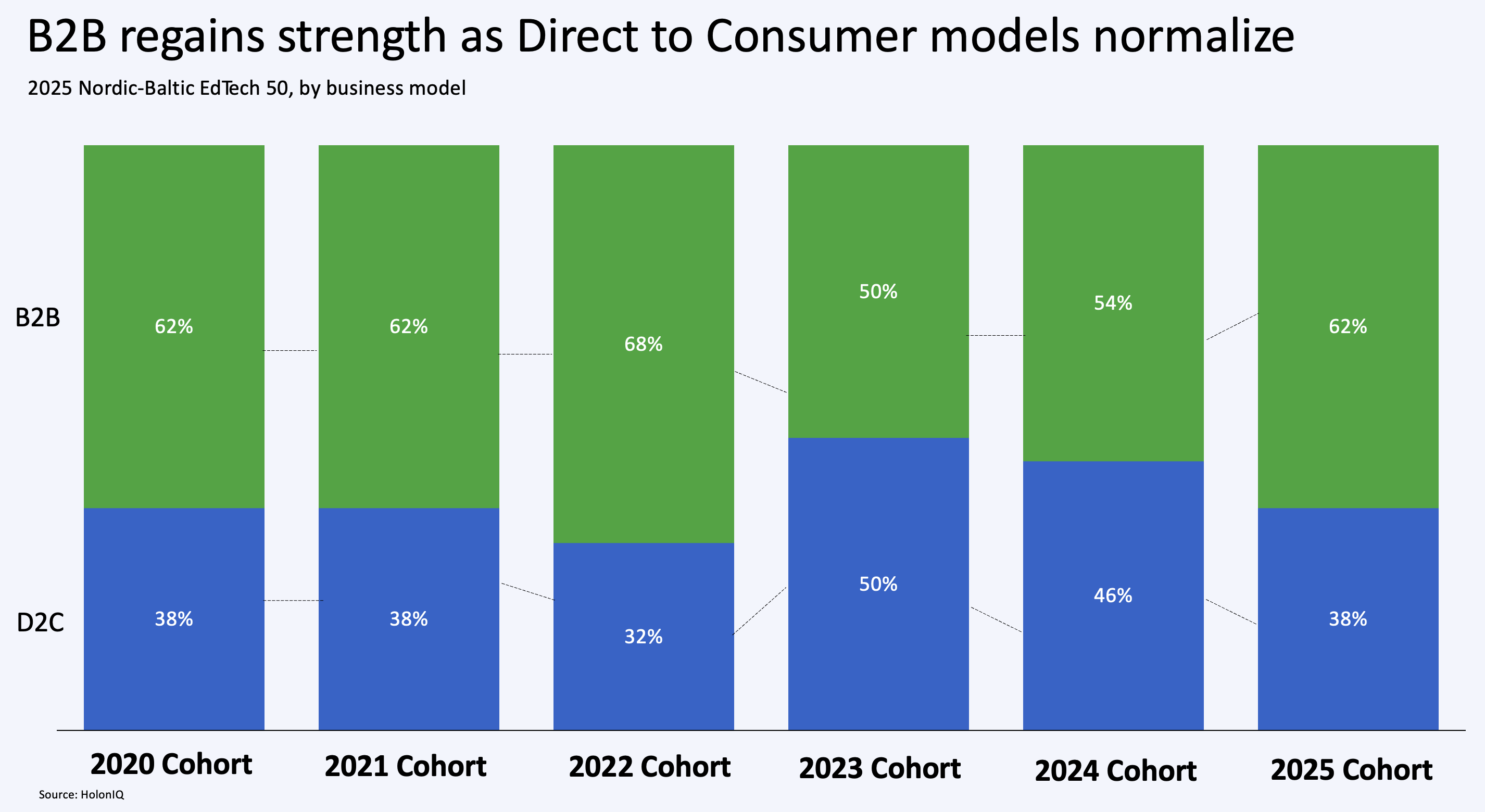
B2B business models regain strength as Direct to Consumer models normalize.
B2B companies have rebounded to 62% of the 2025 cohort, returning to their 2020–2021 levels after hitting a low in 2023. D2C models, meanwhile, have normalized at 38% after a temporary peak in 2023, likely an effect of pandemic. Workforce startups in particular are leaning into enterprise buyers, including LearnLab in Norway who is building infrastructure for employers. At the same time, D2C solutions remain visible, such as Denmark’s TopTutors, an online tutoring platform, and Iceland’s Evolytes, which provides interactive math learning. The balance suggests employers and institutions are prioritizing system solutions, while consumer demand remains strong in point solutions such as tutoring and supplemental learning.
Exhibit 3
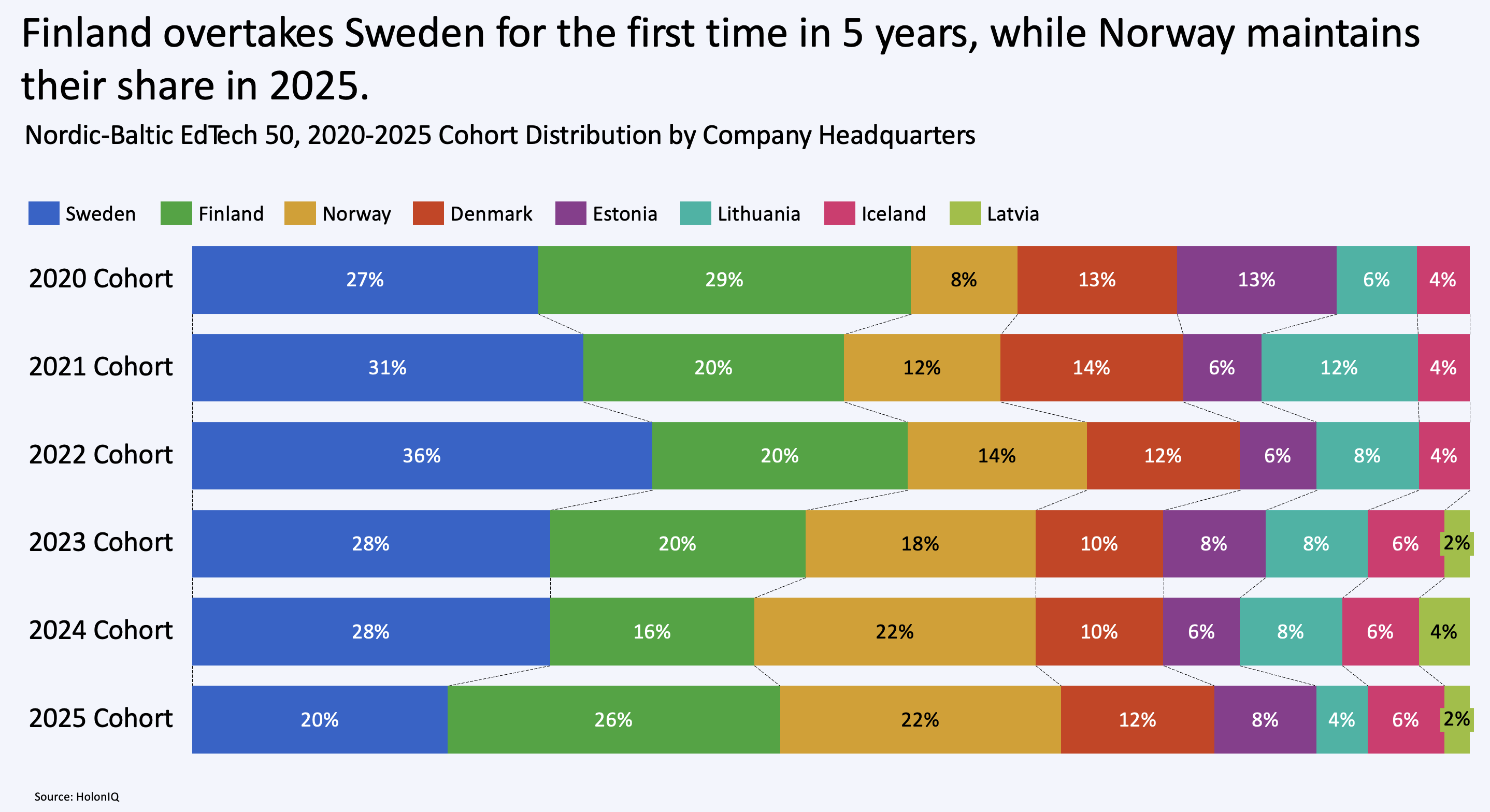
Regional balance shifts away from Sweden’s dominance.
Sweden’s share fell to 20% in 2025, its lowest since 2020, continuing a downward trend from its 36% peak in 2022. Finland rebounded strongly to 26% this year, overtaking Sweden for the first time in five years, with companies like Eduten, a digital math platform, and GraphoGame, a literacy game. Norway also maintained its highest-ever share at 22%, anchored by startups such as Scrimba, an interactive coding platform. Denmark continues to hold steady and Estonia regains ground. Lithuania saw its share halved to 4%, represented by newcomers like EditAI.
Exhibit 4
Exhibit 4
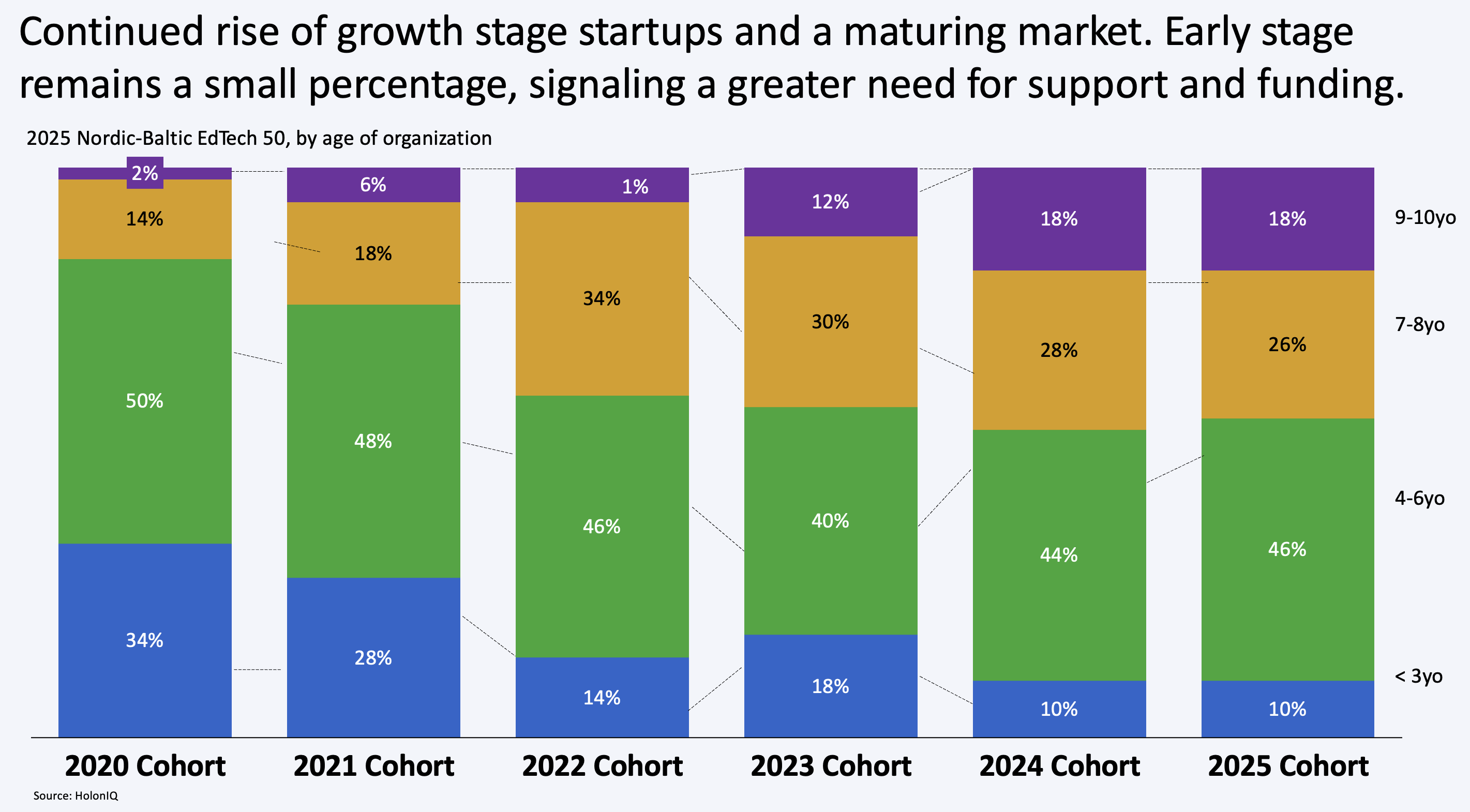
Growth stage and mature firms are strong, with less early stage startups making the cut.
The age distribution of the 2025 cohort remains relatively stable, though mature startups in the 9–10 year-old bracket continue to hold at near 20% of the cohort. Norway’s SignLab (founded 2017) and Finland’s Qridi (2015) reflect the maturity of many in the cohort, while newer entrants like Estonia’s Lingolette, a workforce language training platform founded in 2023, highlight the pipeline of young organizations despite challenging funding conditions.
Exhibit 5
Track the 2025 Cohort
HolonIQ customers can track the data for the most promising EdTech startups in the region on the HolonIQ Intelligence Platform. Look for the 2025 Nordic Baltic EdTech 50 list and double click into the data behind the charts. Request a Demo if you are not a customer and would like to learn more.
Deep Dive the List
Customers can deep dive the list on the platform. Request a demo to learn more.
We provide you with relevant and up-to-date insights on the global impact economy. Choose out of our newsletters and you will find trending topics in your inbox.



.png)


.png)