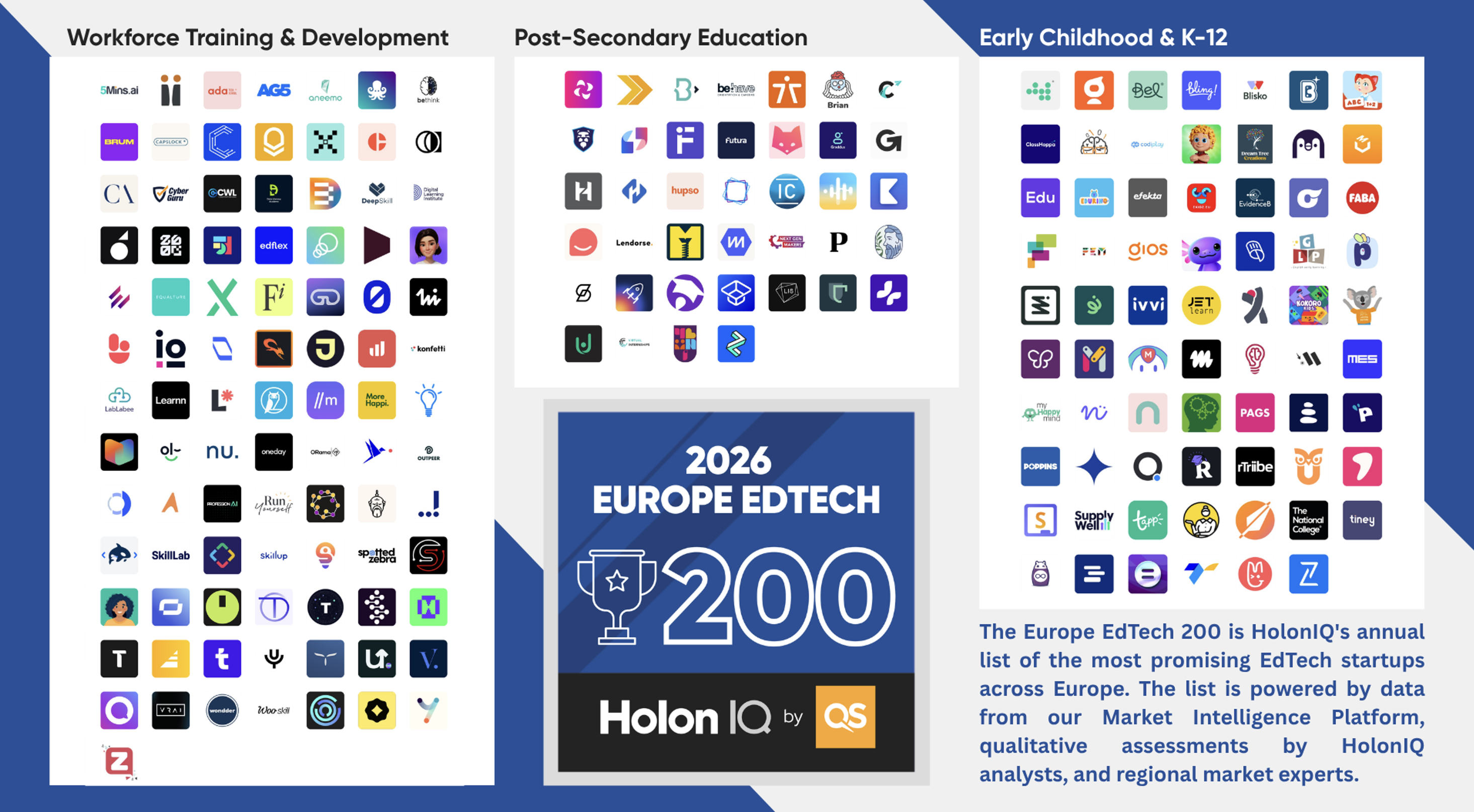
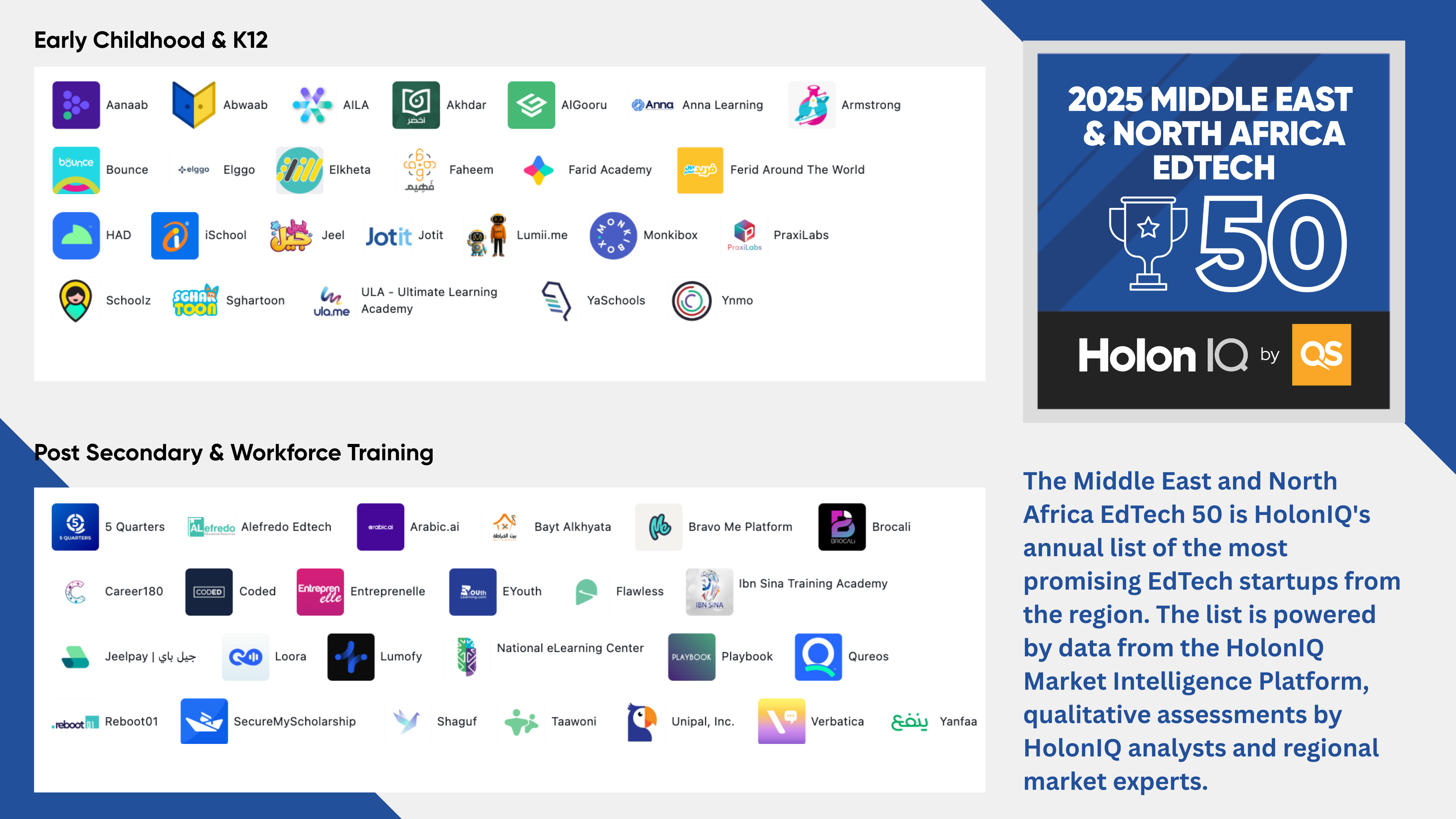
The MENA EdTech 50 is HolonIQ's annual list of the most promising EdTech startups from the region.
The Middle East & North Africa EdTech 50 is focused on identifying young, fast growing and innovative learning, teaching and up-skilling startups from the Middle East and North Africa region. Powered by data and insights from our Impact Intelligence Platform together with qualitative assessments by HolonIQ’s Intelligence Unit, and local market experts, organizations are evaluated and scored based on our eligibility and assessment criteria, which excludes EdTech's founded over 10 years ago, or those which have exited (listed, acquired or controlled by another organisation).
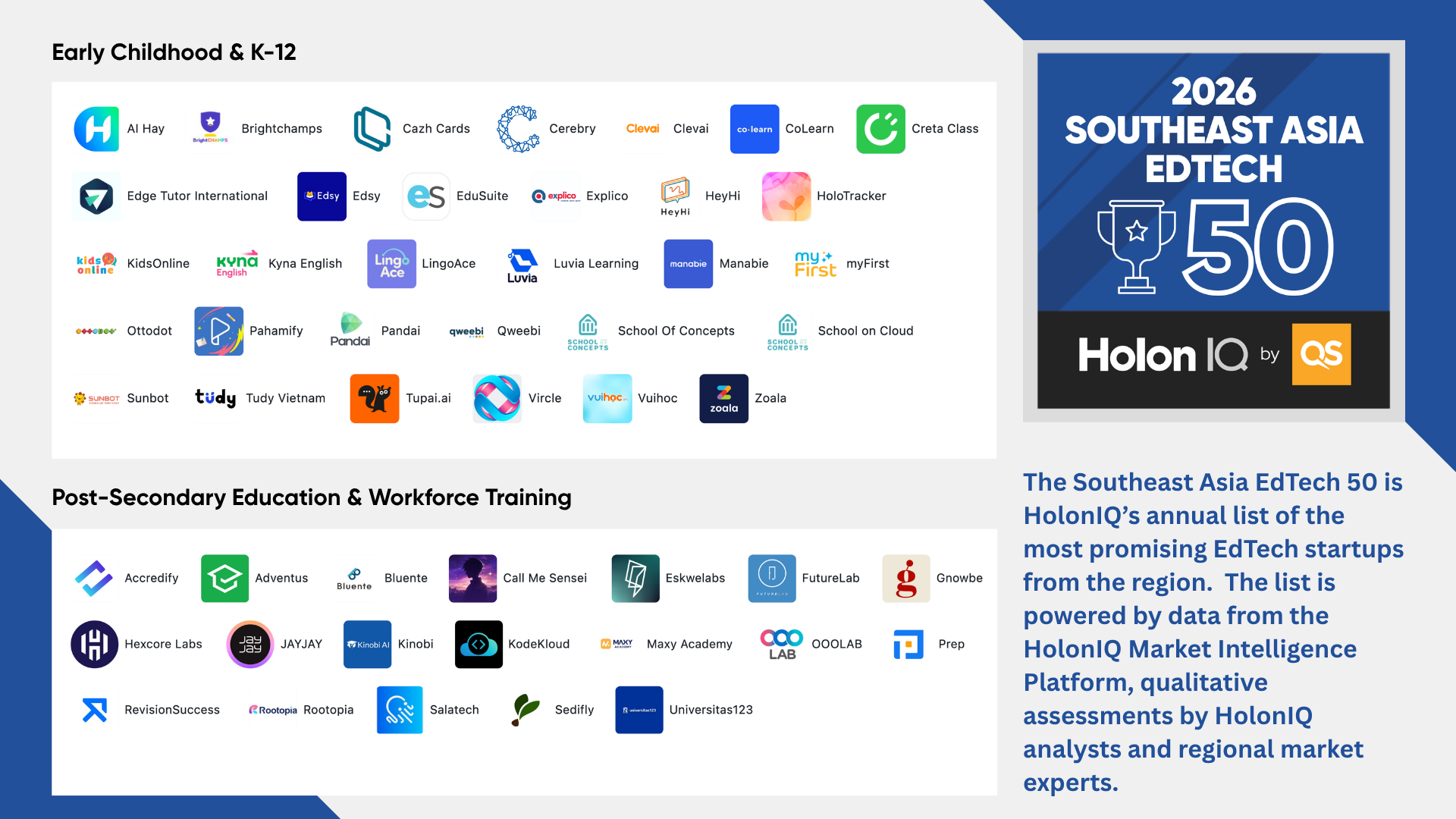
Download the Market Map. Companies are categorized by their main area of focus following the globallearninglandscape.org. Categories in the market map are not mutually exclusive.
Deep Dive the List
Customers can deep dive the open-source list on the platform. Request a demo to learn more.
The MENA EdTech 50 is aligned to the Global Learning Landscape, an Open-Source Taxonomy that maps the education and talent market
Exhibit 2
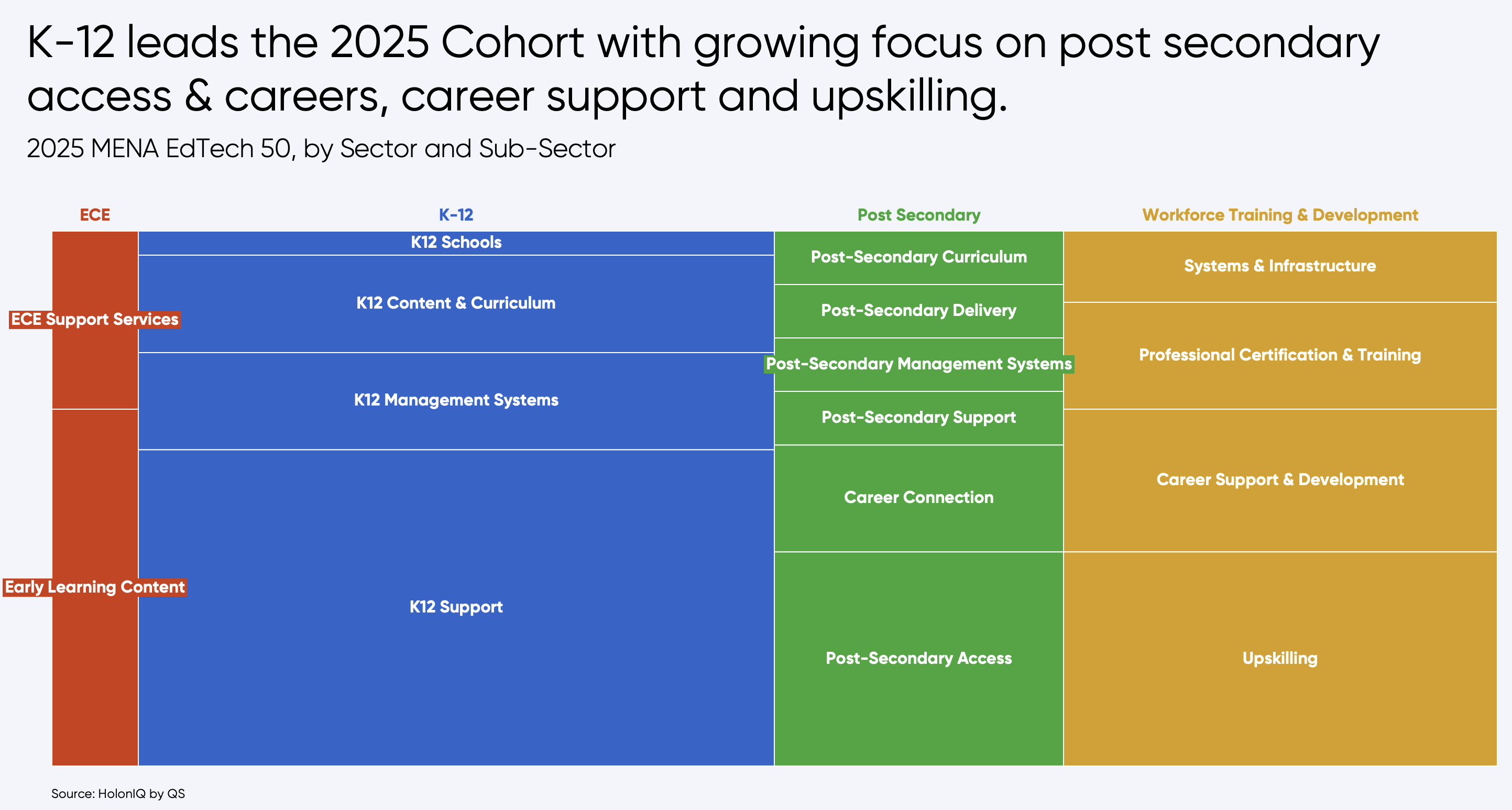
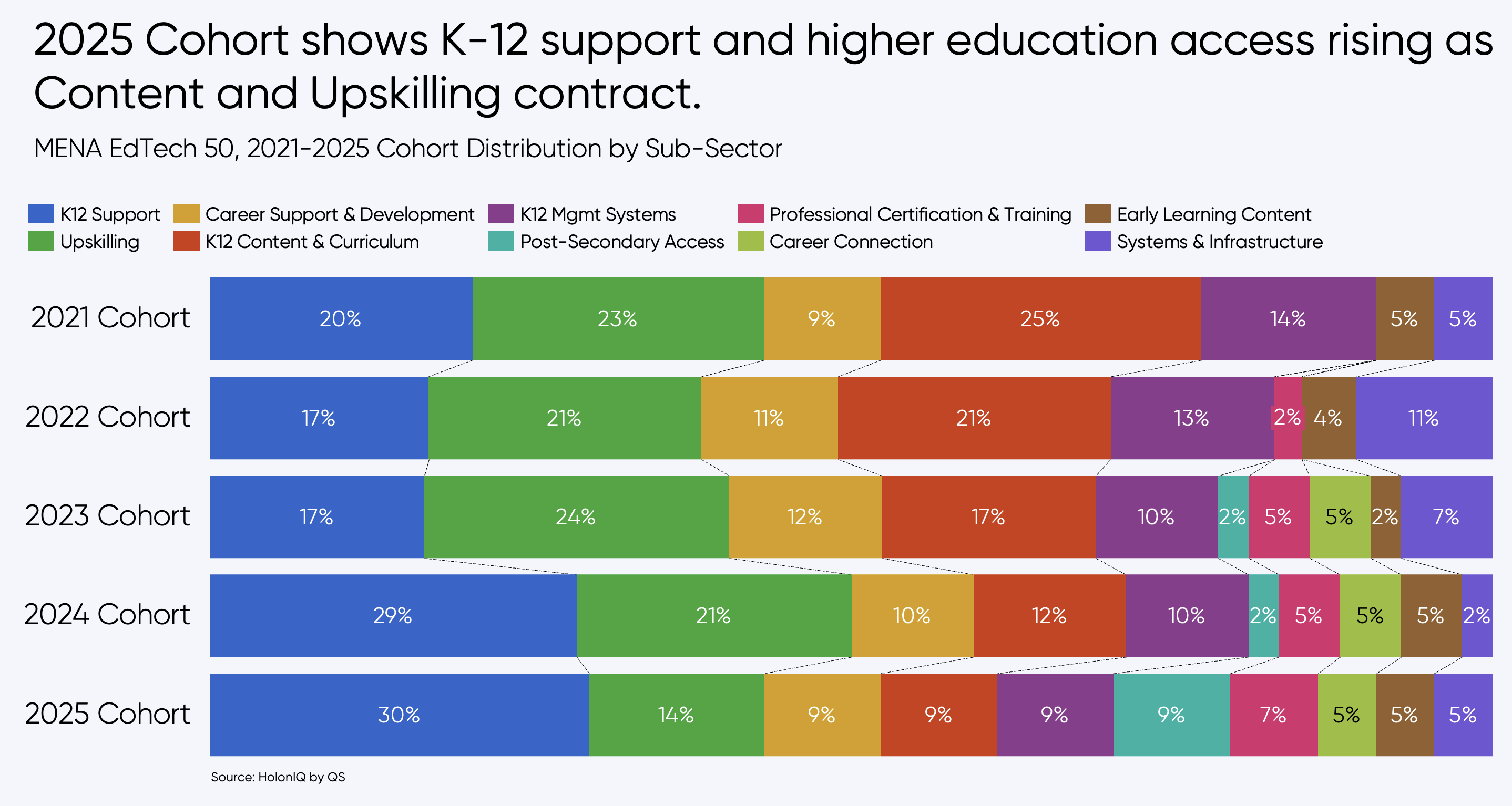
K–12 and workforce learning drive 2025’s innovation focus
K-12 education leads the 2025 cohort with a marked emphasis on support and classroom solutions. In 2025, K-12 companies make up 44% of the cohort, reflecting sustained investor and policy attention on schooling and learner-facing products across the region. While K-12 support and content remain prominent, with notable returning startups such as Abwaab, and startups focused on engagement gained investor attention (Ultimate Learning Academy ). There is meaningful growth in post-secondary access solutions (20% of the list) as startups race to remove barriers into higher education. Workforce-focused companies remain an important segment taking nearly a third of the cohort, but the composition within that sector has shifted: upskilling now accounts for a smaller share, while career services and employer-facing match and placement products have expanded. The result is a cohort where classroom modernization and access-focused post-secondary plays coexist with a newer generation of career and placement platforms.
Exhibit 3
Ready to get started?
Get a personalized walkthrough of HolonIQ's Global Intelligence Platform.
Saudi Arabia takes the lead as MENA’s EdTech powerhouse
Saudi Arabia overtakes Egypt as the single largest headquarters market in this year’s cohort, taking a third of the list compared with Egypt’s quarter and the UAE at 18%. This geographic shift reflects a combination of policy-driven demand, large-scale education programs, and growing local start-up support. Saudi-based ventures such as Taawoni demonstrate the country’s push into both post-secondary access and employer-aligned pathways. Egypt continues to give rise to innovators such as Jotit and Career180 and show how its population scale and deep talent pools keep it central to MENA innovation, while the UAE retains a vital hub role for regional expansion and scaling, demonstrated by platforms such as Qureos.
Exhibit 4
Direct-to-consumer still dominates, but B2B holds steady.
Direct-to-consumer models still dominate the cohort, but institutional models retain meaningful share. D2C platforms represent over half of the 2025 list, while B2B models account for a third. The persistence of learner- and parent-directed services shows continued demand for consumer learning experiences across MENA, yet the steady B2B share indicates ongoing institutional adoption: schools, universities, and employers are increasingly receptive to third-party edtech solutions. Examples of this institutional traction can be seen in K-12 platforms securing multi-school deployments and post-secondary access providers piloting relationships with universities.
Exhibit 5
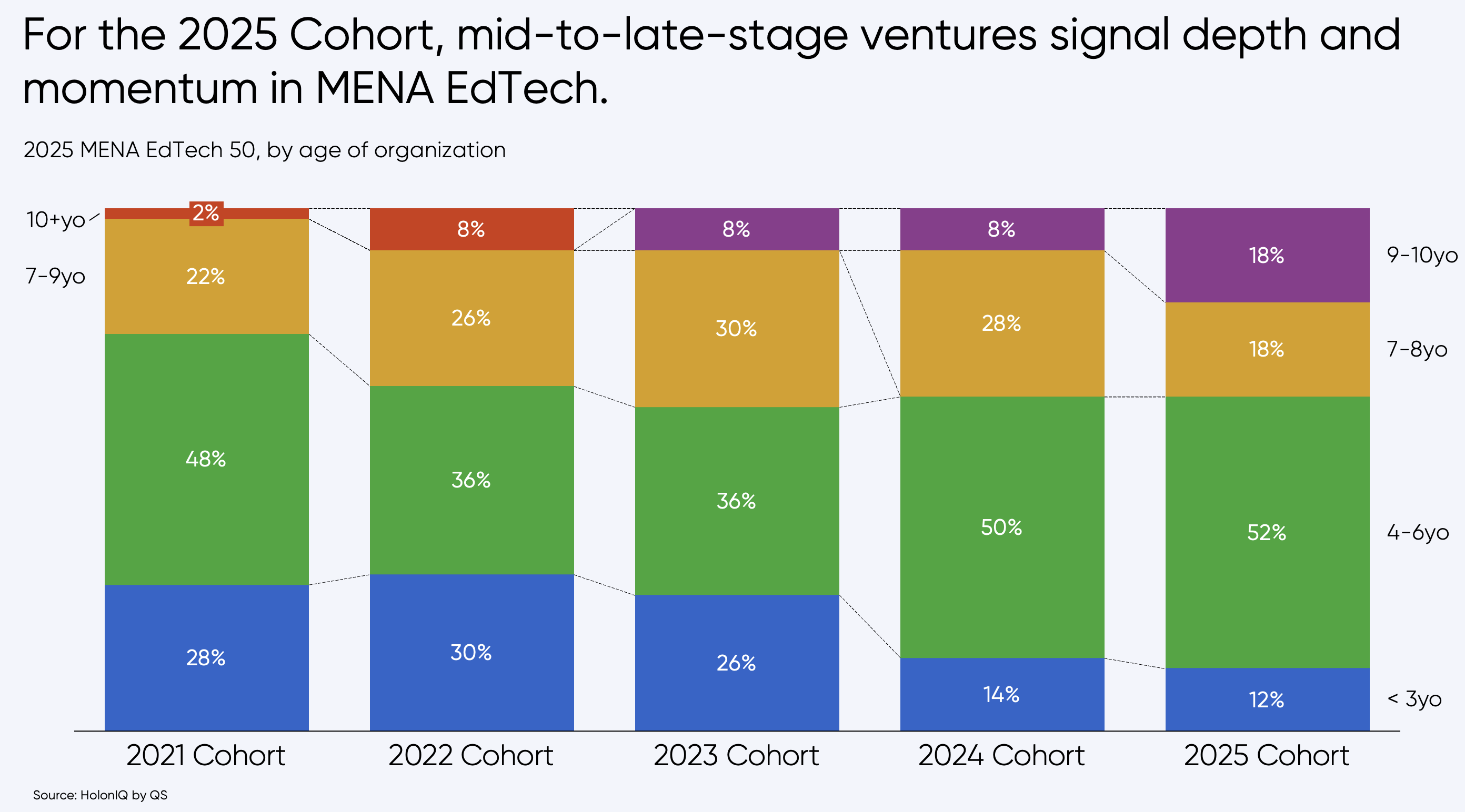
Mid-stage maturity defines 2025’s cohort profile.
The 2025 cohort reflects a balanced but maturing ecosystem. Just under half of the companies are between 4–6 years old, marking the cohort’s dominant age segment. A smaller but meaningful share is 7–8 years old, signaling continued endurance and scale among mid-stage ventures. The presence of younger startups under 3 years old highlights a steady pipeline of early innovation, though the overall distribution signals that region is rewarding mid stage, sustainable models with growing customer traction. Few companies are older than eight years, showing that regional EdTech remains relatively young but increasingly stable. Together, this profile points to a market emphasizing sustainable growth and operational maturity over rapid experimentation.
Exhibit 6
Track the 2025 Cohort
HolonIQ customers can track the data for the most promising EdTech startups in the region on the HolonIQ Intelligence Platform. Look for the 2025 Middle East & North Africa EdTech 50 list and double click into the data behind the charts. Request a Demo if you are not a customer and would like to learn more.
Deep Dive the List
Customers can deep dive the open-source list on the platform. Request a demo to learn more.
We provide you with relevant and up-to-date insights on the global impact economy. Choose out of our newsletters and you will find trending topics in your inbox.





.png)


.png)