Education venture funding reached $1.3B through Q3 2026, as 2025’s recovery to $2.6B did not hold.
Capital is still flowing into education, but more of it is going into buying existing businesses than funding new ones. Venture funding reached $1.28B in the first nine months of 2026, down 35% from the same period last year, representing the weakest venture quarter in more than a decade. Over the same nine months, announced acquisitions rose 34%, about two for every venture round. Buyers are mostly education operators and education companies themselves: nursery and school groups adding sites, and publishers and software companies buying specific capabilities, including AI tools that do a defined job.
Figure 1. EdTech Venture Capital Funding over time
No items found.
Smaller cheques, stable volume.
Every sector is down in dollars globally, and the pullback goes beyond a few missing large rounds. With rounds of $50M or more removed, total funding is still down 40%: workforce training falls 50%, K-12 about 40% and post-secondary about 25%. Early childhood is a small base, and its fall traces mainly to Animaj’s $85M round in 2025, with nothing comparable so far in 2026.
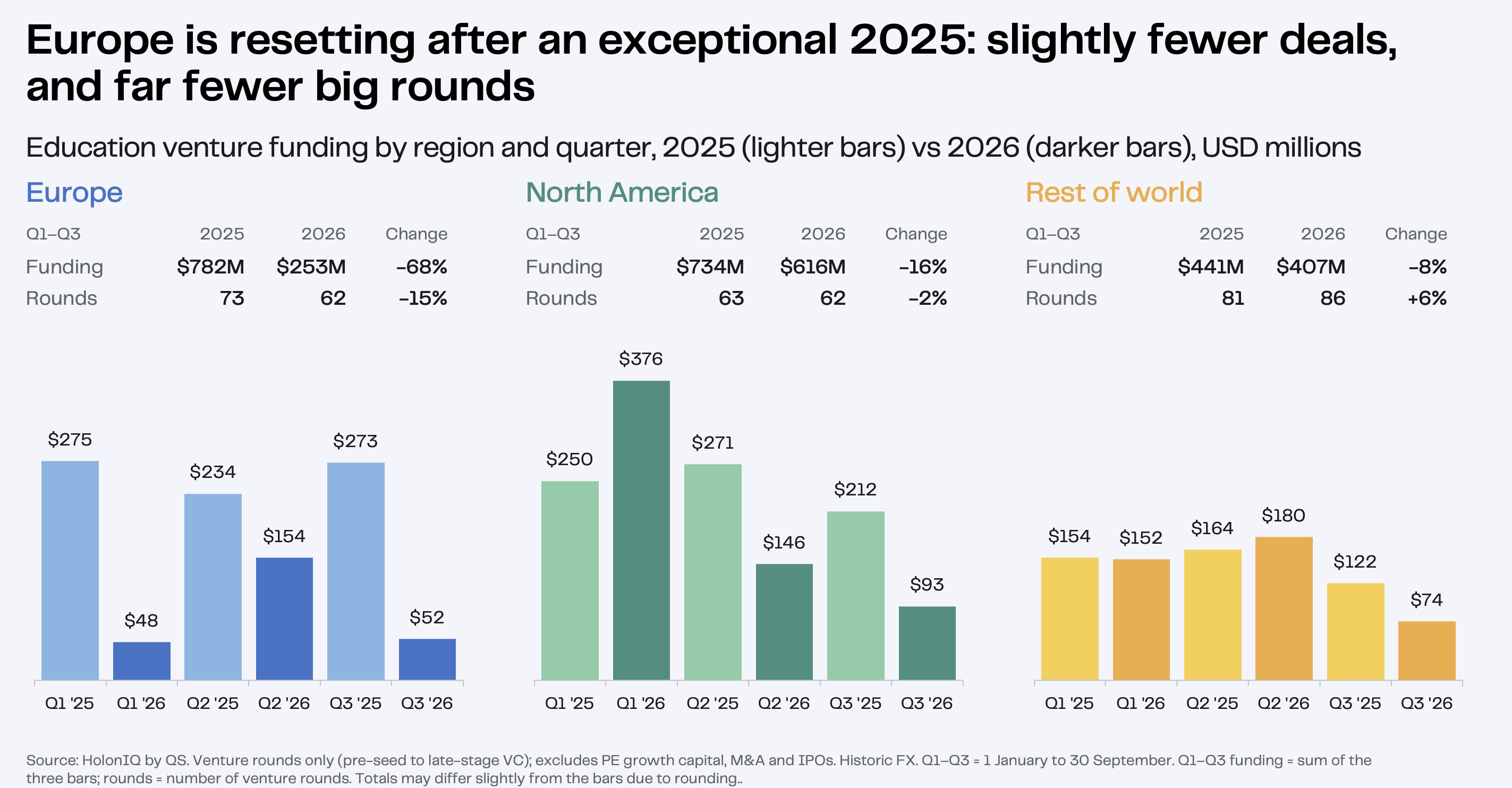
Europe had the steepest fall. European education venture funding was $253M in the first three quarters of 2026, against $782M a year earlier, down 68%. Much of that gap reflects how unusual 2025 was. Three large rounds, Synthesia ($180M), Lingokids ($120M), and Animaj ($85M), raised $385M between them, half of Europe’s total for the period. Synthesia raised again in Q4, and over the full year Europe raised $1.04B, ahead of North America ($.96B). In 2026, only one European round has passed $50M (Multiverse, $70M).
Figure 2. Education venture deals (count) by round size, share of rounds Q12025-Q32026
As in most regions, the deeper gap is in growth-stage rounds, the bigger cheques that help a proven company scale. European rounds of $5–50M fell from $330M to $125M. Early-stage funding held up: European pre-seed and seed funding rose from $61M to $98M, and the number of rounds fell only 15%. Rounds are smaller across the board, though: the typical (median) disclosed European round fell from $3.6M to $1.45M, in line with the global shift towards rounds under $5M. North America is down 16% with a flat round count, and the rest of the world is down 8% with more rounds than last year.
Figure 3. Education venture funding by region and quarter, 2025 to Q3 2026
By number of rounds, K-12 led Q3 with nearly half of all venture rounds, and K12 support alone made up a quarter, much of it the AI tutors. Upskilling came next, led by AI English tutor Loora and life-skills and writing platform Marker. Dollars tell a different story. Post-secondary took about two-fifths of Q3 funding, largely on a single round.
Education companies and operators did most of the buying in Q3 2026.
Forty per cent of education acquisitions in Q3 were by education operators: nursery groups, school groups, colleges and training providers. Examples include Kids Planet, AcadeMedia, Dukes, Kindred and Lion Cubs added sites. Education companies buying software, content or services, made up most of the rest, the majority were capability buys, such as Pearson’s purchase of Workera, McGraw Hill’s of TeachFX and Teachally, and deals by Faria, Finalsite and upGrad.
Notable categories where education companies are adding specific capabilities to the products they already sell:
Tutoring. Deal activity picked up across India, the Middle East and Latin America, including upGrad’s purchase of Unacademy.
Universities and colleges made a handful of acquisitions, mostly mergers with other institutions such as Kent and Greenwich in the UK, and Elon and Queens in the US. Private equity firms bought directly in only four deals. That understates their role: many of the most active operators, particularly nursery and school groups, are PE-backed, so much of the consolidation is PE capital working through platforms it owns.
Figure 4. Q3 2026 global education M&A by category of acquiring organisation
AI is bought for defined jobs
AI runs through this year's deals on both sides. In Q3, AI tutors drew several of the quarter's larger K-12 venture checks, including Medly AI, Wild Zebra and Aristotle. On the M&A side, incumbents are buying AI capabilities, including Quizlet, who bought AI note-taking app Coconote, one of three study tools it acquired this year. OpenAI bought Chalkie, though AI model makers have spent much of 2026 partnering with institutions or building their own education products.
AI deals clustered in institutional and classroom support, with little in content and curriculum. Grading, productivity, study help, assessment delivery and data analysis all have clear, checkable results. That may make it easier for buyers and end users to judge whether the AI works than with broad outcomes such as wellbeing or curriculum or “learning” quality. These deals are likely to show up as new AI features or product launches over the next year.
Skills and workforce: investing in AI training apps and career-connected learning delivery
Workforce drew a quarter of Q3 venture funding, $55M across 16 rounds. That is well below Q3 2025, when several rounds of $20M or more lifted the quarter. Investors put most of the money into AI-first learning apps rather than training software. Language and personal learning apps led, including AI English tutor Loora and Marker. Training platforms and authoring tools drew only three small rounds.
Workforce made up about a fifth of Q3 M&A deals, and buyers leaned toward certification, compliance and technology training businesses with established learners. Enduring Ventures bought Global Knowledge, 360training bought life-support certifier eMedCert, OpenGate Capital bought Maersk Training, and Info Edge bought coding bootcamp Coding Ninjas. Software deals were fewer and aimed at specific capabilities, as with the Pearson-Workera deal and Unstop’s purchase of AI talent assessment company PerspectAI. Activity here appears to favor training programs with proven demand, while investors keep backing AI-first learning apps.
Ready to get started?
Get a personalized walkthrough of HolonIQ's Global Intelligence Platform.
We provide you with relevant and up-to-date insights on the global impact economy. Choose out of our newsletters and you will find trending topics in your inbox.