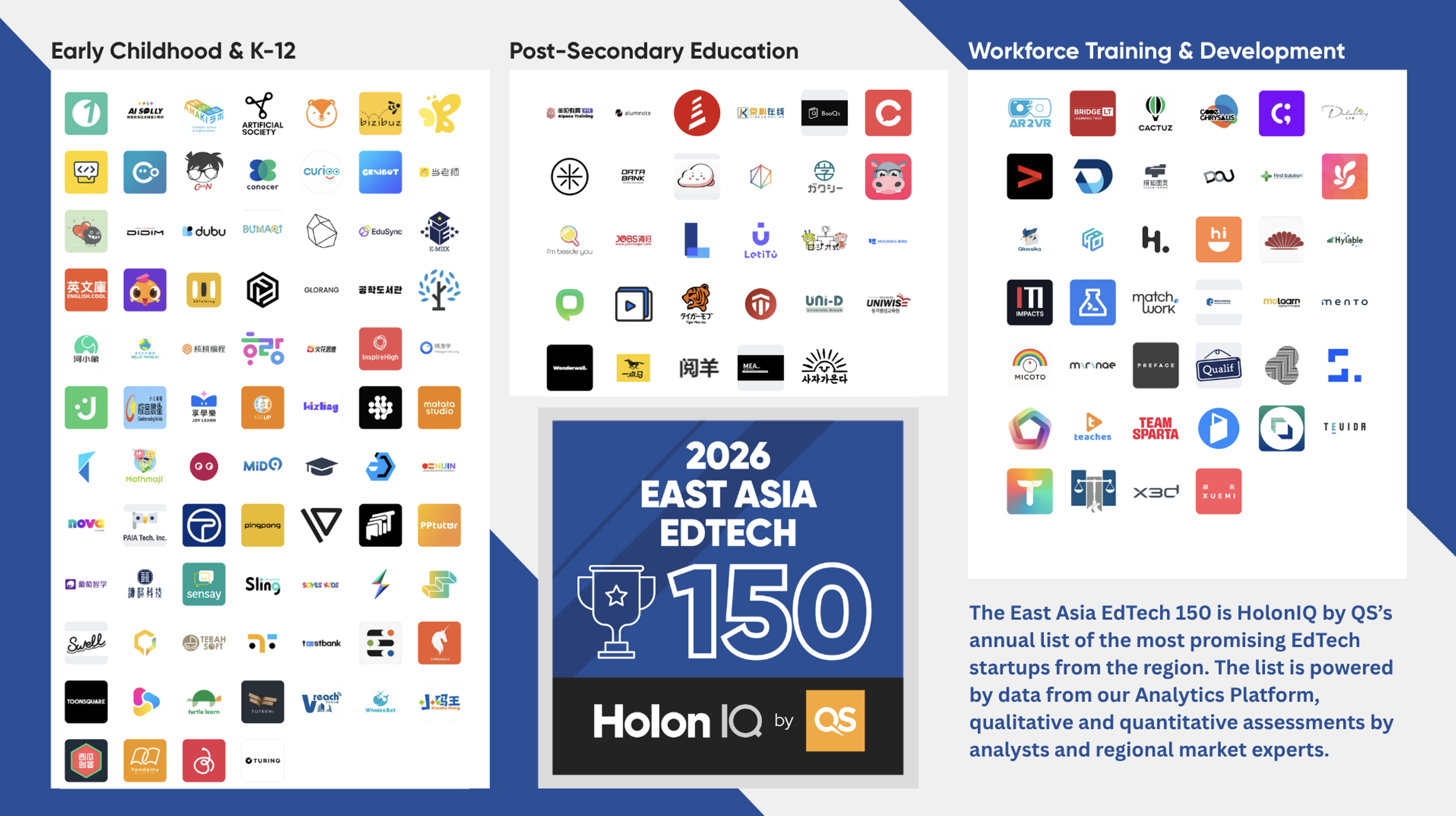
The East Asia EdTech 150 is HolonIQ's annual list of the most promising EdTech startups from the region.
The East Asia EdTech 150 is focused on identifying young, fast growing and innovative learning, teaching and up-skilling startups from greater China, South Korea and Japan. Powered by data and insights from our Impact Intelligence Platform together with qualitative assessments by HolonIQ’s Intelligence Unit, and local market experts, organizations are evaluated and scored based on our eligibility and assessment criteria, which excludes EdTech's founded over 10 years ago, or those which have exited (listed, acquired or controlled by another organisation).
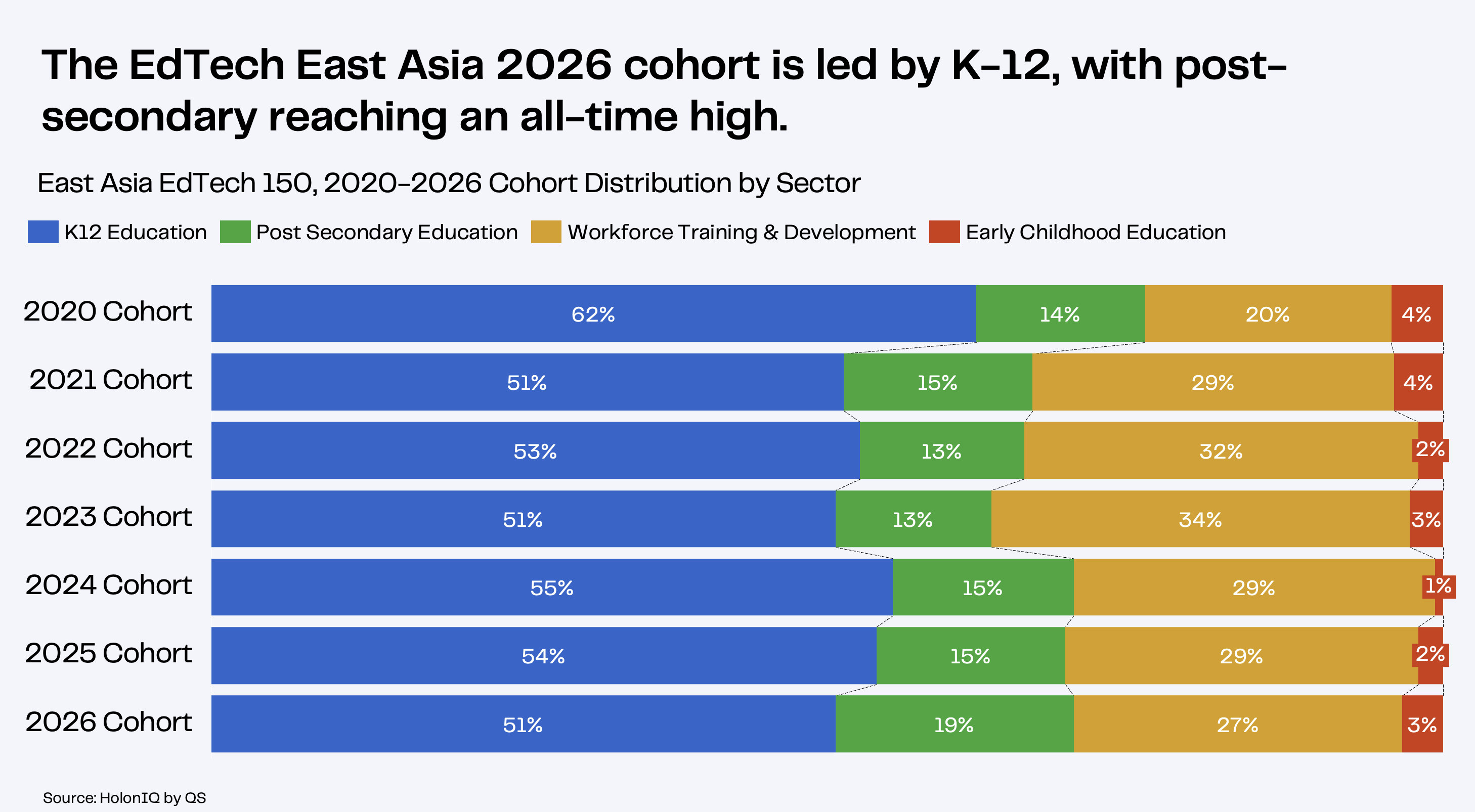
This year's cohort keeps school-age learning in focus and follows learners further: more companies are supporting the move into and through university and on to work, more are selling to schools and employers, and Japan has a larger presence in the regional picture.
K-12 remains East Asia's innovation hub, accounting for half the cohort. Founders are building for a region where families spend heavily on supplementary learning and where exam results continue to shape opportunity; math, language and STEAM learning tools stay prominent. Notably, Japan's vreach matches visually impaired children with tutors who are visually impaired themselves, teaching through screen readers, enlarged text and Braille.
Post-secondary reached its largest share of the cohort in seven years, grabbing nearly 20% of the group. Many organizations are helping learners choose a university, prepare for entrance exams, pay for study or stay connected once they graduate; for example, Japan's Gaxi, runs a scholarship platform for students and the organisations that fund them. Others serve universities directly: Japan's Alumnote helps universities engage alumni and raise funds, China's Beacon Education delivers online master's degrees with partners including Belhaven University, and Korea's Uniwise offers online engineering study for adult learners. The rise in organizations appears consistent with demographic pressure on the sector across the region to educate an aging population.
Exhibit 2. East Asia EdTech 150, 2020-2026. Cohort Distribution by Sector
Ready to get started?
Get a personalized walkthrough of HolonIQ's Global Intelligence Platform.
Credentials and learning infrastructure gains ground
A fast-growing part of the cohort sits underneath learning: credentials, training systems and simulation. Taiwan's Turing Space issues verifiable digital certificates and transcripts for universities and training providers. Korea's Decasight uses augmented reality for surgical training.
General upskilling platforms thinned out of this year’s cohort. Some course platforms have aged out or been absorbed by larger companies; the companies taking their place in the sector tend to verify skills, not just supply content. Japan's DOU, for example, works with Chiba Institute of Technology to record students' learning on a blockchain and has introduced an AI university lecturer.
Exhibit 3. 2026 East Asia EdTech 150 Cohort Distribution by Sector and Sub-Sector
More founders sell to institutions as B2B business models climb.
Nearly a third of the cohort now sells to schools, universities and employers, the highest share in seven years. Consumer models still carry the majority, but institutional selling changes how these companies grow: longer sales cycles, with procurement and government catalogues as the milestones that matter.
Taiwan's JoyLearn, whose AI teaching platform guides students by asking questions, now serves elementary schools in Chiayi City. Korea's PostMath, which builds AI math content for teachers and academies, raised $1.2M this year.
Exhibit 4. East Asia EdTech 150, 2020-2026. Cohort Distribution by Business Model
Established players lead as newcomers find new niches
60% of companies in the cohort are seven to ten years old. The list favours companies that have shown traction through several market cycles, but younger companies are fewer, and they are building in new places. Korea's Corca Research (2023) builds collaborative math editing and AI tools for researchers and raised $7.8M this year. Japan's MICOTO trains company staff to use generative AI at work.
Exhibit 5. 2026 East Asia EdTech 150. Cohort Distribution by founded date
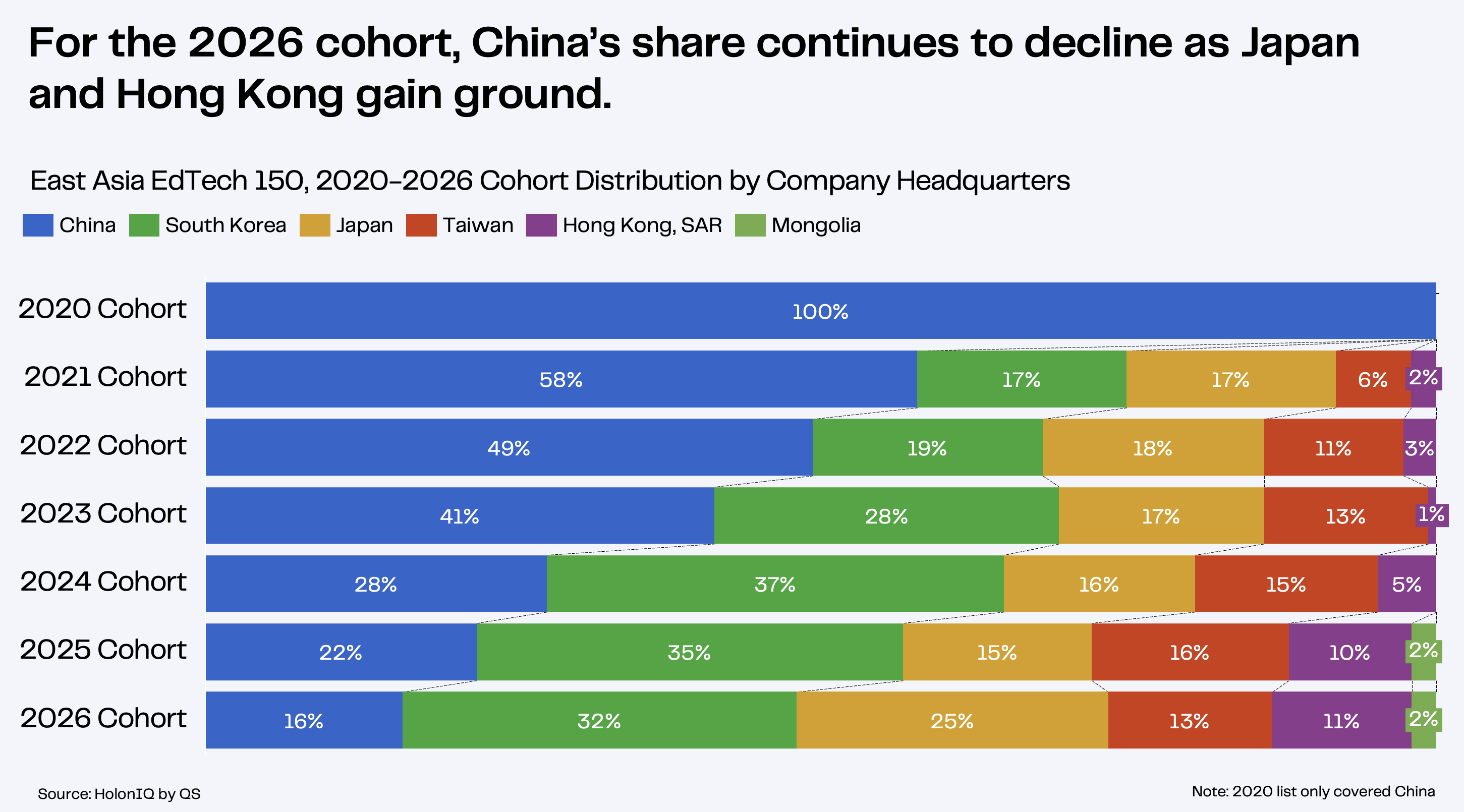
South Korea leads as Japan's share rises
South Korea remains the cohort's largest ecosystem, with nearly a third of the companies. Japan's share rose to a quarter, the largest in seven years, while China's continued to ease.
Japan's companies lean toward institutional buyers and post-secondary. Tokyo-based x3d delivers corporate AI training nationwide. China's remaining companies cluster in K-12 coding, language and robotics; Hetao101 teaches programming to children with a model that pairs AI-led lessons with human teaching assistants.
Exhibit 6. 2026 East Asia EdTech 150. Cohort Distribution by company headquarters.
Analyze the list on the QS Analytics Platform
Will post-secondary companies keep winning university and government partners? Will institutional sellers convert? And what will the next generation of founders build in 2027 and beyond?
The full 2026 East Asia EdTech 150, with company profiles, funding and partnership data, is available on the QS analytics platform.
Deep Dive the List
Customers can deep dive the open-source list on the platform. Request a demo to learn more.
We provide you with relevant and up-to-date insights on the global impact economy. Choose out of our newsletters and you will find trending topics in your inbox.