The South Asia EdTech 100 is HolonIQ's annual list of the most promising EdTech startups from the region.
The South Asia EdTech 100 is focused on identifying young, fast growing and innovative learning, teaching and up-skilling startups from the region. Powered by data and insights from our Impact Intelligence Platform together with qualitative assessments by HolonIQ’s Intelligence Unit, and local market experts, organizations are evaluated and scored based on our eligibility and assessment criteria, which excludes EdTech's founded over 10 years ago, or those which have exited (listed, acquired or controlled by another organisation).
Organisations are categorized by their main area of focus following the globallearninglandscape.org. Categories in the market map are not mutually exclusive.
The South Asia EdTech 100 is aligned to the Global Learning Landscape, an Open-Source Taxonomy that maps the education and talent market
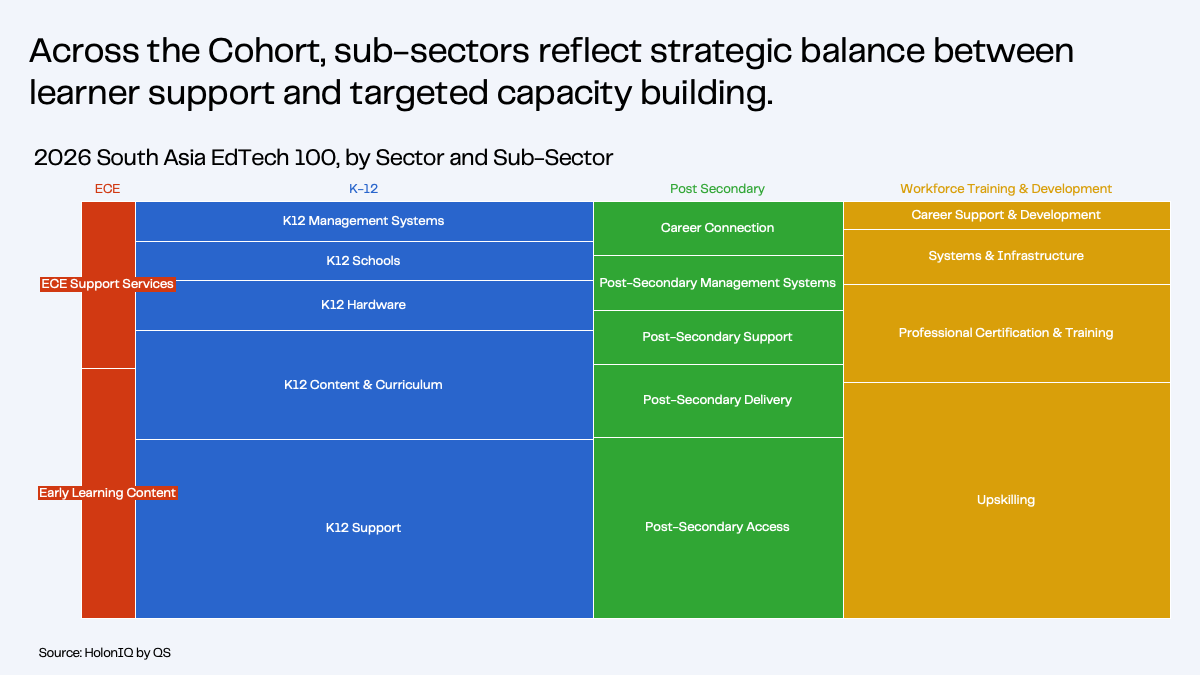
Exhibit 1. 2026 South Asia EdTech 100, by sector and sub-sector.
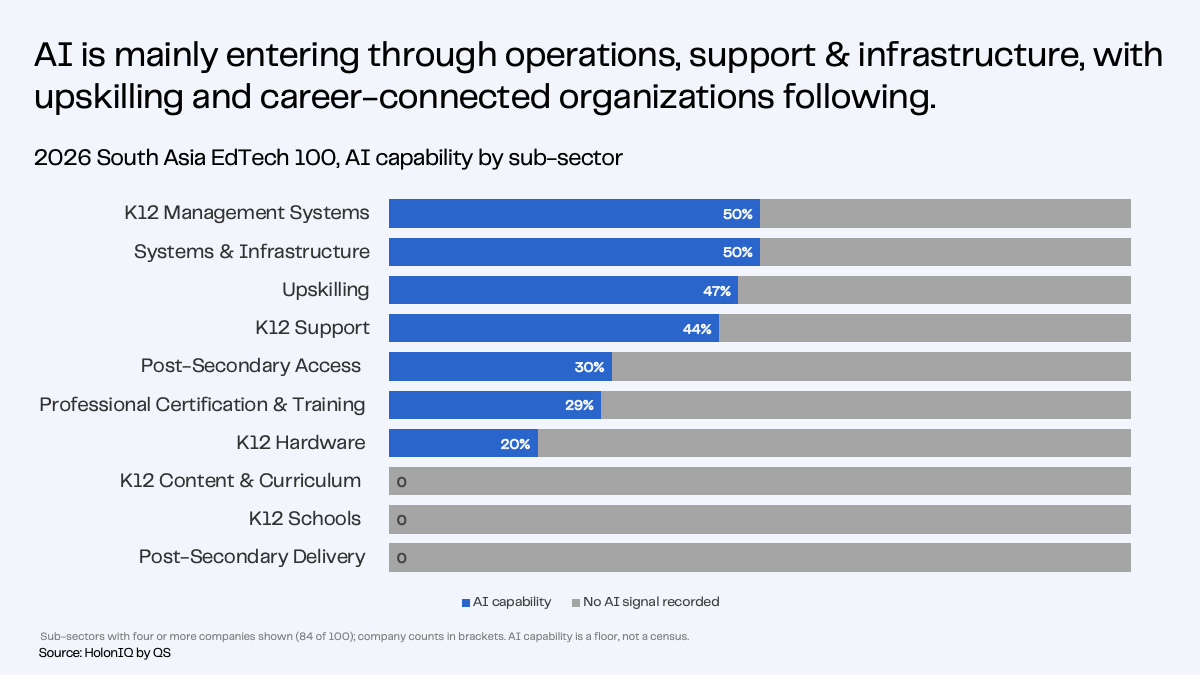
AI is supporting infrastructure before it reaches instruction
This year’s cohort prioritizes innovation with support, access, and delivery, and the intelligence sits underneath it, with K-12 learning remaining the cohort's largest segment. AI is concentrating in the administrative and support layer rather than in teaching itself, though half of the cohort's K12 management systems and systems & infrastructure companies carry an AI feature. Curriculum, schools and degree delivery don’t regularly mention AI, and these are the places where accreditation, quality assurance and institutional trust are regularly built.
The companies applying AI are selling into instructional workflow. Toddle is a licensed International Baccalaureate platform, a position built on curriculum alignment rather than content generation. Arivihan Technologies raised $10M to automate exam preparation end to end. Teachmint has taken the intelligence layer into classroom hardware. Smart Paper goes furthest on assessment, reading handwritten responses so schools get analytics without going paperless first. The expectation has shifted from delivering content to analyzing it.
Exhibit 2. 2026 South Asia EdTech 100. AI capability by sub-sector
Ready to get started?
Get a personalized walkthrough of HolonIQ's Global Intelligence Platform.
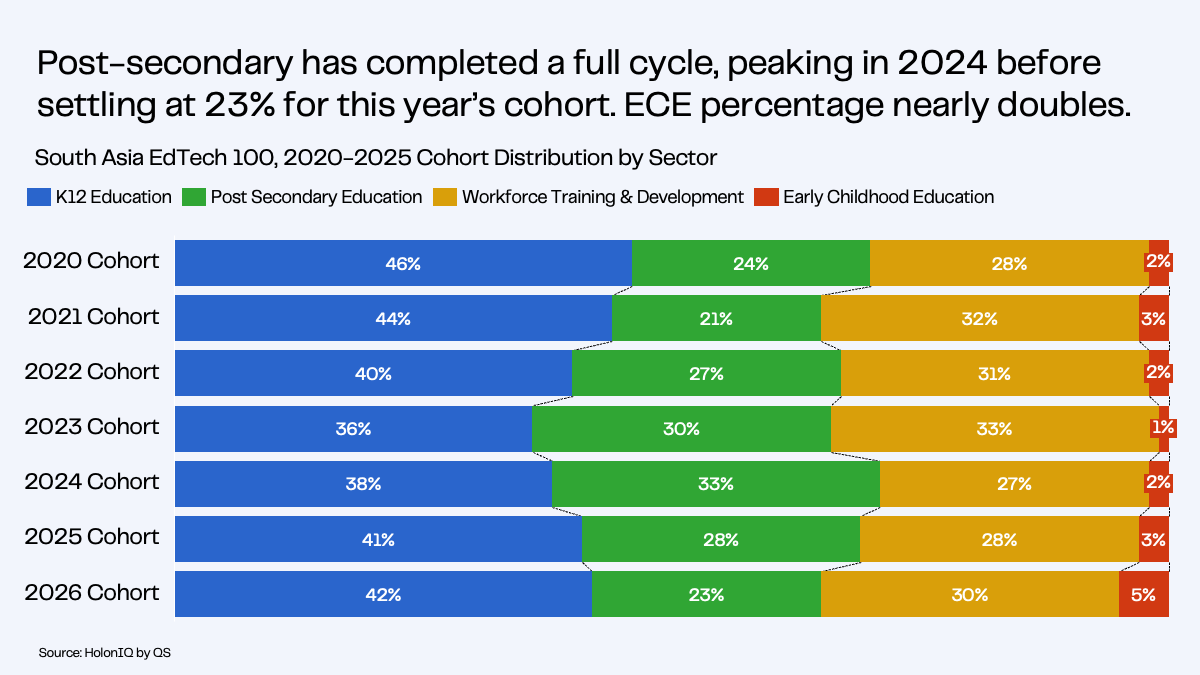
Post-secondary cohorts over the years have completed a cycle: 24 companies in 2020, a peak of 33 in 2024, and 23 this year, below where it started. Looking at the count suggests retreat; but looking at capital suggests concentration and market expansion. Notably, Leap Scholar raised $65M and is broadening from student lending into counselling, remittance and foreign exchange. Leverage Edu raised $20M and has been buying its way into adjacent markets. Emversity raised $30M and builds degrees delivered with employers rather than alongside them, working with the University of Cambridge on programme design. There may be fewer companies, but they are establishing larger positions.
Exhibit 3. South Asia EdTech 100, 2020–2026 cohort distribution by sector.
Workforce platforms build partnerships for credential capability.
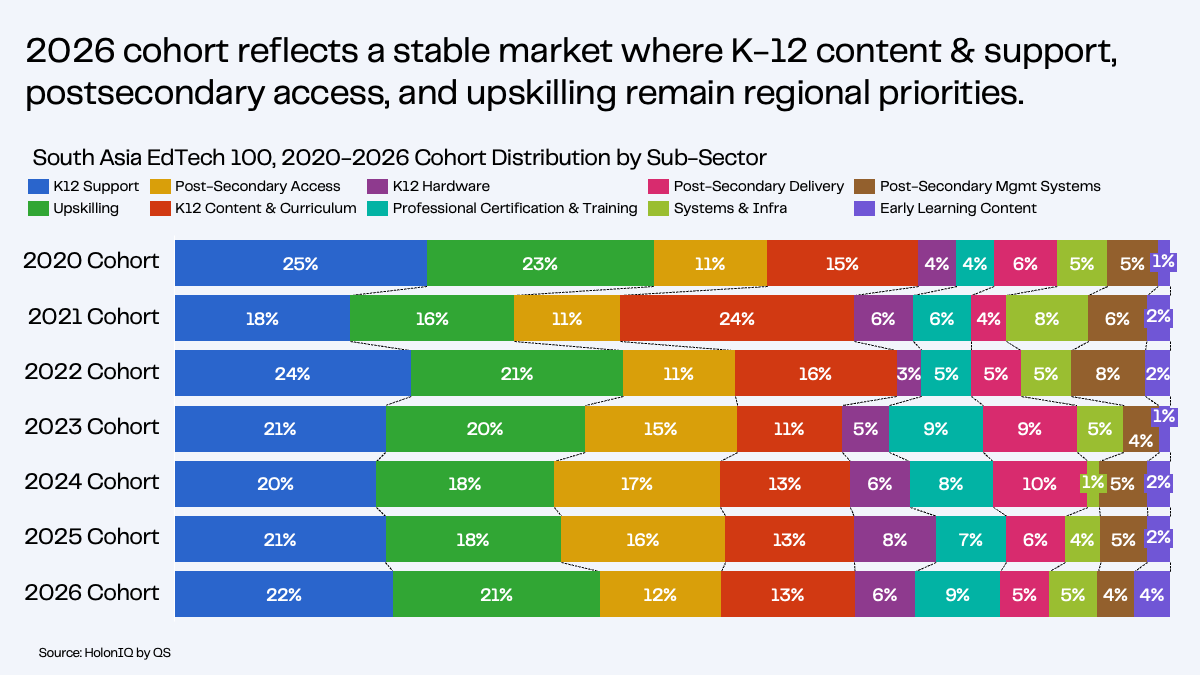
Workforce learning accounts for nearly a third of the cohort, and this year's organizations aren't competing on course offerings; they are accumulating recognizable credentials through partnerships. edForce provides vendor training accreditation with partners spanning NVIDIA, the Linux Foundation, Alibaba Cloud, HPE and Red Hat. ByteXL pairs Microsoft and HackerRank programmes with delivery inside engineering colleges. NxtWave builds technology career pathways in vernacular languages, reaching non-english speakers. Nprep is building for nursing examinations, betting on specialization. The trend is moving from delivering and teaching skills to skills recognition by the organizations that hire.
Exhibit 4.South Asia EdTech 100. 2020–2026 cohort distribution by sub-sector.
Consolidation becomes a route to building capability
Seven of this year's companies have acquired or taken strategic stakes in the past two years, with the activity concentrated in post-secondary. Adda247 and Toprankers have each absorbed competing businesses to widen their examination coverage. Classplus is assembling stakes across education financing, exam preparation and test preparation while launching an offline technology college of its own.
Consolidation at this pace is showing up across regions, not only South Asia. The motives differ; some of these deals buy a capability the acquirer lacked, while others absorb businesses that had run their course, but the direction may be clearer, fewer, broader platforms, and domestic buyers for founders who would once have waited on further investment.
Revenue generating startups continue to see traction.
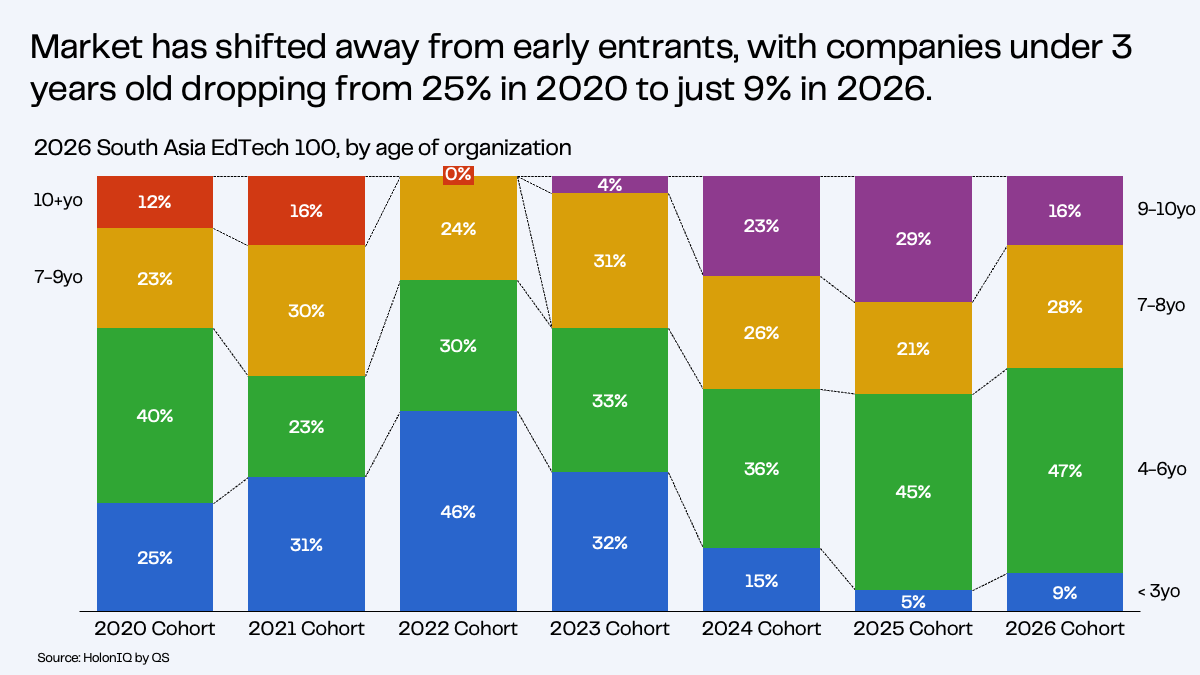
Nearly half of this year's cohort are four to six years old, the highest that band has reached in seven years, while companies under three years old account for only 9% against nearly half in 2022. The companies that raised through the pandemic surge are now old enough to have revenue worth watching.
Exhibit 5.2020–2026 cohort distribution by age of organization.
India's share reaches its highest point in seven years as distribution sustains the periphery
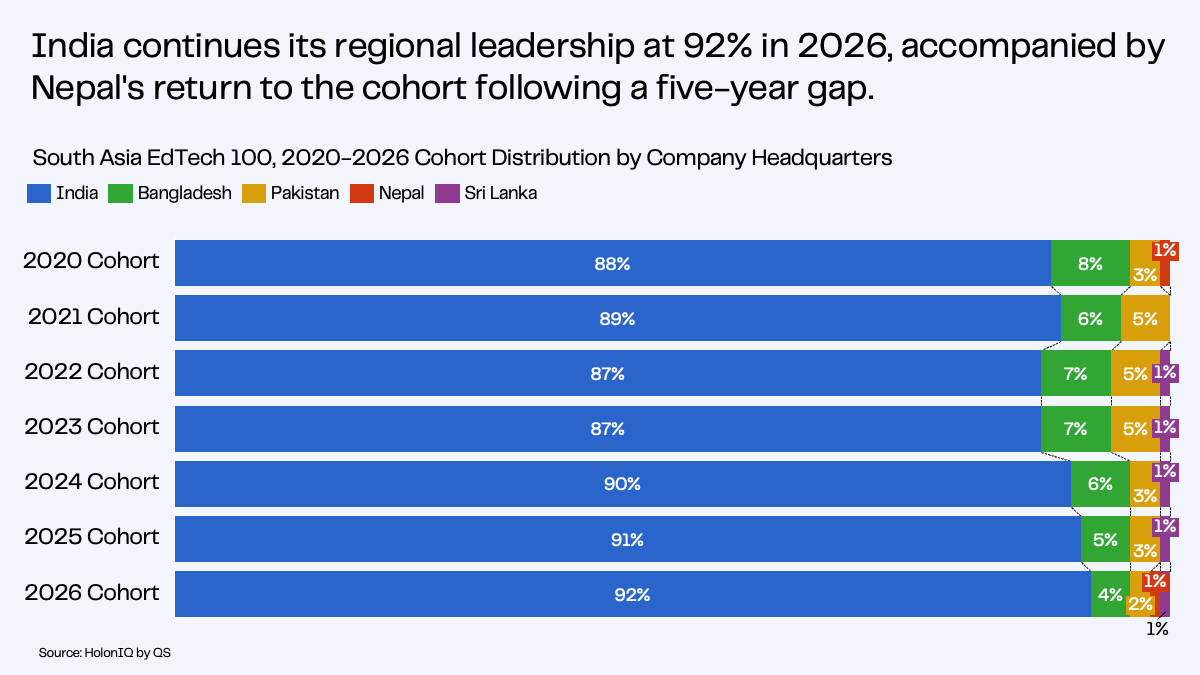
India accounts for 92% of the cohort, its largest share since the list began. Capital explains most of it: all but two of this year's recorded deals went to Indian companies. Elsewhere, educational access is critical. Notable examples are organizations such as Shikho, which raised $8M and anchors Bangladesh through a Grameenphone distribution partnership, reaching learners via carrier channels rather than paid acquisition. EduFi lends to students in Pakistan, where larger lenders have withdrawn. Magicbit carries Sri Lanka with electronics kits that teach engineering through physical construction. Nepal returns to the cohort after a five-year absence. Outside India, the companies that persist hold a distribution partner or a position that is hard to replicate.
Exhibit 6. 2020–2026 cohort distribution by company headquarters.
Track the 2026 Cohort
Customers can track the data for the most promising EdTech startups in the region on the QS Analytics Platform. Look for the 2026 South Asia EdTech 100 list and double click into the data behind the charts. Request a Demo if you are not a customer and would like to learn more.
We provide you with relevant and up-to-date insights on the global impact economy. Choose out of our newsletters and you will find trending topics in your inbox.




.png)