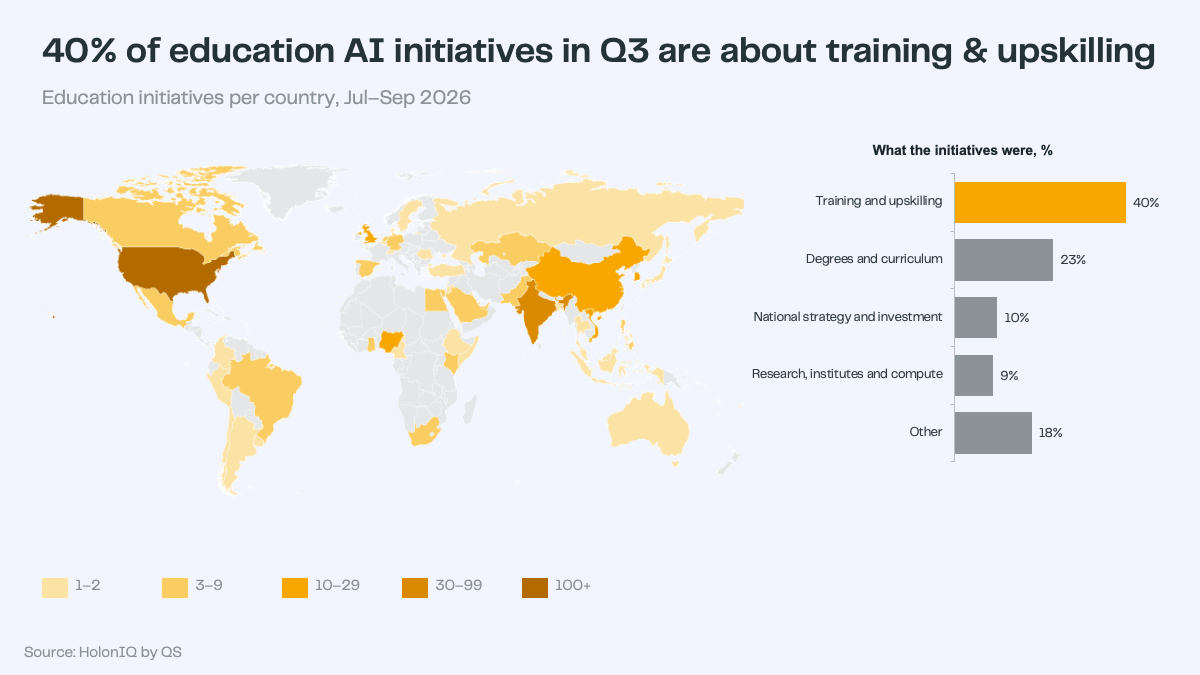
Governance for AI in education is taking shape across a growing, global set of contributors. Through the Q3 of 2026, institutions, governments and companies made strong AI commitments while the terms that support them are still developing, leaving output ownership, skills certification and responsible use as open questions.
Those commitments ranged from institution-wide AI licensing agreements and AI credentials co-designed with model developers to new national and state policies and employer training programs worth billions. Decisions like these will have a lasting impact on what learners experience next.
The QS Analytics Platform tracks AI and digital trends, grants, partnerships, policy and product developments across the global education market. None of these trends started this quarter, but Q3 data shows four players each pushing further into writing their part of the terms.
Governments are defining acceptable use
Policy for AI in learning continues to evolve across secondary and postsecondary education and the workforce. The Philippines' Commission on Higher Education issued Memorandum Order 21, a national framework for AI in teaching, research and operations, while Florida now requires its 28 public colleges to bar AI on graded work unless the instructor allows it. Policy items naming higher education rose five-fold between July and September.
Guidance and frameworks outnumber outright bans about two to one, which makes sense when 67% of academics and 62% of students already use generative AI every week, according to QS research.
School systems and departments of education will likely ask for AI disclosure in course design, syllabi, and classroom policies along with data privacy terms and integrity standards.
Model developers are impacting the solution landscape, and could affect the credentials
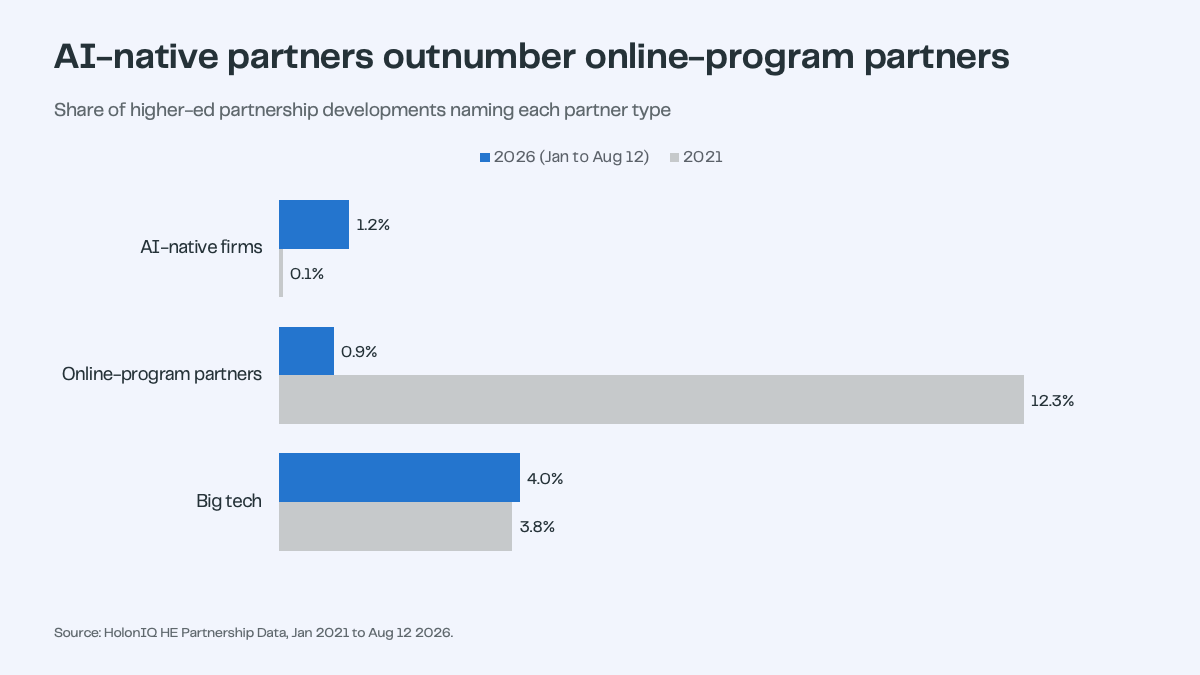
AI and data made up 12% of higher-ed partnerships in 2026, up from 2.1% in 2021, and AI-native firms now outnumber the online-program partners that defined the last decade of education dealmaking. The deals keep getting wider and deeper. INSEAD and the University of Sydney gave ChatGPT Edu to every student and staff member, and WGU, the world's largest online university, is working with Anthropic on a blueprint for AI credentials. Platforms and publishers are moving too, with Instructure building an AI study coach into Canvas and Pearson agreeing to acquire Workera to verify AI skills.
Expect direct agreements with model developers to become foundational technology in educational systems, and expect output ownership and model portability to become the terms everyone negotiates hardest.